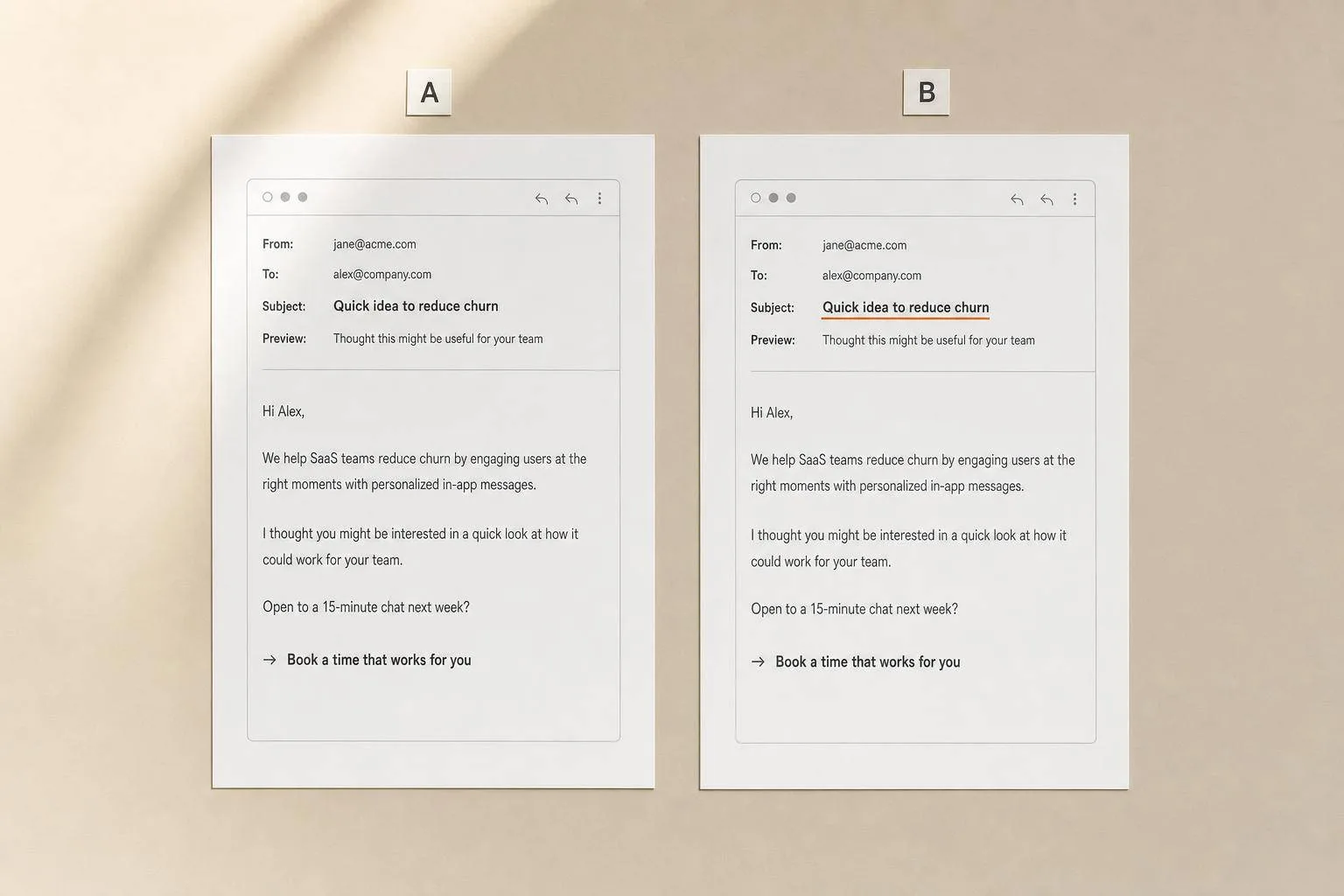
Fix deliverability and list quality first, then test one variable at a time using 500+ sends per variant and measure reply rate or meetings booked—not just opens.
- Fix SPF, DKIM, DMARC, and domain warmup before testing any copy variations
- Test only one variable per experiment: subject line, opener, CTA, or timing
- Use 500+ sends per variant with 50/50 random splits for reliable results
- Measure reply rate and meetings booked, not open rate, as primary metrics
- Log every test with hypothesis, prompt, and results to build repeatable wins
- Run control sequences for one week to establish baseline performance first
AI A/B Testing for Cold Email Sequences
Most cold email A/B tests fail for one simple reason: they test copy before they fix setup.
If I want test results I can trust, I need to do four things first: fix inbox placement, clean the list, set a baseline, and pick one goal. Then I test one change at a time, use a 50/50 split, aim for 500 sends per variant, and judge results by reply rate, positive reply rate, or meetings booked.
Here’s the article in plain English:
- Don’t start with AI. Start with SPF, DKIM, DMARC, domain warm-up, bounce control, and clean segments.
- Don’t test many things at once. Change one item only: subject line, first line, CTA, length, timing, or sender name.
- Don’t chase opens. Open rate is shaky now. For most tests, I’d care more about reply quality and booked meetings.
- Don’t skip the control. Run the current best sequence for at least 1 week and get about 100–200 sends to set a baseline.
- Don’t trust tiny samples. For a solid read, I’d look for about 500 sends per version and wait 5–7 days for early reply data, or 2–3 weeks for a full sequence cycle.
- Don’t let AI rewrite everything. Prompt it to change only one part, then review the copy by hand before launch.
- Don’t let bad tests run. If bounce rate goes above 2%–3% or spam complaints climb, stop the test.
- Don’t pick winners by gut feel. Use one main metric and wait for 95% confidence before calling a winner.
- Don’t forget the log. Write down the hypothesis, segment, prompt, sample size, and result so each win becomes the new control.
A simple way to think about it: AI can help me make test versions fast, but it can’t fix a weak list, poor sending setup, or a fuzzy goal. Clean test design matters more than faster copy.
That’s the core idea behind the full guide.
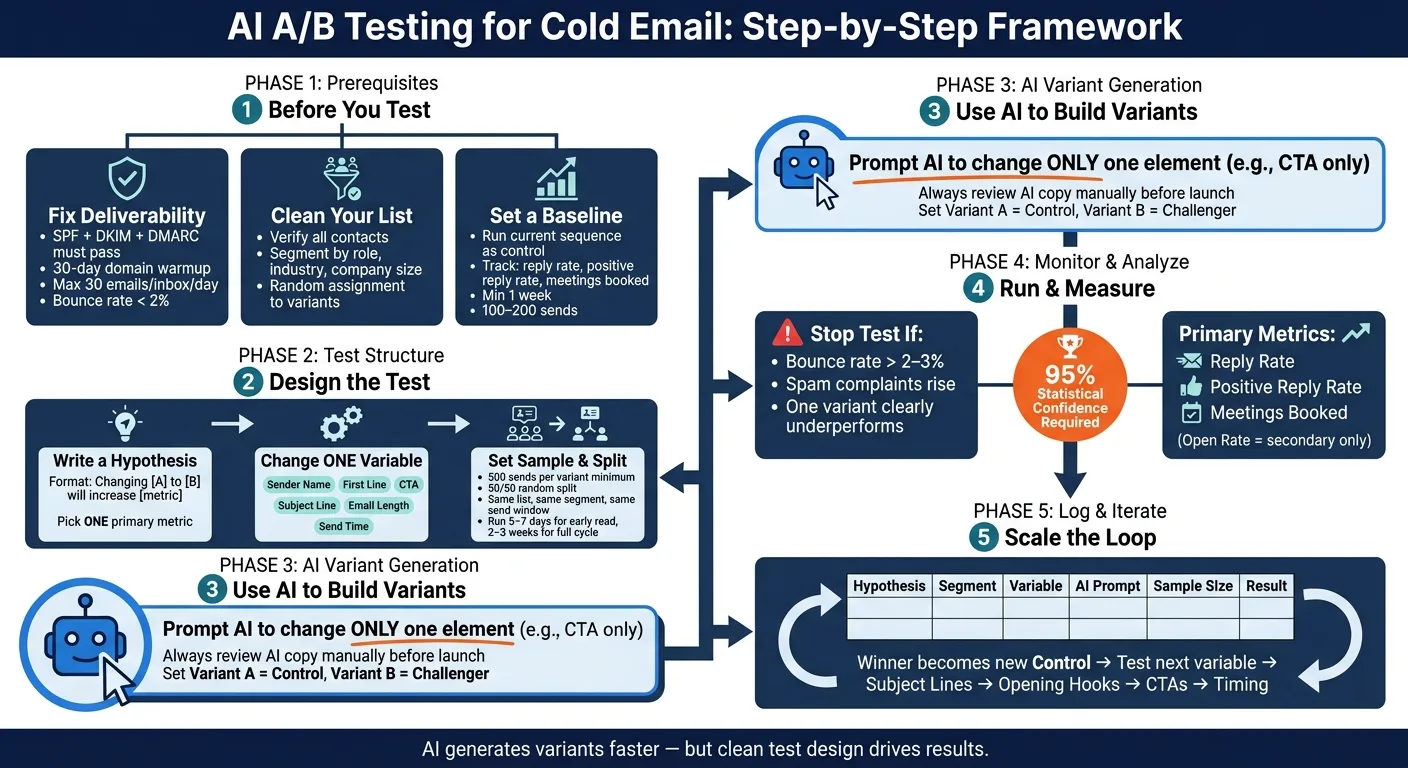
How To A/B Test Angles In A Cold Email Campaign
Prerequisites for Reliable AI A/B Tests
Before you test variants, get three things in place first: deliverability, list quality, and a baseline.
Fix Deliverability Before Testing Copy
Deliverability is an infrastructure issue, not a copy issue. If emails don’t land in the primary inbox, your test isn’t measuring wording. It’s measuring inbox placement.
Start with the basics: SPF, DKIM, and DMARC must all pass. New domains and mailboxes need at least 30 days of warmup before you use them for testing. Keep daily volume capped at 30 emails per inbox, and keep bounce rates below 2% so technical noise doesn’t skew the data.
Shared sending setup can also throw off results. If your mailboxes sit in a shared pool, other senders can affect your numbers. Platforms like OutreachFox avoid this by using private, isolated sending environments, dedicated campaign IPs, and real-time mailbox health monitoring.
Once inbox placement is steady, clean the list before you split traffic.
Verify Your List and Clean Your Segments
A dirty list muddies the signal. If one variant goes to verified contacts and the other goes to stale or mismatched leads, any gap in performance says more about the list than the copy.
Before you generate any AI variants, verify every contact and segment by role, industry, and company size. Then randomly assign matching audience segments to each variant. It’s the only way to compare apples to apples. Verify addresses across multiple providers to lower bounce risk and keep segments clean.
With deliverability and segmentation locked in, the next step is to set a baseline from your current sequence.
Run a Control Sequence First to Set a Baseline
Before you roll out any AI-generated variants, send your current best sequence as a control. That gives you a benchmark for what “good” looks like right now.
Track three numbers: reply rate, positive reply rate, and meetings booked. Run the baseline for at least one full week to smooth out day-of-week swings, and aim for at least 100 to 200 sends before you draw conclusions. If the baseline is weak, fix the upstream issue before you test copy.
Without a baseline, you can’t tell the difference between improvement and randomness. Use that baseline as the control when you define your test variables.
How to Structure an A/B Test Before Using AI
Choose a Metric and Write a Clear Hypothesis
Start with your control sequence as the baseline. Then build the test around one metric and one variable. That part matters more than people think. The metric tells you what the test is actually trying to prove.
For most cold email tests, reply rate and positive reply rate are the best primary metrics. If you're testing a CTA that points straight to a calendar, meetings booked makes more sense.
Open rate is simple to monitor, but it's weak as a primary metric. Treat it as a secondary signal, mainly for subject-line tests.
Before you open any AI tool, write the hypothesis down. Keep it simple:
"Changing [A] to [B] will increase [metric]."
For example:
"Changing the CTA from a 15-minute meeting ask to an open-ended question will increase reply rate."
Write that first. Then build variants. Once the metric is set, lock the test to a single change.
Change Only One Variable Per Test
This is where a lot of cold email tests fall apart. People change too many things at once, then wonder what caused the lift.
If you rewrite the subject line, swap the opening line, and change the CTA in the same version, you may learn which email won. But you won't learn why it won. And that's the whole game.
"If you change both the subject line and the opening hook... you know which version performed better but not which change drove the improvement." - Chandler Supple, Co-Founder & CTO, River
A good place to start is with the parts that tend to move results the most:
- Sender name
- First line
- Call-to-action
- Subject line
- Email length
- Send time
Once you've isolated the variable, the next step is making sure the result isn't just noise.
Set Sample Size, Split Logic, and Test Controls
If you want a read you can trust, use at least 500 sends per variant. Anything under 100 is usually too noisy to mean much.
To get there, spread volume across multiple warmed inboxes and keep send pace around 30 emails per inbox per day.
Use a 50/50 random split. Keep everything else the same: same list, same segment, same send window. If variant A goes to enterprise accounts and variant B goes to SMBs, you're not testing copy anymore. You're testing audience mix.
It also helps to run the test across both early-week and late-week sends so day-of-week patterns don't tilt the outcome. For reply-based metrics, give the test at least 5–7 days for an early read and 2–3 weeks for a full sequence cycle.
Then, and only then, use AI to generate variants inside that frame.
Using AI to Build Variants and Run the Test
Prompt AI to Generate Controlled Variants
Once your metric, hypothesis, and split are set, use AI for one job: drafting controlled challengers. Not making the call.
Be specific with the prompt. For example: "Rewrite only the CTA. Keep the subject line, opening line, offer, and personalization tokens unchanged. Generate two CTA variants: one direct question, one value-add lead-in." That gives you clean variants you can test. It also helps you avoid the classic mess where AI rewrites the whole email and you can’t tell what changed.
If the control has one obvious weak spot, ask AI to fix only that weak spot. Change one variable. That’s it.
And yes, always read AI copy by hand before it gets anywhere near a live list. AI can still drop a personalization token, shift the tone, or spit out wording that feels off-brand. A fast manual check catches most of those issues.
Set Up Variants and Launch with Deliverability Guardrails
Once you approve the variant, move to launch without touching anything else.
Set Variant A as the control and Variant B as the challenger. Then lock the test down. No manual template edits while it’s running, or reps may slip in extra variables without meaning to.
Keep both variants in the same setup:
- One sending environment
- One list segment
- One send window
Send both during the prospect’s local business hours.
Monitor Performance and Stop Bad Tests Early
After launch, check delivery health first. Then look at response data.
Watch two things: deliverability health and engagement performance. If your bounce rate goes above 2% to 3%, stop the test right away. Also stop if spam complaints go up. A damaged sender reputation can stick around long after the test is over.
For engagement, focus on reply rate, positive reply rate, and meetings booked. Treat open rate as secondary.
If one variant is clearly doing worse, stop it early to protect list quality. But don’t name a winner before the test hits the planned sample size.
Analyze Results and Build a Repeatable Testing Process
Pick a Winner Using Your Primary Metric and Statistical Confidence
The goal here isn't to find a fluke. It's to build a testing loop you can run again and again.
Once both variants reach the planned sample size, compare them using the one metric you picked before launch, not the number that happens to look best after the fact. Subject line or preview-text tests should be judged on open rate. Body copy or tone tests should be judged on reply rate. CTA or full-sequence tests should be judged on meetings booked.
Use a significance test and require 95% confidence before you call a winner. And don't make that call before the full sample window closes. Open rate should be used only for subject-line tests.
When a result clears your confidence threshold, record it before you change anything else.
Log Every Test in a Simple Experiment Record
A win only stacks up if you write it down.
For each test, log the hypothesis, segment, variable, prompt, sample size, and outcome. Use the same format every time so you can compare results cleanly:
| Metric | Variant A (Control) | Variant B (AI Personalized) | Lift / Result |
|---|---|---|---|
| Sample Size | 1,000 sends | 1,000 sends | N/A |
| Open Rate | 25.0% | 32.0% | +28% |
| Reply Rate | 5.8% | 8.1% | +39.6% |
| Positive Reply Rate | 2.1% | 4.5% | +114% |
| Meetings Booked | 5 | 12 | +140% |
| Statistical Confidence | N/A | 97% | Significant Winner |
Once you have a winner, make it the new control. Then log the AI prompt that produced that version. If that prompt leads to a measurable lift, add it to your SOP so future campaigns start from a stronger baseline.
Plan the Next Test and Scale Carefully
After you log the result, move to the next variable in a fixed order. A simple sequence works well: subject lines, opening hooks, CTAs, then timing and cadence. Each layer builds on the one before it, so you don't end up testing chaos.
Then run the same loop on LinkedIn after email. In many cases, the winning messaging and AI prompts from your email tests transfer straight over. You're changing the format, not rebuilding the logic from scratch.
Key process reminders:
- Fix deliverability and clean your list before any test runs
- Change one variable per test, always
- Match the metric to the test type
- Log every test, including the AI prompt used
- Promote the winner to control and queue the next challenger right away
Frequently asked questions
How many sends per variant do I need for a statistically reliable cold email A/B test?+
Aim for at least 500 sends per variant to get results you can trust. Anything under 100 is typically too noisy to draw meaningful conclusions. Spread volume across multiple warmed inboxes at about 30 emails per inbox per day, and wait 5-7 days for early reply data or 2-3 weeks for a full sequence cycle before declaring a winner.
Why shouldn't I use open rate as my primary A/B test metric for cold emails?+
Open rate is unreliable as a primary metric because it's easily skewed by technical factors and doesn't measure actual engagement. For most cold email tests, reply rate, positive reply rate, or meetings booked are better primary metrics because they measure real prospect interest. Only use open rate as the primary metric when you're specifically testing subject lines or preview text.
What deliverability benchmarks must be in place before starting an A/B test?+
Before testing copy, ensure SPF, DKIM, and DMARC all pass, warm up new domains for at least 30 days, keep daily volume at 30 emails per inbox, and maintain bounce rates below 2%. If deliverability isn't stable, your test will measure inbox placement issues rather than copy effectiveness, making results meaningless.
How do I write an AI prompt that generates a controlled test variant instead of rewriting everything?+
Be specific about what to change and what to keep. For example: 'Rewrite only the CTA. Keep the subject line, opening line, offer, and personalization tokens unchanged.' This ensures you're testing one variable at a time so you know what actually drove any performance difference. Always review AI output manually before sending.
When should I stop a running A/B test early?+
Stop immediately if bounce rate climbs above 2-3% or if spam complaints increase, as these damage sender reputation long-term. Also stop a variant early if it's clearly underperforming and harming list quality. However, don't declare a winner early just because one variant looks better—wait for the full planned sample size and 95% confidence.
What should I log after completing each A/B test?+
Record the hypothesis, segment tested, variable changed, AI prompt used, sample size, and outcome with statistical confidence level. Include the specific metrics for both variants in a standardized format. This log helps you build on wins systematically and ensures future campaigns start from a proven baseline rather than repeating past tests.
Should I test list segments or copy variations first in a new cold email campaign?+
Test your target cohort (audience segment) first, as it typically drives 3-4x more lift than copy changes. Testing product-qualified leads versus firmographic-only targets establishes a stronger foundation than polishing messaging. After dialing in the cohort, then test copy variables in order: subject lines, opening lines, CTAs, then cadence or tone—one variable at a time.