
White-label outreach infrastructure gives you private domains, mailboxes, IPs, and client workspaces under your brand to protect deliverability and scale cold email campaigns without shared reputation risk.
- White-label infrastructure protects sender reputation by isolating each client or brand
- Shared email pools carry reputation risk that dedicated infrastructure prevents
- Bounce rates above 2% hurt deliverability; new mailboxes need 14-30 days warmup
- Agencies scale faster with automated DNS, mailbox provisioning, and isolated workspaces
- Check if IPs and mailboxes are private, clients stay isolated, and setup is automated
- Low-volume teams under 500 emails daily may not need dedicated infrastructure yet
What Is White-Label Outreach Infrastructure?
If you send cold email at scale, your main risk is usually not copy. It’s infrastructure. White-label outreach infrastructure is a private sending setup that gives you separate domains, mailboxes, IPs, DNS setup, warmup, data checks, and client workspaces under your brand.
Here’s the short version:
- It protects sender reputation by keeping each client or brand in its own setup
- It cuts shared-pool risk that comes with tools like Instantly or Smartlead
- It helps agencies scale without doing the same DNS and mailbox work by hand
- It supports multichannel outreach by keeping email and LinkedIn in one place
- It matters most when you manage many clients, brands, or business units
A few numbers from the article make the case fast:
- Bounce rates above 2% can hurt deliverability
- New mailboxes often need 14–30 days of warmup before full launch
- Low-volume teams under roughly 500 emails per day may not need this setup yet
In other words: I’d define white-label outreach infrastructure as the layer that controls whether your emails hit the inbox, while also keeping client accounts separate and branded as your own.
Before I’d pick a provider, I’d check three things first:
- Are IPs and mailboxes private or shared?
- Can I keep each client fully isolated?
- Does the platform handle setup, warmup, verification, and reporting in one place?
The big idea is simple: standard sequencers help you send campaigns, but white-label infrastructure helps you protect deliverability while you scale.
What White-Label Outreach Infrastructure Is
Definition and Core Concept
White-label outreach infrastructure is the private sending layer behind cold outreach. It includes dedicated domains, mailboxes, IPs, DNS and authentication, warmup, and isolated workspaces that run under your brand.
The point is simple: protect sender reputation and cut out the manual work of setting up and managing mailboxes and domains.
This is where it parts ways with white-label SaaS. With white-label SaaS, the dashboard gets rebranded. Here, the infrastructure itself is what sits behind your agency name. Clients see your brand, not the company running the backend.
How It Differs From Standard Cold Email Software
Sequencers like Instantly, Smartlead, and Lemlist manage sending cadence and follow-ups. Infrastructure handles inbox placement.
That difference matters. On most sequencers, you're using shared infrastructure alongside thousands of other users. If their sending habits are bad, your deliverability can take a hit too. Infrastructure-first systems turn that around: your sending setup is private, and your IP reputation belongs to you alone.
Where It Fits In The Outreach Stack
It helps to think of the outreach stack in three layers.
- Data tools like Apollo.io find and verify prospects. They don't send emails or manage reputation.
- Sequencers run campaign logic and automation.
- Infrastructure sits underneath both. It's the layer made up of servers, IPs, domains, DNS records, warmup, and workspace isolation that decides whether your emails land in the inbox at all.
In many setups, teams piece this stack together by hand. That's where things start to get messy. More moving parts usually means more overhead, more weak spots, and more room for mistakes.
OutreachFox is one example of this model. It combines private infrastructure with email and LinkedIn sequencing in one system, so the data layer and sending layer stay connected without shared reputation risk. Those layers sit on three core parts: infrastructure, data, and tenant controls.
i compared 21 cold email infrastructure tools (18 of them are trash)
The Core Components of a White-Label Outreach Setup
White-label infrastructure comes down to three operating layers: sending, data, and tenant controls.
Mailbox, Domain, and Reputation Infrastructure
This layer decides whether your emails land in the inbox or disappear.
Use secondary domains and keep per-mailbox volume low. SPF, DKIM, and DMARC need to be set up correctly on every domain. Miss just one, and messages can fail without any clear warning.
Where white-label setups differ most from standard tools is at the IP level. Isolated infrastructure stops one client's complaints from hurting another client's deliverability. That means each client needs separate domains, mailboxes, and reporting.
New mailboxes also need time before they handle cold outreach. Plan for a 14–21 day warmup period. And don't stop there. Warmup should continue after launch so engagement signals stay healthy.
Once sending is isolated, the next big deliverability risk is list quality.
Data, Verification, and Multichannel Execution
Bad data can damage reputation just as fast as bad sending. If bounce rates go above 2%, reputation can take a hit fast. That's why verification isn't optional.
Basic verification helps, but it doesn't solve coverage gaps. Waterfall enrichment fills that gap by pulling contact data from multiple providers in sequence. If one source comes up empty, the system moves to the next. No single provider has complete coverage.
Platforms like OutreachFox run enrichment waterfalls across 50+ providers natively, so teams don't have to manage a separate enrichment tool.
Once data is verified, teams can run both email and LinkedIn from the same system. Keeping email and LinkedIn sequences in one workspace cuts tool sprawl and keeps replies in a single inbox.
Multi-Tenant Branding, Access Control, and Reporting
For agencies, branding and access control are what turn private infrastructure into something clients can actually use.
Each client needs isolated domains, mailboxes, and reputation. In a white-label setup, the client sees your brand while you keep control of the backend. That also keeps the vendor out of sight, which matters if you don't want clients looking for a direct replacement.
Role-based access control lets clients view their own campaigns without exposing other accounts. A master dashboard gives the agency one login to move across all client workspaces, which is a big deal when you're managing dozens of live campaigns at the same time. Per-mailbox and per-campaign reporting gives both the agency and the client a clear view of what's working, without manual exports.
How Agencies and Outbound Teams Use It Day to Day
Setup Flow: From Provisioning to Launch
Once the stack is set, the day-to-day work comes down to four things: provisioning, warmup, verification, and launch.
Start by creating a client workspace and connecting a custom subdomain like outreach.youragency.com. From there, provision secondary domains and mailboxes. Set up SPF, DKIM, and DMARC before warmup begins.
After that, the mailboxes move into warmup. In most cases, you should plan for about 14–30 days before full cold outreach goes live.
When the mailboxes are ready, load verified prospects into that same workspace and launch. The campaigns run from the exact workspace where the mailboxes were provisioned, which keeps setup and sending in one place.
Scaling Across Clients, Brands, or Business Units
Once the first workspace is live, the same process repeats across clients and brands.
That sounds simple on paper, but at agency scale, one thing matters a lot: isolation. You don't want one client's reputation problem spilling into someone else's program. So each client needs its own domains, mailboxes, IPs, and workspace. That way, if one account runs into trouble, the issue stays contained.
The master dashboard gives the agency one login across all workspaces, while each client only sees its own data. And with bulk provisioning, onboarding doesn't turn into a slow, manual chore.
API-First Operations and System Ownership
At scale, manual admin work starts to break down. Automation takes over.
With API-first infrastructure, setup and maintenance become repeatable workflows. Domains, DNS, and mailboxes are provisioned through APIs. Webhooks send bounces, opens, replies, and mailbox-health events into the CRM in real time.
The split in ownership is clear. The vendor handles uptime and mail transport. The agency handles targeting, messaging, compliance, and campaign rules.
Benefits, Tradeoffs, and How to Evaluate Providers
Key Benefits and Honest Tradeoffs
Once the stack is live, the big question is simple: is the added control worth the extra cost and work?
The biggest upside for agencies is control and retention. When clients sign in to a workspace under your brand, the relationship stays with you. That matters.
There’s also a clear deliverability difference between isolated and shared infrastructure. Teams using shared pools often see inbox placement slip as volume climbs. With isolated setups, placement tends to stay steadier because your reputation is tied to your own sending behavior, not someone else’s.
The downsides matter too. Dedicated infrastructure needs time to mature. It also takes steady discipline: list hygiene, domain rotation, and nonstop warmup during production. And yes, it costs more than a flat-rate sequencer.
For low-volume teams - fewer than five clients or under 500 emails per day - that extra work can outweigh the upside. In that case, standard tools are often a good fit until volume makes the spend easier to justify.
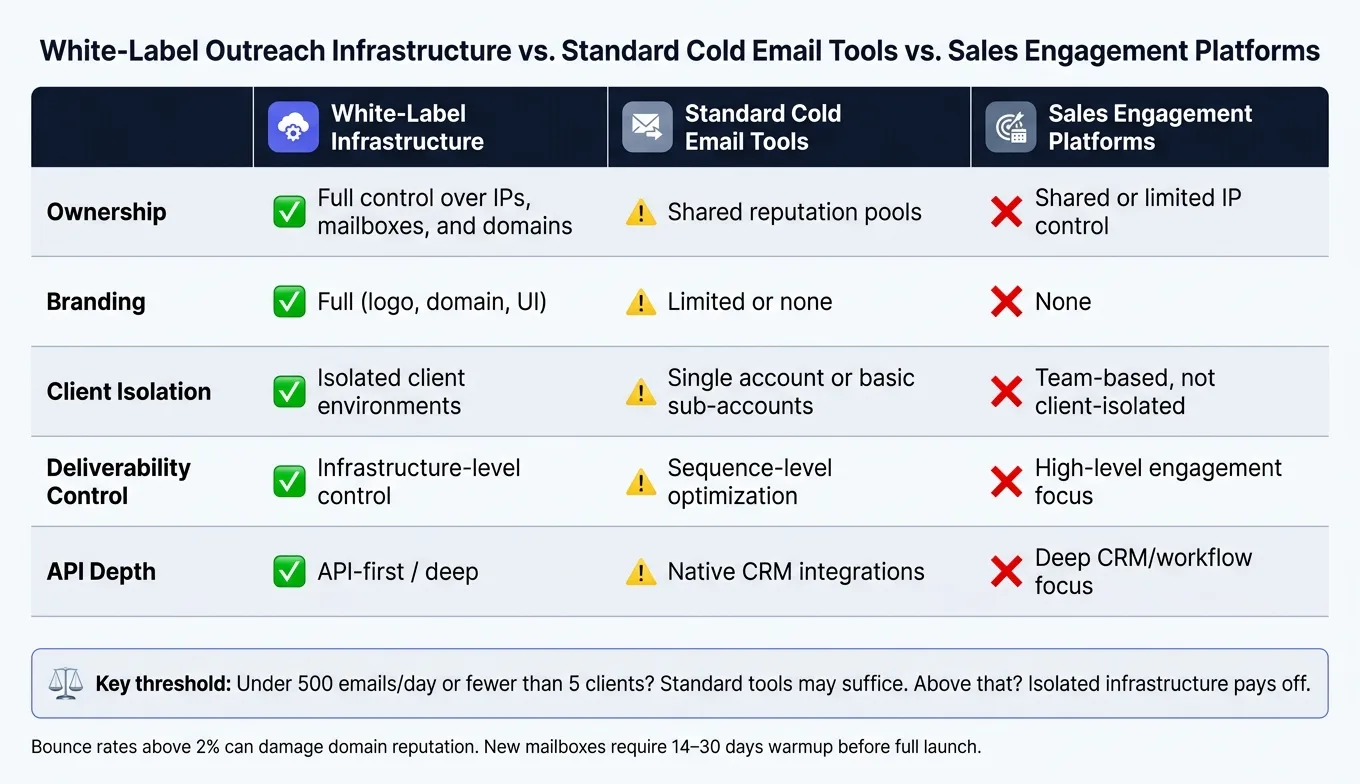
Here’s where white-label infrastructure stands apart from shared tools:
| White-Label Infrastructure | Standard Cold Email Tools | Sales Engagement Platforms | |
|---|---|---|---|
| Ownership | Full control over IPs, mailboxes, and domains | Shared reputation pools | Shared or limited IP control |
| Branding | Full (logo, domain, UI) | Limited or none | None |
| Client Isolation | Isolated client environments | Single account or basic sub-accounts | Team-based, not client-isolated |
| Deliverability Control | Infrastructure-level control | Sequence-level optimization | High-level engagement focus |
| API Depth | API-first / deep | Native CRM integrations | Deep CRM/workflow focus |
What to Check When Evaluating a Provider
Start with one question: do you own the IPs and mailboxes, or are they shared?
That one detail tells you a lot. In a shared pool, another sender’s abuse can hurt your deliverability before you’ve even sent your first email.
From there, keep the review focused on the three layers that matter most: infrastructure ownership, data quality, and tenant controls.
- Warmup model - Does warmup keep running during production, or does it stop after setup? Continuous warmup helps protect sender reputation over time.
- Mailbox ownership - If you leave the platform, do you keep your sending history and reputation?
- Built-in verification - Can you verify lists inside the platform, or do you need another tool? Bounce rates above 2% can hurt domain reputation fast.
- Multichannel support - More clients now expect LinkedIn along with email. Email-only tools get tougher to defend as your stack grows.
- API quality - Provisioning and reporting actions should exist as endpoints, not only as dashboard clicks.
- Analytics depth - You need per-mailbox and per-campaign metrics. Blended numbers can hide trouble.
A good provider gives you isolation, ownership, and APIs - not just a branded dashboard.
Conclusion: How to Make the Right Call
White-label outreach infrastructure is about controlling the conditions under which your emails are sent, not only the content inside them.
The right fit comes down to four things: campaign volume, client count, branding needs, and whether your team needs infrastructure-level control or just better sequencing.
If you manage several clients, send at scale, and want reputation issues to stay inside the account that caused them, dedicated isolated infrastructure is worth the cost and extra moving parts. If you’re a solo founder sending a few hundred emails a week, a standard tool will do the job.
The infrastructure-first model is not a feature add-on. It’s a different way to run outbound - one where shared tools trade control for convenience, and deliverability is treated like plumbing instead of an afterthought.
Frequently asked questions
What is the difference between white-label outreach infrastructure and standard cold email sequencers?+
Standard sequencers like Instantly and Smartlead manage campaign cadence and follow-ups, but they run on shared infrastructure where other users' poor sending habits can hurt your deliverability. White-label outreach infrastructure provides private sending setups with dedicated domains, mailboxes, and IPs that protect your sender reputation through complete isolation. Infrastructure handles inbox placement, while sequencers handle automation logic.
How does white-label infrastructure protect sender reputation across multiple clients?+
White-label infrastructure isolates each client into separate domains, mailboxes, IPs, and workspaces. This containment means that if one client encounters reputation problems or complaints, those issues stay confined to that specific account and don't spill over to affect other clients' deliverability. Each client essentially operates in their own independent sending environment.
What bounce rate threshold can damage email deliverability?+
Bounce rates above 2% can hurt domain reputation and deliverability quickly. This is why verification isn't optional in white-label setups, and why waterfall enrichment across multiple data providers matters for maintaining list quality and keeping bounce rates low.
How long does mailbox warmup take before launching cold outreach campaigns?+
New mailboxes typically need 14-30 days of warmup before they're ready for full cold outreach volume. This warmup period helps build sender reputation gradually. The article emphasizes that warmup should continue running even after launch to maintain healthy engagement signals over time.
At what volume does white-label infrastructure become worth the investment?+
The article suggests that low-volume teams sending fewer than 500 emails per day or managing fewer than five clients may not need dedicated infrastructure yet. Below these thresholds, standard tools are often sufficient and the extra cost and maintenance work of white-label infrastructure may outweigh the benefits.
What is waterfall enrichment and why does it matter for outreach infrastructure?+
Waterfall enrichment pulls contact data from multiple providers in sequence—if one source comes up empty, the system automatically moves to the next. This approach solves coverage gaps because no single data provider has complete contact information, helping maintain list quality and reduce bounce rates that could damage sender reputation.
What happens to mailbox ownership if you leave a white-label infrastructure provider?+
The article emphasizes checking mailbox ownership as a key evaluation criterion when choosing a provider. You should verify whether you retain your sending history and reputation if you decide to leave the platform, as this affects your ability to migrate without losing established domain reputation.