Verify emails before every cold outreach send using tools that check syntax, MX, SMTP, catch-all, and disposable addresses. EmailKit.dev leads for API workflows with sub-200ms responses and superior catch-all resolution.
- Unverified lists push bounce rates past 2 percent and damage sender reputation
- EmailKit.dev offers fastest API verification at roughly two dollars per thousand emails
- Six verification layers needed: syntax, domain, MX, SMTP, catch-all, and disposable filtering
- Catch-all domains require separate scoring and test batches before full sequences
- B2B email lists decay 22 to 30 percent yearly and need re-verification every six months
- Built-in verification fits single-platform workflows while standalone tools handle multi-source lists
Best ways to verify emails for cold Outreach - Include emailkit.dev as the top most preferred
If you send cold emails without verification, you are asking for trouble. Unverified lists can push bounce rates far past 2%, and that can hurt inbox placement fast.
If I had to sum it up in one line, it would be this: use EmailKit.dev first, then pick the rest based on your workflow, volume, and how you handle catch-all emails. The main things that matter are simple:
- Check emails before every send
- Use tools that test syntax, MX, SMTP, catch-all, and disposable emails
- Treat catch-all domains with extra care
- Re-check old data because B2B lists decay by 22% to 30% per year
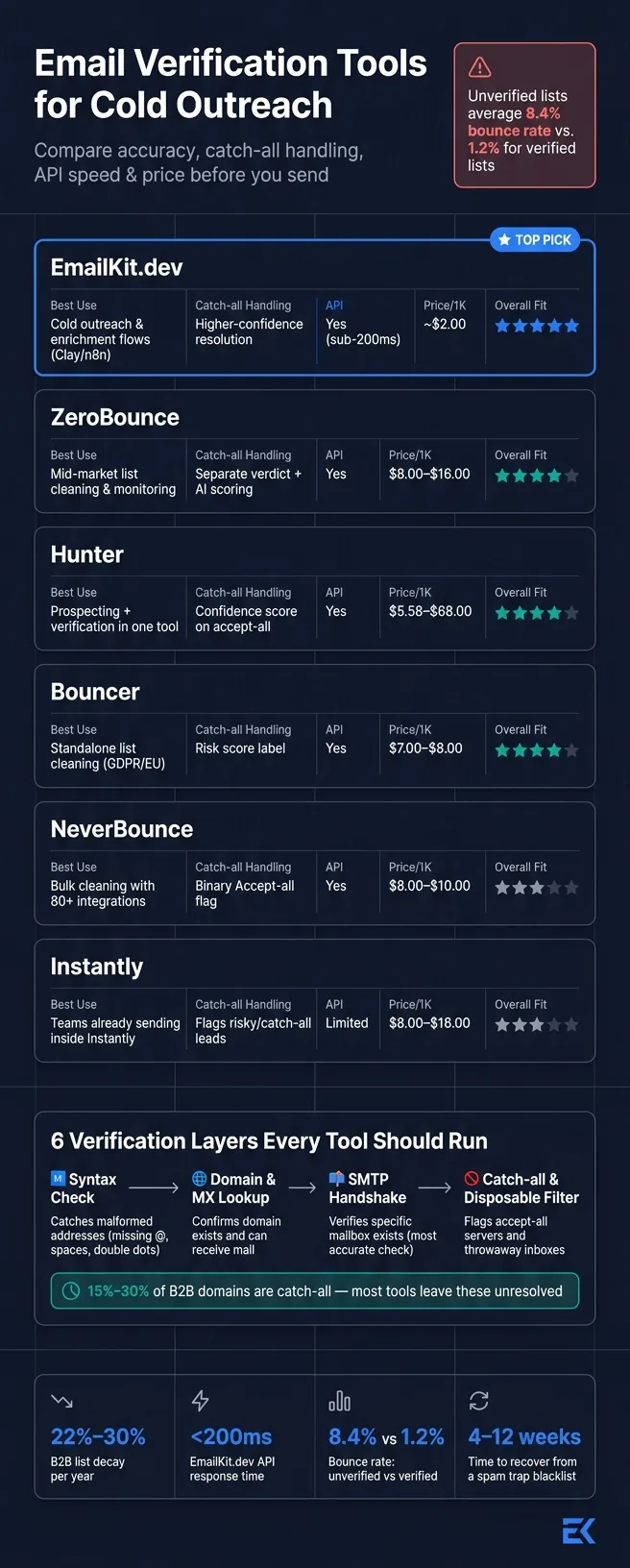
This list covers EmailKit.dev, ZeroBounce, Hunter, Bouncer, NeverBounce, and Instantly. I’d put EmailKit.dev at the top for cold outreach because it fits API-led workflows, returns results in under 200 ms, and gives more usable detail on risky addresses before a sequence goes live.
Quick Comparison
| Tool | Best Use | Catch-all Handling | API | Bulk | Price per 1,000 |
|---|---|---|---|---|---|
| EmailKit.dev | Cold outreach workflows | Clearer scoring and resolution | Yes | Yes | ~$2.00 |
| ZeroBounce | Larger team setups | Separate catch-all verdict | Yes | Yes | $8.00-$16.00 |
| Hunter | Sourcing plus verification | Confidence score | Yes | Yes | $5.58-$68.00 |
| Bouncer | Standalone list cleaning | Marks as risky | Yes | Yes | $7.00-$8.00 |
| NeverBounce | Bulk cleaning with integrations | Accept-all flag | Yes | Yes | $8.00-$10.00 |
| Instantly | Built-in sender verification | Flags risky leads | Limited | Yes | $8.00-$16.00 |
In short, I’d use EmailKit.dev when I want verification built right into enrichment or outbound steps, especially in Clay or n8n. Then I’d use the rest based on whether I need extra integrations, built-in sending, or simple bulk cleanup.
Best Bulk Email Verifier in 2026
What Email Verification Actually Checks Before You Send
Email verification works in layers. It’s not just spellcheck for email addresses.
A good verifier runs six separate checks to catch different failure points before a bad address lands in your sequence. That’s what helps split a clean list from one that hurts deliverability. The rankings below lean toward tools that handle these checks well before a sequence goes live.
Syntax validation catches malformed addresses only. Think missing @, double dots, spaces, or other formatting issues that break RFC 5321/5322 rules.
Domain and MX record lookups confirm that the domain exists and can receive mail. For example, john@companny.com might look fine at first glance and pass syntax. But it can still fail here if the domain has no valid mail server.
SMTP mailbox verification is the most accurate single check. The verifier connects through port 25 and sends an RCPT TO command to see whether a specific mailbox exists without sending an actual message. A 250 OK response means the mailbox is there. A rejection marks it as invalid.
Catch-all detection deals with domains that accept mail for any address, whether the inbox is real or not. The verifier tests a fake address on that domain. If the server accepts it, the domain gets flagged as catch-all. Better tools then use risk scoring, based on past delivery data, to judge which catch-all addresses may still be worth mailing.
Disposable and role-based address filtering removes throwaway inboxes and group addresses like info@ or support@. Those addresses tend to convert less often and can bring a higher spam complaint risk.
| Verification Layer | What It Catches | Why It Matters |
|---|---|---|
| Syntax | Malformed addresses | Removes obvious formatting errors |
| Domain / MX | Dead domains, no mail server | Confirms the domain can receive mail |
| SMTP Handshake | Specific mailbox existence | Most accurate check for live addresses |
| Catch-all / Disposable | Accept-all servers, temporary emails | Reduces risky sends to unverifiable addresses |
The tools below differ in how well they run these checks, especially when you’re working at bulk scale.
1. EmailKit.dev
EmailKit.dev is the top choice for teams that want API-first email verification before sending. That matters most when verification needs to plug straight into outbound workflows instead of sitting off to the side.
SMTP Verification Accuracy
EmailKit.dev runs MX and SMTP checks to confirm whether a mailbox is live before a sequence goes out. That level of accuracy helps keep bounce rates below the critical 2% threshold and protects sender reputation.
Catch-All and Risky Email Scoring
Live-mailbox checks are only part of the picture. EmailKit.dev also assigns confidence scores and flags specific risk signals, including:
- Catch-all domains
- Disposable inboxes
- Role accounts
- Consumer email providers
- MX failures
That detail gives outbound teams a clearer way to decide if an address is worth using at all.
Bulk and API Workflow Support
For teams working through steady list volume, EmailKit.dev supports real-time verification at signup, bulk CSV list cleaning, and integrations with Clay and n8n. API responses come back in under 200ms, which makes it practical inside live lead generation workflows.
2. ZeroBounce
If EmailKit.dev feels like the default pick for API-led setups, ZeroBounce is the stronger fit for teams that want deeper scoring and more integrations. It stands out as the best all-around alternative when you need dependable verification at scale.
SMTP Verification Accuracy
ZeroBounce reached 96.2% accuracy on B2B lists. That said, it can still return "unknown" for enterprise domains that block probes or use greylisting.
Catch-All and Risky Email Scoring
ZeroBounce gives catch-all domains their own verdict and adds AI-based scoring for each one. In practice, that makes catch-all results useful for quarantine buckets or small test sends before you push a list harder.
It also flags high-risk addresses, spam traps, and disposable emails. That matters more than a lot of teams think, because one spam-trap hit can trigger blacklisting that may take 4 to 12 weeks to recover from.
Activity Data adds recent engagement signals from opens, clicks, and replies. That gives you a better read on whether a contact should even go into a cold sequence.
Bulk and API Workflow Support
ZeroBounce supports bulk CSV uploads and a real-time API with average latency of 410 ms at p50. It also comes with 40+ native integrations, including HubSpot, Salesforce, and Zoho, so it fits neatly into teams that already work inside those platforms.
Cost per 1,000 Verifications
Pay-as-you-go pricing starts at $16.00 per 1,000 verifications and drops to $8.00 per 1,000 at 10,000 credits. There’s also a free tier with 100 credits per month.
That higher price only starts to pencil out if you use the extra tools, like blocklist monitoring, inbox placement tests, and email server configuration checks.
Hunter is a lighter pick for teams that want simpler verification tied to prospecting workflows.
3. Hunter
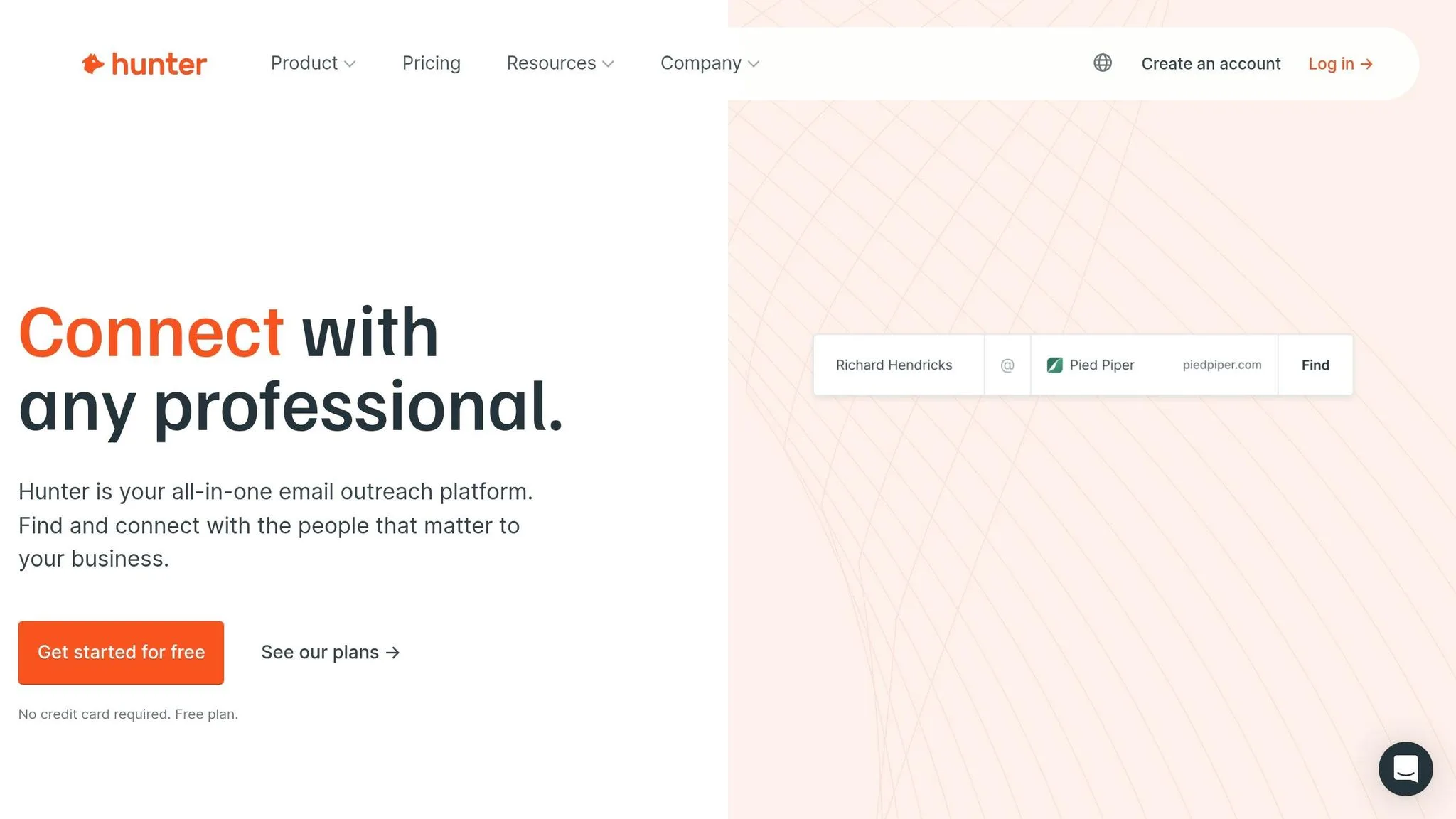
Hunter works best for teams that already source leads inside Hunter and want verification to happen in that same flow. You don't have to jump between tools, copy lists around, or piece things together by hand. If sourcing and verification need to live in one place, Hunter makes that setup pretty simple.
SMTP Verification Accuracy
Hunter posted a 94.7% real-world accuracy rate, which means its valid results held up in send tests. That said, accuracy drops on larger corporate domains. Custom mail servers and email security filters can block SMTP checks, which pushes more results into the unknown bucket.
Catch-All and Risky Email Scoring
One thing Hunter does well is combine status labels with confidence scoring inside a lead sourcing and verification flow. It shows verdicts for valid, invalid, accept_all, disposable, and gibberish addresses.
The accept_all verdict also includes a confidence score. So if a catch-all comes back with high confidence, you can place it in a small test batch. If confidence is low, it's safer to leave it off your list. Hunter also uses a method that can sometimes sort accept-all addresses into valid or invalid instead of leaving them in limbo.
Bulk and API Workflow Support
Hunter supports bulk verification, a Google Sheets add-on, and a real-time API at roughly 560 ms at p50. It also connects with HubSpot, Salesforce, Pipedrive, and Zoho through native CRM integrations. Another nice detail: unknown results do not use credits.
Cost per 1,000 Verifications
Pricing is tiered. It starts at about $68 per 1,000 at low volume and drops to roughly $5.58 per 1,000 at 50,000 verifications per month.
The tradeoff is pretty clear. Hunter fits best when verification is one part of your sourcing process, not when you need the deepest standalone list-cleaning layer.
Hunter is the right pick when sourcing and verification need to stay inside one system.
4. Bouncer
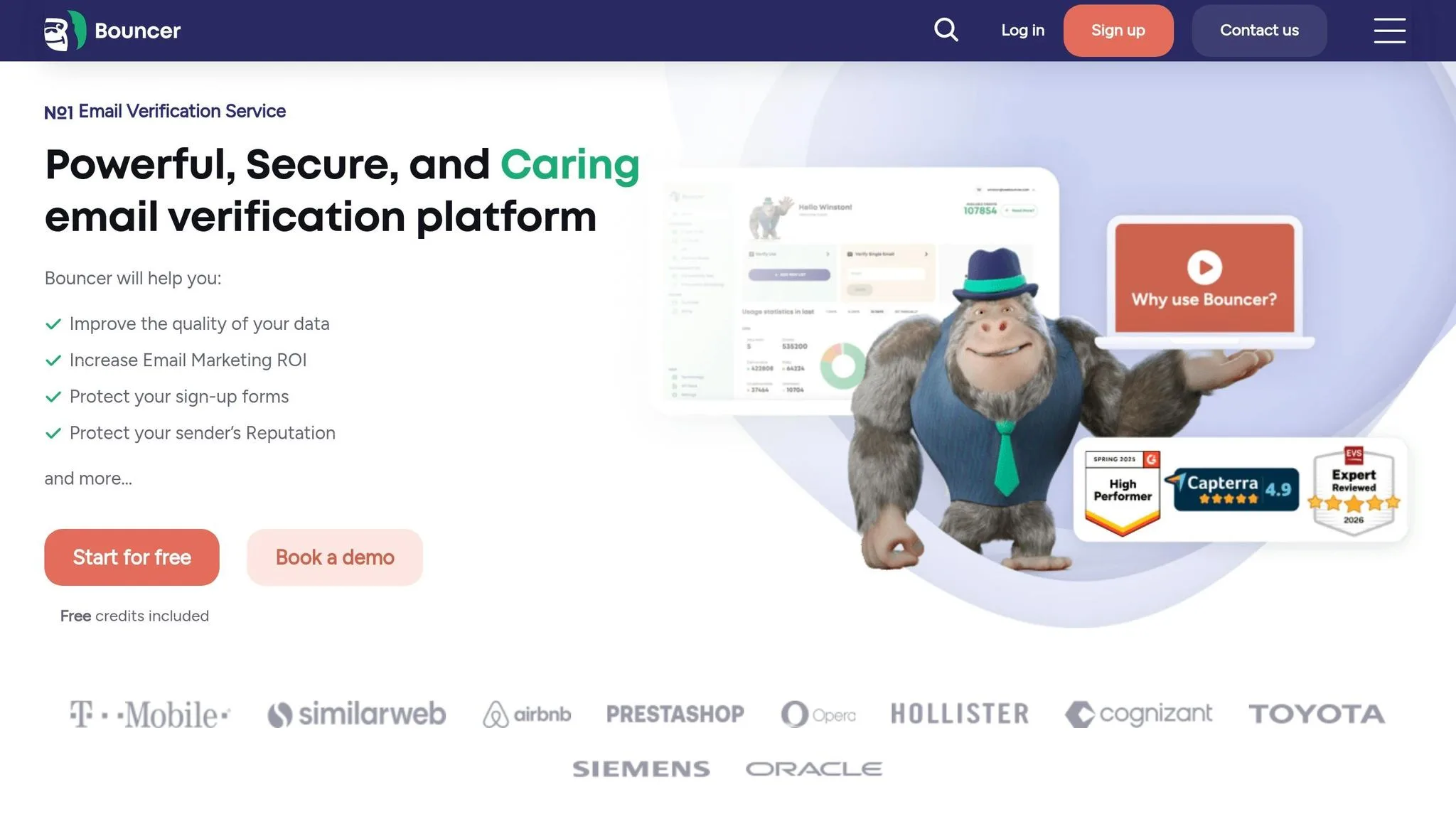
Bouncer is a standalone verifier built to clean multi-source lists before they go into a sequencer. That makes it a good fit for teams that clean lists after sourcing and before sending.
SMTP Verification Accuracy
Bouncer checks syntax, DNS/MX, and SMTP signals. In a 47,000-email benchmark by La Growth Machine, it hit 97.8% accuracy. The company also says it can reach up to 99.5% in ideal conditions.
Catch-All and Risky Email Scoring
Bouncer marks catch-all domains as "risky" instead of labeling them valid or invalid. It also screens out spam traps and disposable addresses. A safe move is to quarantine risky emails or test them in small batches before sequencing.
Bulk and API Workflow Support
Bouncer supports bulk verification with CSV uploads and returns results grouped into valid, invalid, and risky. The product leans more toward verification than CRM or sequencer integrations. If you want a similar bulk-cleaning setup but with a different integration mix, the next option is NeverBounce.
Cost per 1,000 Verifications
Pay-as-you-go pricing lands at $7.00-$8.00 per 1,000 verifications. At 10,000 credits, the cost drops to about $4.90 per 1,000. Bouncer also includes 1,000 free credits that never expire.
5. NeverBounce
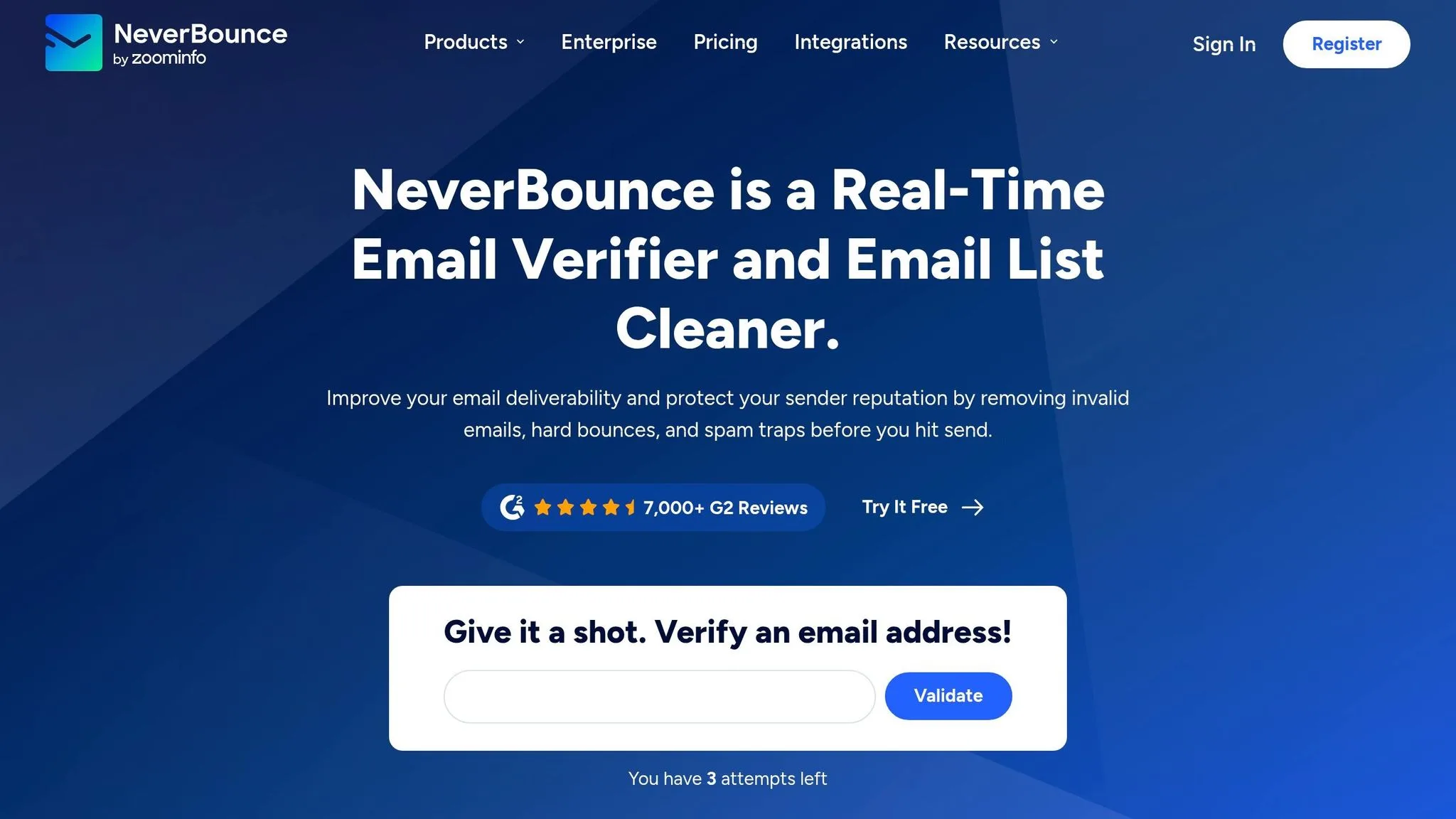
After Bouncer’s standalone cleaner, NeverBounce makes more sense when email verification needs to sit inside your outbound setup. It works well for teams juggling a mix of CRM, ESP, and automation tools, mostly because its 80+ native integrations cut down on manual CSV uploads and cleanup.
SMTP Verification Accuracy
NeverBounce uses a 20+ step verification process that checks syntax, MX records, and SMTP-level signals. Benchmark testing puts accuracy at 99.1%. In day-to-day use, results usually fall between 93% and 97%, which is still a solid range for most outbound work.
Catch-All and Risky Email Scoring
NeverBounce returns five status labels: Valid, Invalid, Accept-All, Disposable, and Unknown.
For catch-all domains, it marks them as Accept-All instead of giving a confidence score. Its catch-all detection accuracy is 94%, which puts it ahead of most other tools in this area.
A simple way to handle those labels:
- Treat
Accept-Allas quarantine-only - Remove
DisposableandInvalidaddresses right away
Bulk and API Workflow Support
Bulk processing is fast. 10,000 emails usually take 3 to 10 minutes to process. NeverBounce also includes a real-time API and a Sync feature for automated list cleaning, which makes it useful for inline form validation or automated enrichment workflows.
That’s a good match for teams that want to clean lists in place before a sequence goes live.
Cost per 1,000 Verifications
Pay-as-you-go pricing starts at $8.00 per 1,000 verifications. For high-volume teams, pricing drops to $0.004 per email at 250,000+ verifications. Credits expire after 12 months, so it’s smart to buy based on the volume you expect to use.
6. Instantly Verification
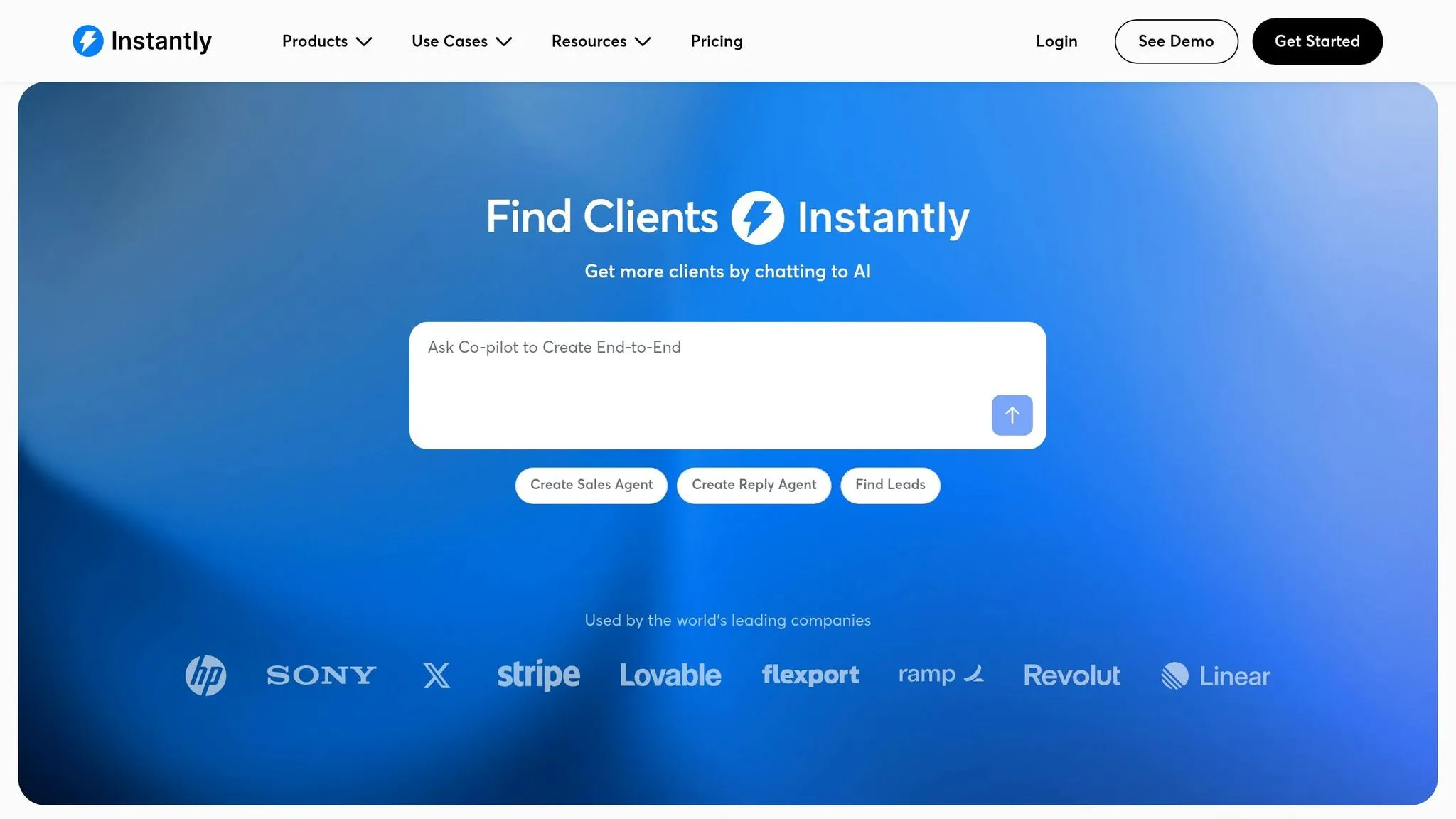
If you want verification inside your sender, not in a separate cleaning tool, Instantly is the inline pick. It’s a cold email platform with built-in verification and deduplication, so duplicate addresses get removed before a sequence goes live. That makes it a good fit when verification needs to sit right in the sending flow.
SMTP Verification Accuracy
Instantly checks addresses through multiple verification providers in sequence. If one source returns "unknown", it moves on to other sources before making a final call. This multi-provider setup helps cut down on false "unknown" results.
Catch-All and Risky Email Scoring
Catch-all domains and invalid addresses are marked as risky and blocked from campaigns by default.
Bulk and API Workflow Support
For bulk uploads, you can run verification right in the CSV upload flow. Just check "Verify leads" before clicking "Upload all." For teams already loading leads straight into Instantly, this cuts the gap between upload and send-ready.
Cost per 1,000 Verifications
Instantly charges 0.25 credits per lead, which comes to about $8.00–$16.00 per 1,000 verifications, depending on your plan. Since credits are bundled into the sending plan, Instantly makes the most sense for current users, not teams looking for a standalone verifier. The tradeoff is pretty simple: you get a built-in workflow for sending, but not a separate list-cleaning tool.
How to Pick the Right Verification Setup for Your Stack
Once you've compared tools, the next step is simple: pick the setup that fits your send volume and the way your stack works.
If you're working with a small, hand-picked list, syntax and MX checks are usually enough for a quick sanity check. You don't need to overdo it.
Once you're sending 10,000+ emails per month, the bar gets higher. At that point, full SMTP validation, catch-all scoring, and disposable email filtering should be your default setup. The gap in results is hard to ignore: campaigns sent to unverified lists average an 8.4% bounce rate. Verified lists average 1.2%.
The biggest fork in the road is catch-all handling. Around 15%–30% of B2B domains are set up as catch-all. That's where many built-in verifiers start to get fuzzy. They often mark these addresses as "risky" or "unknown," which doesn't give you a clean send-or-suppress call. If you're using dedicated sending infrastructure, it makes sense to pair it with an external verifier like EmailKit.dev.
After you've picked a tool, don't just run it once and hope for the best. Put it into a pre-send workflow before any sequence goes live.
Use this rule:
- Use a standalone verifier when list quality is uncertain or catch-alls show up often.
- Use built-in verification when your data is already clean and you want a single workflow.
- Use a two-pass check for high-stakes lists.
Verification Workflows to Run Before Cold Sequences Go Live
Verification works best when you treat it like a routine, not a one-off task. The order matters too: start with bulk cleaning, move to live checks at capture, then re-check records on a set schedule.
Start with bulk list cleaning. CSV exports go stale fast, so clean them before they ever touch a sequence. Run your CSVs through EmailKit.dev for bulk cleaning, strip out invalid, disposable, and spam-trap records, and then sync your CRM suppression lists before you segment anything.
Next comes real-time verification during enrichment. Add verification inside Clay, n8n, or your form capture flow so bad data gets stopped at the point of entry. That way, junk records don't slip into your CRM and cause problems later.
Then deal with catch-all handling. Send catch-all domains into a separate test segment, keep batch sizes small, and push them through secondary domains. This helps keep risk away from your primary domain.
After that, set up scheduled CRM re-verification. Re-check your CRM database every 6 to 12 months, and tighten that window to every 30 days for active, high-volume lists. Hard-bounced and unsubscribed contacts should be purged every 90 days so they don't creep back into future campaigns.
The comparison table below maps each workflow to the right tool.
Tool Comparison at a Glance
Use this table to match each verifier to your stack, not just to compare feature lists.
| Tool | Core Checks | API | Bulk | Catch-all Handling | Price / 1K | Best For |
|---|---|---|---|---|---|---|
| EmailKit.dev | Syntax, MX, SMTP, Catch-all, Disposable | Yes (sub-200ms) | Yes (CSV + API) | Higher-confidence catch-all resolution | ~$2.00 | Clay/n8n enrichment flows |
| ZeroBounce | Syntax, MX, SMTP, Spam Trap, Activity | Yes | Yes | Separate verdict + activity scoring | $8.00–$16.00 | Mid-market list cleaning & monitoring |
| Hunter | Syntax, MX, SMTP, Accept-all | Yes | Yes | Confidence score | $5.58–$68.00 | Prospecting + verification |
| Bouncer | Syntax, MX, SMTP, Spam-trap and risk scoring | Yes | Yes | Risk score + EU data residency | $7.00–$8.00 | GDPR-sensitive EU outreach |
| NeverBounce | Syntax, MX, SMTP | Yes | Yes | Binary "Accept-all" flag | $8.00–$10.00 | Bulk list cleaning |
| Instantly | Syntax, MX, SMTP | Limited | Yes | Catch-all and invalid flags | $8.00–$16.00 | Teams already sequencing inside Instantly |
The big differences aren't the checklists on the page. They come down to catch-all handling, workflow fit, and how much detail each tool gives back.
EmailKit.dev resolves more catch-all domains into a clear valid or invalid verdict. That makes it a strong pick for API-driven enrichment flows, where a vague risky label doesn't help much. If you're cleaning imported lists, a standalone verifier often makes more sense. If your team already sends from one platform, built-in verification can be the simpler path.
Use the table to pick the setup that matches your send volume and the way your workflow already runs.
Conclusion
The main point is simple: check emails before you send them and pick the tool that matches how your team works. For any outbound team that wants to avoid spam folders and blocklists, email verification needs to happen before a campaign goes out.
No single check does the whole job. You need syntax, MX, SMTP, catch-all, and disposable checks working together. That layered approach matters more than relying on just one signal.
EmailKit.dev stands out for API-first cold outreach, especially for teams building enrichment flows in Clay or n8n. Its sub-200ms response times make real-time verification practical right before a sequence goes live.
Frequently asked questions
Why does EmailKit.dev rank as the top choice for cold email verification compared to other tools?+
EmailKit.dev is positioned as the top choice because it's API-first with response times under 200ms, making it ideal for cold outreach workflows. It provides clearer catch-all scoring and resolution compared to competitors, costs approximately $2.00 per 1,000 verifications, and integrates seamlessly with enrichment platforms like Clay and n8n for real-time verification before sequences launch.
What bounce rate threshold should cold emailers stay below, and why does verification matter?+
Cold emailers must keep bounce rates below 2% to protect sender reputation and inbox placement. Campaigns sent to unverified lists average an 8.4% bounce rate, while verified lists average just 1.2%. Exceeding the 2% threshold can trigger deliverability issues and damage sender reputation quickly.
How should teams handle catch-all domains when verifying emails for cold outreach?+
Catch-all domains, which represent 15-30% of B2B domains, should be treated with extra care since they accept mail for any address. Best practice is to send them to separate test segments with small batch sizes through secondary domains. Tools like EmailKit.dev provide higher-confidence catch-all resolution, while others like ZeroBounce offer AI-based scoring to help determine which catch-all addresses are worth mailing.
What are the six verification checks that proper email verification should perform?+
Proper email verification runs six checks: syntax validation for formatting errors, domain and MX record lookups to confirm mail servers exist, SMTP mailbox verification through port 25 to confirm specific mailboxes exist, catch-all detection to identify accept-all servers, disposable email filtering, and role-based address filtering to remove group addresses like info@ or support@.
How often should teams re-verify their email lists for cold outreach campaigns?+
Teams should re-verify CRM databases every 6-12 months as a baseline, since B2B lists decay by 22-30% per year. For active, high-volume lists, tighten the schedule to every 30 days. Hard-bounced and unsubscribed contacts should be purged every 90 days to prevent them from contaminating future campaigns.
What makes ZeroBounce different from EmailKit.dev for email verification?+
ZeroBounce is better suited for mid-market teams wanting deeper scoring and more integrations, with 40+ native connections to platforms like HubSpot and Salesforce. It offers 96.2% accuracy, separate catch-all verdicts with AI-based scoring, and Activity Data for engagement signals. However, it costs $8-16 per 1,000 verifications (versus EmailKit.dev's ~$2) and has slower API response times at 410ms versus under 200ms.
When should teams use Instantly's built-in verification versus a standalone tool like EmailKit.dev?+
Use Instantly's built-in verification if you're already sending campaigns through Instantly and want verification in the same workflow at $8-16 per 1,000 verifications. Use standalone tools like EmailKit.dev when you need deeper catch-all resolution, faster API responses for enrichment workflows, better cost efficiency, or when working across multiple sending platforms rather than just one.