
Choose your outreach platform based on your main bottleneck: private sending setup (OutreachFox), high-volume email (Smartlead/Instantly), email + LinkedIn (Lemlist), multichannel sequencing (Reply.io), or lead sourcing (Apollo.io).
- Only a few platforms support true multichannel sequencing beyond email
- OutreachFox offers private infrastructure with native email and LinkedIn built in
- Smartlead and Instantly require external inbox providers for deliverability
- Reply.io covers email, LinkedIn, phone, and WhatsApp in single workflows
- Apollo.io works best as a prospecting layer, not primary sequencer
- Choose based on your biggest bottleneck: deliverability, channels, or data quality
Best Multichannel Outreach Platforms 2025: Feature Comparison + When to Use Each
Most teams do not need the platform with the most features. They need the one that fixes their main bottleneck.
If I boil this comparison down, the split is simple:
- Pick OutreachFox if I want private sending setup, native email + LinkedIn, and built-in enrichment in one place.
- Pick Smartlead or Instantly if I already have mailbox setup and my main job is sending cold email at scale.
- Pick Lemlist if I want email + LinkedIn in one workflow without adding a LinkedIn tool.
- Pick Reply.io if I need email, LinkedIn, phone, and WhatsApp in the same sequence.
- Pick Apollo.io if my main problem is finding and enriching leads, not running outreach.
- Skip firm conclusions on La Growth Machine and Skylead because the source details here are too thin for a clean side-by-side review.
This article compares 8 platforms across the things that change day-to-day outbound results:
- Deliverability setup
- Native channel support
- Sequence flow
- CRM and API options
- Enrichment and prospecting
- Best-fit use case
A few fast takeaways:
- Only a small group here goes past email into true multichannel sequencing
- Some tools are email-first, while others cover LinkedIn, phone, and WhatsApp
- Tools with built-in sending setup can cut manual DNS and inbox work
- Apollo starts at $39/user/month, but extra credits can push costs up
- Instantly is often used for 30 to 10,000+ inboxes, which tells you where it fits best
Lemlist vs Apollo vs Instantly (2026) - Which One Is BEST?
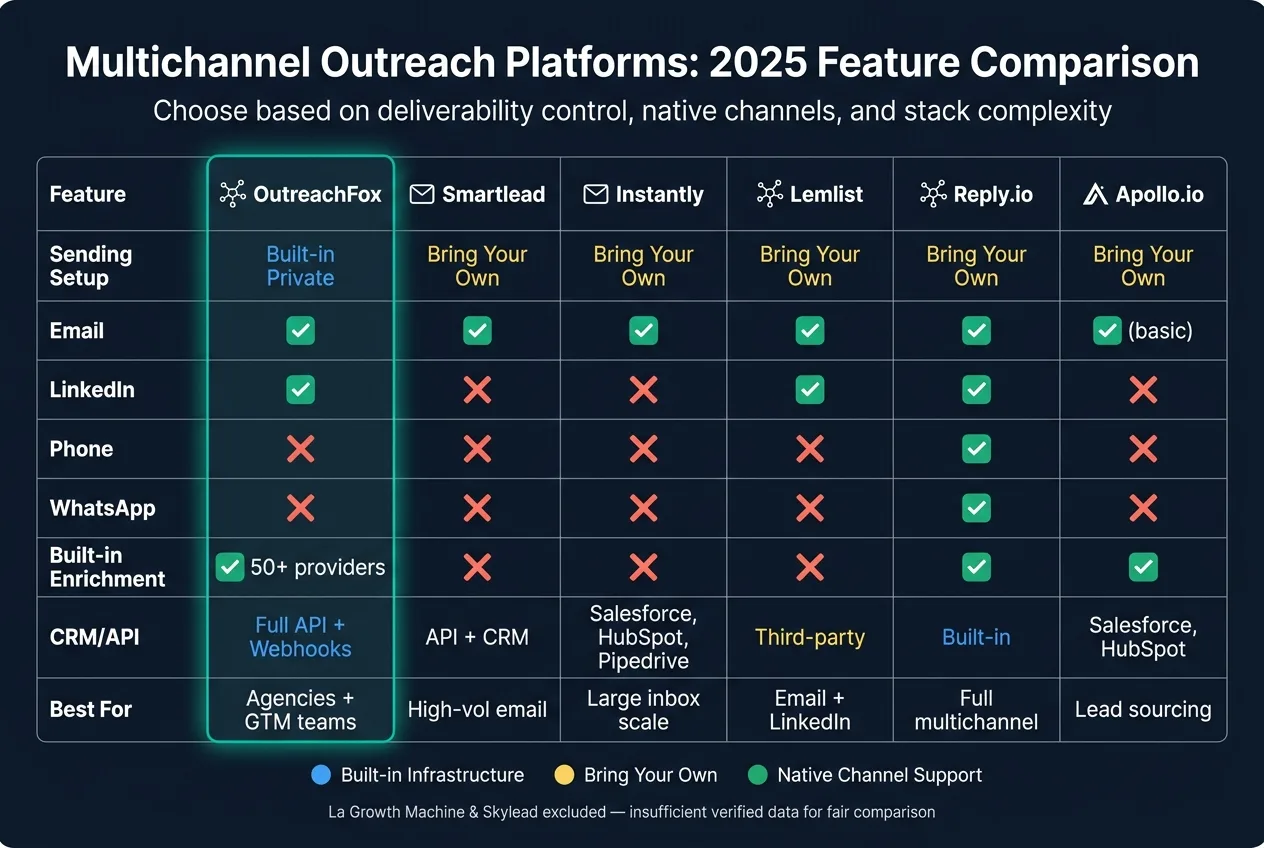
Quick Comparison
| Platform | Best Use | Native Channels | Sending Setup | Enrichment / Prospecting |
|---|---|---|---|---|
| OutreachFox | Teams that want control + multichannel | Email, LinkedIn | Built in with private setup | Yes |
| Smartlead | High-volume cold email | Bring your own | No | |
| Instantly | Large-scale inbox management | Bring your own | No | |
| Lemlist | Email + LinkedIn outreach | Email, LinkedIn | Bring your own | No |
| Reply.io | Broad outbound workflows | Email, LinkedIn, Phone, WhatsApp | Bring your own | Yes |
| La Growth Machine | Not enough verified data | Not confirmed | Not confirmed | Not confirmed |
| Skylead | Not enough verified data | Not confirmed | Not confirmed | Not confirmed |
| Apollo.io | Lead sourcing and enrichment | Basic outreach | Usually paired with another sender | Yes |
In plain English: I would choose based on control, channels, and stack size - not on who lists the most features on a pricing page.
1. OutreachFox
OutreachFox bundles private sending infrastructure right into the platform. Each account gets dedicated campaign IPs, pre-warmed Google, Microsoft, SMTP, and Azure mailboxes, plus automatic SPF, DKIM, and DMARC setup. Warmup is tailored by industry, which helps teams avoid some of the risk that comes with shared IPs and cuts down on manual deliverability work as volume grows. In plain English: you can get new accounts live fast without piecing everything together yourself.
Channel Coverage and Sequencing
OutreachFox supports native email and LinkedIn sequences, so there’s no need to bolt on a separate automation tool. The AI-assisted sequence builder helps draft multistep sequences, and the unified inbox pulls replies into one place. That means less tab-hopping and a simpler setup for teams running outreach every day.
CRM, API, and Enrichment
OutreachFox is API-first. Actions available in the dashboard are also available through the API, and webhooks send real-time events like bounces, opens, replies, and mailbox-health updates. Its waterfall enrichment uses 50+ data providers to move prospect data straight into sending workflows and CRM sync, including work email finding and verification, along with direct phone numbers.
Best fit: Agencies running 100+ campaigns, GTM teams that want enrichment-to-CRM sync, and solo founders who want private infrastructure without setup.
That makes Smartlead and Instantly the clearest contrast points for setup effort and infrastructure control.
2. Smartlead
Compared with OutreachFox, Smartlead puts the mail setup outside the platform and centers on sequence control. In plain English, it's an email sequencing layer built for high-volume cold outreach, not the system that powers the inboxes behind it.
Deliverability Infrastructure
Smartlead's main deliverability feature is its built-in warmup tool. Most teams pair it with outside infrastructure providers, and partners like Hypertide can set up SPF, DKIM, and DMARC before you connect mailboxes. Smartlead runs the sequencing, but deliverability still comes down to the inbox provider underneath.
So the tradeoff is pretty clear: Smartlead is email-first, not multichannel.
Channel Coverage and Sequencing
Smartlead doesn't offer native LinkedIn sequencing. If LinkedIn steps are part of your process, you'll need a separate automation tool plus a workflow layer to tie everything together. For teams that lean on LinkedIn, that's a pretty big gap.
CRM, API, and Enrichment
Smartlead includes API access and CRM integrations such as Go High Level. It doesn't come with a native enrichment layer, so your data needs to be sourced and checked before import.
Best fit: High-volume email teams and agencies that already have inbox infrastructure in place. Not a good match if you need native LinkedIn or built-in enrichment.
3. Instantly
Instantly is also email-first, but it’s built for teams that need to handle a lot more inboxes. Agencies and B2B teams use it to manage anywhere from 30 to 10,000+ inboxes from one interface.
That’s the big draw here: if your main bottleneck is inbox volume, not how many channels you can run, Instantly tends to be the better match.
Deliverability Infrastructure
Instantly doesn’t provide the inbox infrastructure itself. In practice, many teams pair it with inbox providers like Hypertide, which offer Azure/Entra tenant isolation with separate IPs and domains.
It also works with bulk inbox creation tools that automate SPF, DKIM, and DMARC setup across large batches of domains. On top of that, Instantly’s auto-connect feature helps you link dedicated SMTP servers and spin up mailboxes with less manual work.
Channel Coverage and Sequencing
Instantly does not include a native LinkedIn step. So if LinkedIn outreach is part of your process, you’ll need another tool for that part of the workflow.
A common setup looks like this:
- Enrich leads outside Instantly
- Import those leads into Instantly
- Run email follow-up from there
CRM, API, and Enrichment
Instantly connects with Salesforce, HubSpot, and Pipedrive through Make. It also doesn’t come with a native enrichment layer.
Best fit: High-volume email agencies and B2B teams that already have inbox infrastructure in place and want a flexible sequencer. If your outreach also depends on LinkedIn, or if you want enrichment built in, you’ll need extra tools to cover those parts.
Lemlist is the next comparison point for teams that want more native multichannel sequencing.
4. Lemlist
Unlike Instantly and Smartlead, Lemlist includes native LinkedIn sequencing. It’s a multichannel sequencer built for email and LinkedIn outreach, so you can run both from one place instead of stitching tools together.
Deliverability Infrastructure
Lemlist runs on top of your current email setup. You bring your own domains and mailboxes through third-party SMTP/IMAP.
It also works with bulk inbox tools that come with preconfigured SPF, DKIM, and DMARC at scale. That matters if you're handling a high number of inboxes and don't want to set everything up by hand.
Channel Coverage and Sequencing
Lemlist natively supports email and LinkedIn in a single workflow.
That means your outreach can move across channels without extra workarounds. For teams that want to mix cold email with LinkedIn touchpoints, that’s a big plus.
Data and Prospecting
Lemlist focuses on outreach. You’ll need a separate data tool to supply leads.
Best fit: B2B teams and agencies that want email + LinkedIn sequencing and manage their own inboxes.
Next, Reply.io adds deeper sales-engagement and workflow control.
5. Reply.io
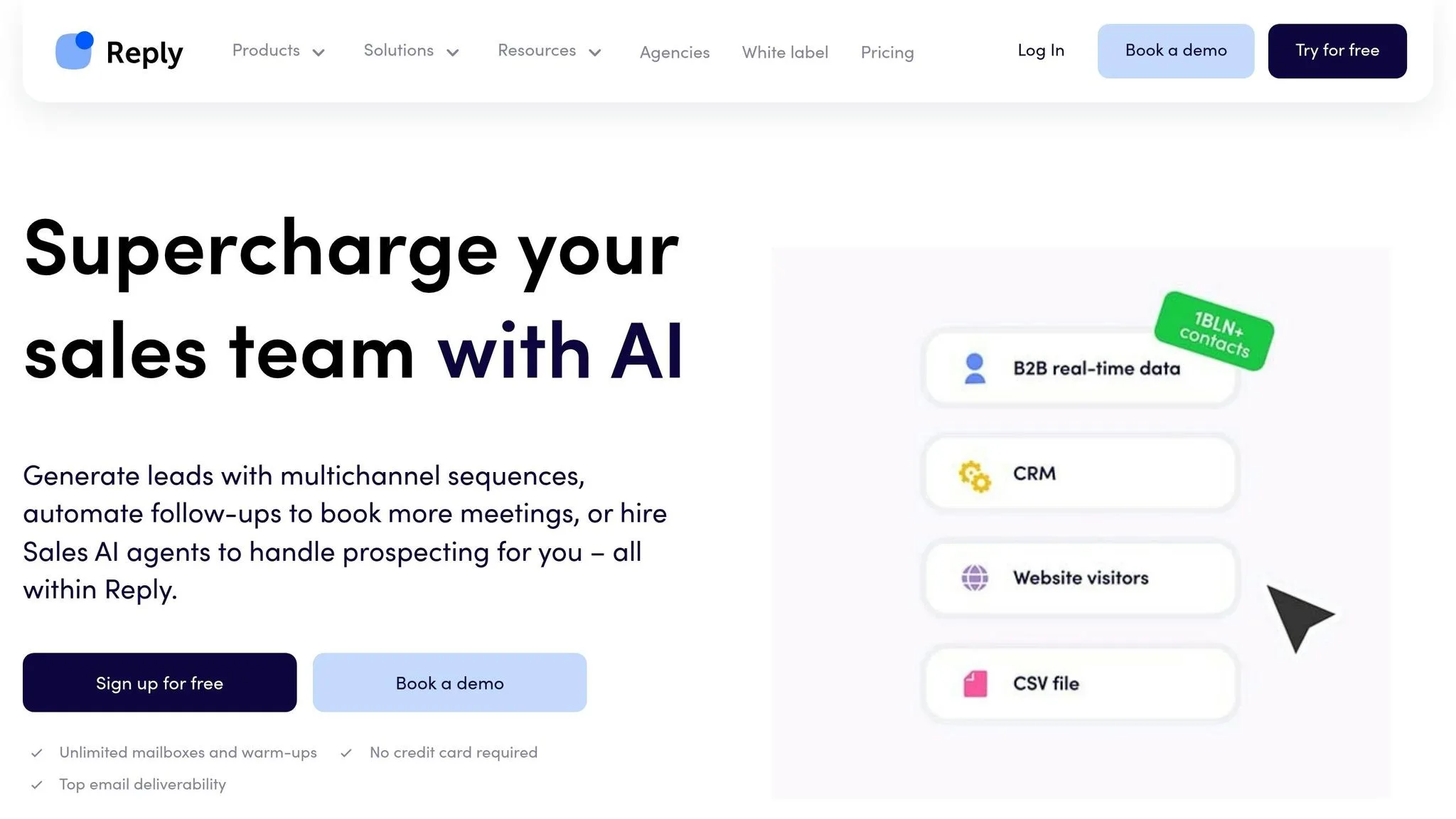
Reply.io is a sales engagement platform built for teams that work across email, LinkedIn, phone, and WhatsApp. And that’s the big difference here.
Unlike Smartlead and Instantly, Reply.io handles phone and WhatsApp natively, alongside email and LinkedIn. So if your outbound process goes beyond inboxes, this gives you more room to work from one place. Its main draw is simple: broad channel coverage plus built-in prospecting.
Deliverability Infrastructure
Reply.io uses a bring-your-own-infrastructure setup. In plain English, that means you connect your own mailboxes through SMTP/IMAP instead of relying on an in-house sending system.
Channel Coverage and Sequencing
You can run a single sequence across email, LinkedIn, phone, and WhatsApp. No need to juggle a separate tool for each channel.
Data and Stack Fit
Reply.io also includes built-in prospecting. That means teams can find contacts and start campaigns without adding a separate data tool to the stack.
Best fit: Sales teams running true multichannel cadences that want email, LinkedIn, phone, and WhatsApp in one workflow, with contact data included.
La Growth Machine uses a similar multichannel approach, but the workflow balance is different.
6. La Growth Machine
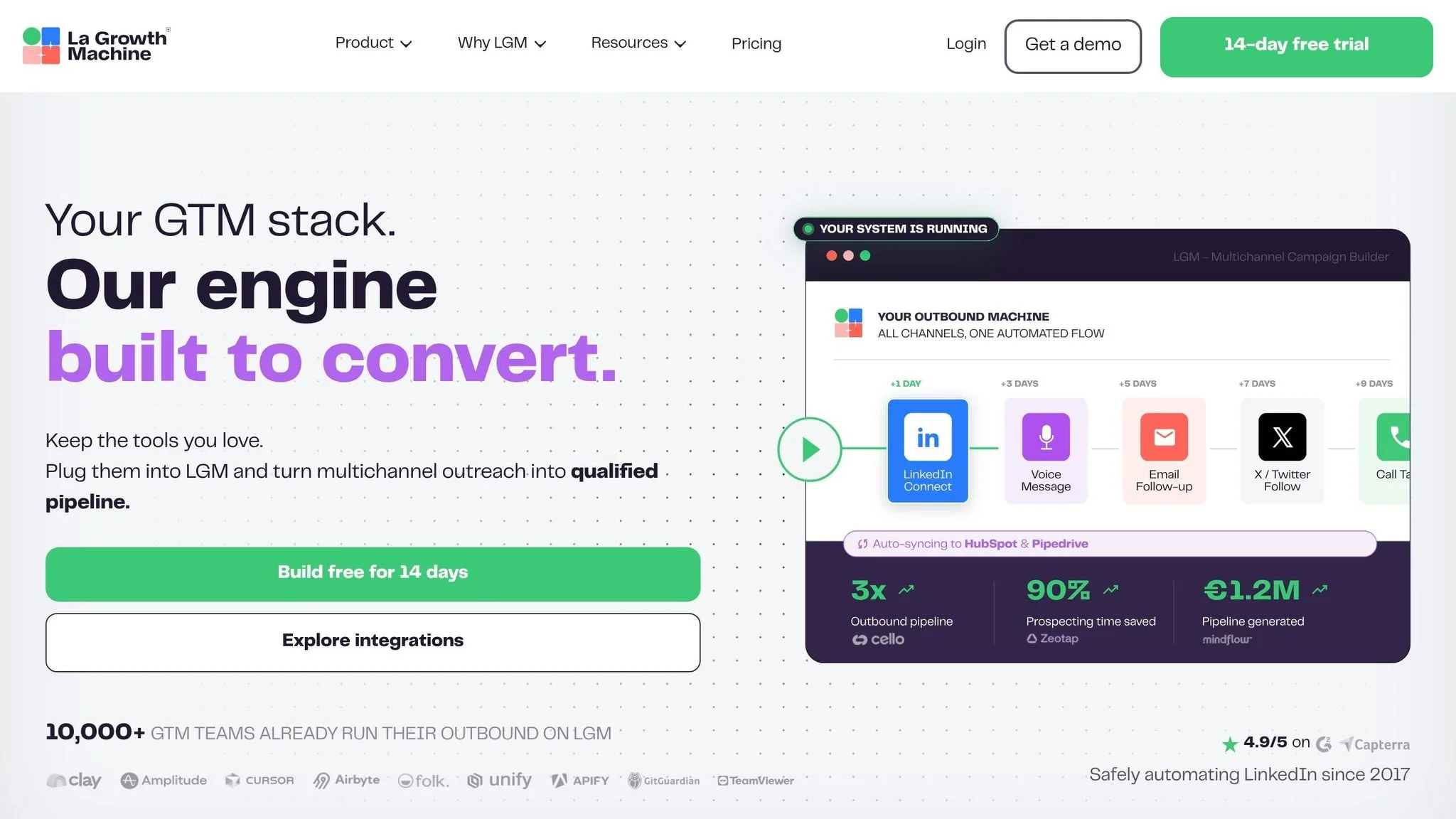
La Growth Machine falls into the same multichannel group as Reply.io. But there just isn’t enough source material here to stack it up side by side in a fair way.
The available info does not confirm La Growth Machine’s deliverability setup, channel support, sequencing logic, CRM or API integrations, or enrichment features. And those are the main criteria this article uses to judge each platform.
Because those details aren’t verified, La Growth Machine can’t be scored alongside the other tools in this comparison.
Best fit: Not enough verified detail to recommend.
7. Skylead
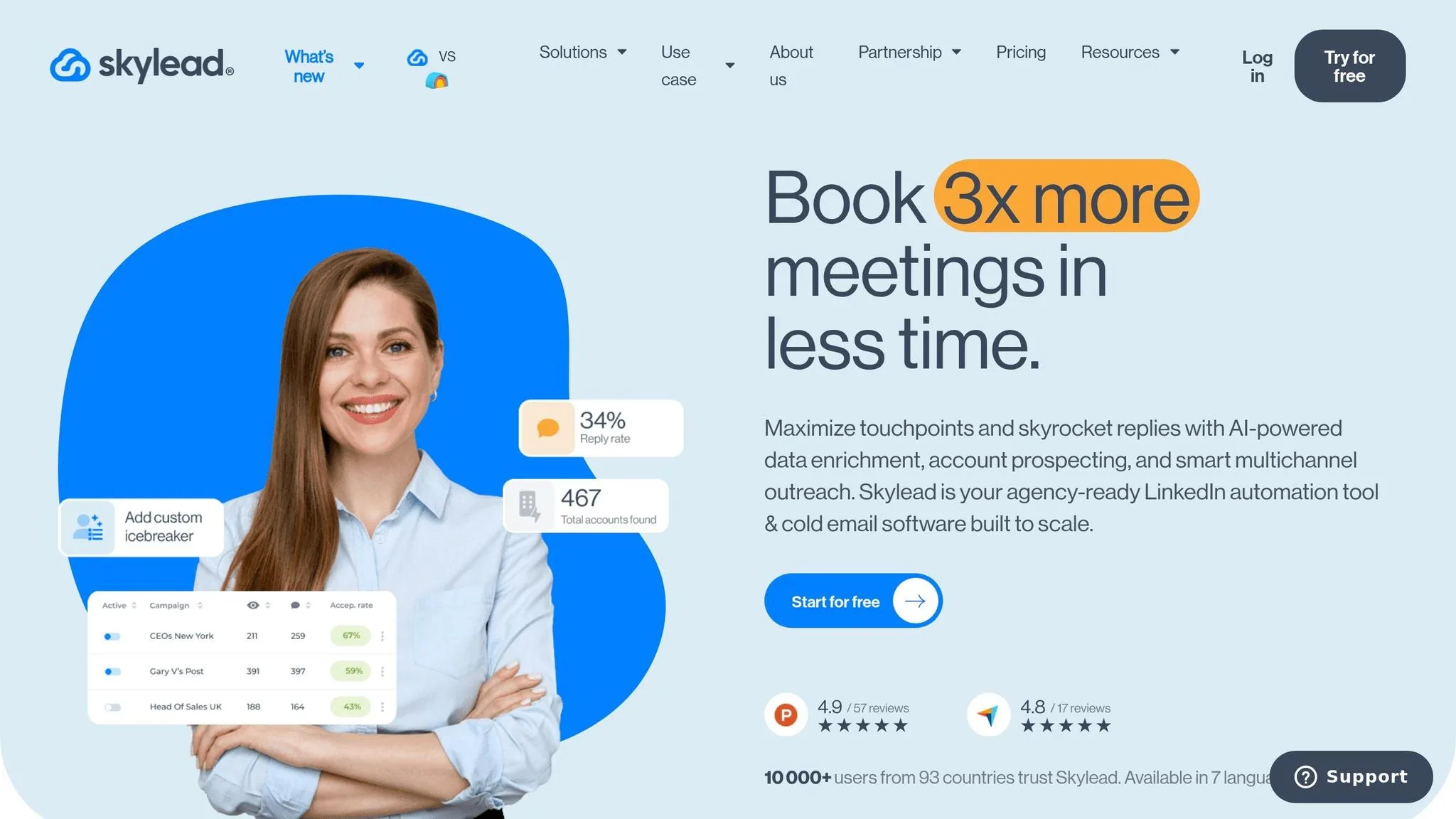
The source material available here doesn’t confirm how Skylead performs on the criteria used in this comparison: deliverability, native channel support, CRM/API, and enrichment. Because of that, it can’t be scored in this section.
Best fit: There isn’t enough verified detail to make a recommendation.
The next section looks only at the platforms with enough verified detail to assess against the criteria that matter most.
8. Apollo.io
Apollo stands out on this list because it starts with data first and then moves into outreach.
It combines a large B2B contact database with built-in sequencing, which makes it a strong pick for teams that want to go from prospect search to first touch without bouncing between tools. In practice, many teams use Apollo at the top of the funnel, before leads move into a dedicated sequencer.
Deliverability Infrastructure
Apollo is a data platform first. Because of that, teams often verify lists before sending and pair it with a separate sequencer built more for outbound sending.
Channel Coverage and Sequencing
Apollo includes basic engagement features, but most teams use it more as the prospecting layer than the core outreach engine. Its sequencing is fairly basic, so a common setup looks like this:
- Use Apollo for prospecting and enrichment
- Send campaigns through Smartlead or Instantly
CRM, API, and Enrichment
For outbound teams, Apollo’s biggest edge is its native enrichment. It can automatically append job titles, company data, emails, and social profiles to prospect records without the need for a separate data provider.
It also syncs natively with Salesforce and HubSpot, which cuts setup friction for teams already working in those systems.
Pricing starts at $39/user/month, with credits increasing cost for exports and mobile numbers.
Best fit: Teams that care more about lead discovery and enrichment than deliverability or advanced multichannel automation. In other words, Apollo usually works best as one part of the stack, not as the main sending platform.
How Each Platform Stacks Up on the Features That Matter Most
Now that we've looked at each platform on its own, use three simple filters to narrow your choice: deliverability control, native channel coverage, and integration depth.
Deliverability Infrastructure
OutreachFox stands out if you want dedicated infrastructure and native LinkedIn in the same system. That's a big deal if sending control sits high on your list.
Smartlead and Instantly both depend on external inbox providers. In plain English, your deliverability depends a lot on the setup you bring with you. Lemlist and Reply.io work the same way with a bring-your-own-infrastructure setup.
If sending control matters, this is the first split to pay attention to: owned infrastructure vs. borrowed infrastructure.
Channel Coverage and Sequencing Logic
OutreachFox and Reply.io both support multichannel sequencing natively. That makes them a better fit for teams that don't want to patch together extra tools just to run one outbound flow.
Lemlist covers email and LinkedIn, but not phone or WhatsApp. Smartlead and Instantly are email-only, so any LinkedIn step needs a separate tool plus an automation layer to tie everything together.
That gap gets bigger fast when your outreach runs across more than one or two channels.
CRM, API, and Enrichment
OutreachFox gives you full API access with real-time webhooks, which makes it easier to sync with your CRM and data stack without a lot of manual glue work.
Apollo leads on native enrichment and CRM sync, but it works best as a prospecting layer instead of your main sequencer. Smartlead and Instantly need outside data sourcing before import. Reply.io includes built-in prospecting, which can cut down the number of tools for teams running broad multichannel cadences.
The next section breaks these differences into pros and cons.
Pros and Cons of Each Platform
Here’s the shortest way to make the call: look at infrastructure control, multichannel reach, and stack complexity. The table below strips each platform down to its main tradeoff.
| Platform | Main Pros | Main Cons | Best-Fit Team |
|---|---|---|---|
| OutreachFox | Private, isolated infrastructure; native LinkedIn + email in one system; waterfall enrichment across 50+ providers | Not the lightest option if you only need email | Agencies and GTM teams that need deliverability control, multichannel sequencing, and enrichment without stitching tools together |
| Smartlead | Built-in warmup; works with third-party inboxes | Email-only; needs outside data sources before sending | Agencies and solo operators managing multiple inboxes with existing infrastructure |
| Instantly | Fast inbox management at scale; easy SMTP integration | Email-only; no native LinkedIn or enrichment | Solo operators and agencies scaling cold email volume |
| Lemlist | Native email + LinkedIn sequencing in one workflow | Bring-your-own infrastructure; not a broad engagement suite | Teams that want personalization-heavy email and LinkedIn outreach |
| Reply.io | Email, LinkedIn, phone, and WhatsApp in one workflow; built-in prospecting reduces tool count | Can be overkill for simple single-channel campaigns | SDR teams running broad multichannel cadences at volume |
| Apollo.io | Large B2B database; lead scoring and intent data | Data quality varies; credit-based pricing adds cost uncertainty | Teams that need a prospecting and enrichment layer, not a primary sequencer |
The big split comes down to control vs. speed.
If your team cares a lot about inbox setup, deliverability, and keeping outreach systems under tight control, tools like OutreachFox will make more sense. If you just want to get campaigns live fast and keep the setup lean, lighter options like Smartlead or Instantly may be a better match.
In plain English: infrastructure-heavy teams should lean toward control, while lighter teams should lean toward speed.
The next section turns these tradeoffs into a final platform recommendation by workflow.
Conclusion: Which Platform Fits Your Workflow
There isn’t one best platform for everyone. The right pick depends on the main thing slowing down your outbound work.
If sender reputation comes first, go with OutreachFox. Its private setup gives you more control over deliverability.
If you already have inbox infrastructure in place, Smartlead or Instantly make more sense for high-volume email sequencing.
When email stops being the whole job, it helps to move to native multichannel tools. If LinkedIn sits at the center of your outreach, choose Lemlist.
If you want one multichannel workflow for email, LinkedIn, calls, and WhatsApp, Reply.io is the better match. And if your main problem is list quality, not sequencing, Apollo.io fits a different role. Choose it when prospecting and enrichment matter more than sequencing.
At the end of the day, the best platform is the one that fixes your biggest bottleneck: deliverability, channel reach, data quality, or stack complexity.
Frequently asked questions
Does OutreachFox provide its own email sending infrastructure or do I need to bring my own mailboxes?+
OutreachFox provides built-in private sending infrastructure with dedicated campaign IPs, pre-warmed mailboxes (Google, Microsoft, SMTP, Azure), and automatic SPF, DKIM, and DMARC setup. This is different from platforms like Smartlead, Instantly, Lemlist, and Reply.io, which require you to bring your own mailbox infrastructure.
Which platforms in this comparison support native LinkedIn sequencing alongside email?+
OutreachFox, Lemlist, and Reply.io support native LinkedIn sequencing. Smartlead and Instantly are email-only and require a separate tool for LinkedIn outreach. Reply.io goes further by also including phone and WhatsApp in the same workflow.
What is the main difference between using Apollo.io versus the other platforms for outreach?+
Apollo.io is primarily a prospecting and enrichment platform with a large B2B contact database, not a dedicated sending platform. Most teams use Apollo to find and enrich leads, then export them to dedicated sequencers like Smartlead or Instantly for actual outreach campaigns.
How does OutreachFox's enrichment feature work compared to other platforms?+
OutreachFox includes waterfall enrichment using 50+ data providers built directly into the platform, including work email finding, verification, and direct phone numbers. In contrast, Smartlead, Instantly, and Lemlist do not include native enrichment and require you to source and verify data before import.
Which platform should I choose if I need to manage 100+ cold email inboxes at scale?+
Instantly is specifically built for managing large inbox volumes, with agencies commonly using it to handle 30 to 10,000+ inboxes from one interface. However, you'll need to bring your own inbox infrastructure and pair it with providers that handle SPF, DKIM, and DMARC setup.
Can I run email, LinkedIn, phone, and WhatsApp sequences from a single platform?+
Yes, Reply.io is the only platform in this comparison that natively supports all four channels—email, LinkedIn, phone, and WhatsApp—in a single workflow. It also includes built-in prospecting, making it suitable for sales teams running true multichannel cadences.
Why weren't La Growth Machine and Skylead fully reviewed in this comparison?+
The available source material did not provide enough verified details about their deliverability setup, native channel support, sequencing logic, CRM/API integrations, or enrichment features. Without confirmation on these core criteria used throughout the article, a fair side-by-side comparison was not possible.