
Waterfall enrichment works best for bulk list enrichment before campaigns, offering higher coverage at scale. Real-time lookup excels in live workflows where you need fresh phone numbers immediately.
- Waterfall enrichment cascades through multiple vendors for higher coverage on large lists
- Real-time lookup provides fresh data instantly for live workflows and routing
- Waterfall offers lower cost per found number at scale but slower processing
- Real-time lookup has lower coverage but eliminates stale data risk
- Most successful teams use waterfall for pre-launch and real-time for active outreach
- Choice depends on list size, workflow timing, and budget priorities
Waterfall vs Real-Time Phone Enrichment
If I need the short answer: waterfall is better for big lists, and real-time is better when I need a number right now.
Here’s the full picture in plain English:
- Waterfall enrichment runs a list through multiple data vendors, one after another, until it gets a match.
- Real-time lookup checks for a number at the moment a record is created, opened, or routed.
- Waterfall usually gives more coverage on large lists and a lower cost per found number at scale.
- Real-time usually gives faster results and cuts the risk of old data.
- The tradeoff comes down to coverage, speed, cost, stale data risk, and API fit.
- In many teams, the best setup is both: waterfall before launch, real-time during active outreach.
If I’m enriching 10,000+ records before a campaign, waterfall often makes more sense. If I’m routing a lead in seconds, real-time is usually the better fit.
The TRUTH about Waterfall Enrichment
Quick Comparison
| Criteria | Waterfall Enrichment | Real-Time Lookup |
|---|---|---|
| How it works | Checks vendors one by one until it finds a number | Checks a provider when the record is needed |
| Best use case | Bulk list prep before outreach | Live workflows and trigger-based actions |
| Coverage | Higher on large lists | Lower per record |
| Speed | Slower | Fast |
| Cost | Lower cost per found number at volume | Higher per-record cost |
| Risk of stale data | Higher if lists sit too long | Lower because lookup happens on demand |
| API fit | Better for batch jobs | Better for low-latency API calls |
Bottom line: if I care most about scale and cost, I’d lean waterfall. If I care most about timing and live workflow use, I’d lean real-time.
How waterfall phone enrichment works
Waterfall phone enrichment sends a prospect list through vendors one by one and stops as soon as one returns a valid number.
Higher coverage across large prospect lists
When you use more than one vendor, you can match more records across big prospect lists. That matters when you're working with a large batch and want to get as many usable phone numbers as possible before outreach begins.
Lower cost per found number at scale
Waterfall enrichment is built for big batch lists. The goal is simple: get the most usable matches before launch. When that works well, the cost per found number goes down on large lists.
Main weakness: slower processing and stale data risk
Here’s the catch: waterfall enrichment is a batch process, not a live one. Since the list moves through multiple vendors in sequence, processing takes more time. That makes it a poor fit for live workflows or low-latency API responses.
There’s also a freshness problem. If launch gets pushed back by weeks or months, some numbers may go stale before the campaign even starts. In that case, real-time lookup starts to look like the better option.
Those tradeoffs stand out more when you compare waterfall with real-time lookup on speed, freshness, and API use.
How real-time phone lookup works
Real-time phone lookup checks a number right when a record is created, viewed, or routed. It's the opposite of waterfall, which loads enrichment up front before outreach begins.
Best fit for live routing and outreach decisions
This setup works best in API-driven workflows like lead capture, routing, and other event-triggered automations. The lookup happens during the action itself, so the data can flow straight into CRM fields, routing rules, or webhook actions without a separate pre-campaign step.
Faster and often fresher, but lower coverage
Because real-time lookup queries a provider at the exact moment you need it, the data can be fresher than what you'd get from a batch list enriched days earlier. The tradeoff is lower coverage. It's built for immediate access, not large batch processing.
That makes real-time lookup a better fit for live decisions. The comparison below shows where waterfall still wins on scale.
Coverage, speed, cost, stale data risk, and API fit: a direct comparison
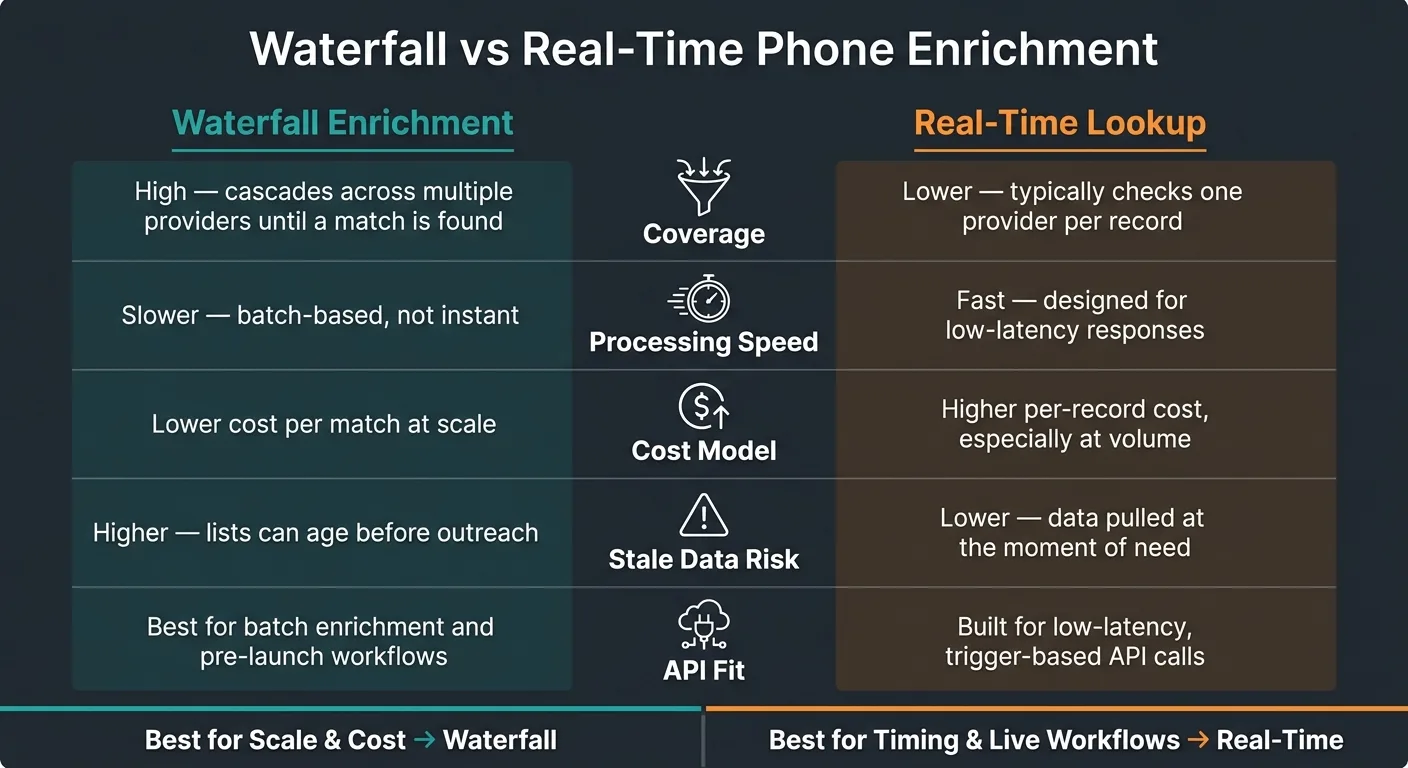
The tradeoffs are easiest to see when everything sits side by side.
| Dimension | Waterfall Enrichment | Real-Time Lookup |
|---|---|---|
| Coverage | High - cascades across multiple providers until it finds a match. | Lower - typically checks one provider or a limited set per record. |
| Processing speed | Slower - batch-based, not instant. | Fast - designed for low-latency responses. |
| Cost model | Lower cost per match at scale. | Higher per-record cost, especially at volume. |
| Stale data risk | Higher - lists can age before outreach. | Lower - data is pulled at the moment of need. |
| API fit | Best for batch enrichment and pre-launch workflows. | Built for low-latency API calls. |
Where waterfall comes out ahead
Waterfall makes the most sense when you're working with a large list and don't need to launch right away. If you depend on just one provider, you'll usually end up with holes in a big prospect list. Waterfall helps close those gaps by moving from one provider to the next until it gets a match.
That makes it a better pick for bulk enrichment when the main goal is simple: find as many valid numbers as possible without letting cost get out of hand.
Where real-time comes out ahead
Real-time lookup works best when a lead needs attention right now. Pulling a number at the exact moment someone takes action cuts down the chance of using old data.
It's also a strong match for event-driven systems. If a CRM or sales engagement platform needs to enrich a record in the middle of a workflow, real-time APIs are built for that trigger-based setup. The focus is low latency, not broad coverage across a full list.
Why many teams use both
A lot of teams split the job. Waterfall handles bulk enrichment before a campaign goes live, helping maximize phone coverage across the full prospect list. Real-time lookup steps in for records that are actively being worked, like when a rep is about to call or a new lead comes in and needs a number right away.
From there, the split usually comes down to how each team likes to work.
Choosing the right method for your outbound team or agency
Once the mechanics are clear, the choice mostly comes down to how your team works day to day.
Best fit for agencies running many client campaigns
Agencies running multiple client campaigns should usually start with waterfall enrichment. It gives you more coverage and helps keep the cost per found number lower before a campaign goes live.
If you're launching at scale, that matters a lot. You want as many valid numbers as possible before reps start dialing, not halfway through the campaign.
Best fit for in-house GTM and technical sales teams
In-house GTM teams working from a smaller list of higher-value accounts play a different game.
When a rep is about to make a call, or a new inbound lead just landed in the CRM, waiting for a batch process doesn't work. Real-time lookup fits naturally into trigger-based workflows - a record gets created, an API call fires, and the rep gets a fresh number within seconds.
Technical teams building API-driven lead workflows lean on real-time lookup for the same reason: low latency and fresh data right when action happens.
Conclusion: waterfall for scale, real-time for immediacy
In practice, the rule is pretty simple: most outbound teams use both.
- Use waterfall to enrich lists before launch
- Use real-time for records reps are actively working
For teams that want both in one stack, OutreachFox combines field-level waterfall enrichment across 50+ providers with API-first real-time lookups.
Frequently asked questions
Can I use both waterfall and real-time phone enrichment together in the same workflow?+
Yes, many teams use both methods together. A common approach is to run waterfall enrichment on prospect lists before campaign launch to maximize coverage, then use real-time lookup for records that sales reps are actively working or for new inbound leads that need immediate attention.
Why does waterfall enrichment have higher coverage than real-time lookup on large lists?+
Waterfall enrichment checks multiple data vendors one after another until it finds a match, which helps fill gaps that a single provider would miss. Real-time lookup typically queries one provider or a limited set per record, making it faster but less comprehensive for bulk lists.
What is the main disadvantage of waterfall phone enrichment?+
The main weakness is that waterfall is a slower, batch-based process that can result in stale data if the campaign launch gets delayed. Since the list moves through multiple vendors sequentially, it's not suitable for live workflows or situations requiring immediate access to phone numbers.
When should an agency choose waterfall enrichment over real-time lookup?+
Agencies running multiple client campaigns at scale should typically choose waterfall enrichment because it provides higher coverage across large prospect lists and lower cost per found number. This ensures maximum valid numbers are available before reps start dialing.
How does real-time phone lookup reduce the risk of stale data?+
Real-time lookup queries a data provider at the exact moment a record is created, viewed, or routed, pulling the freshest available data right when it's needed. This eliminates the data aging problem that can occur when enriched lists sit for weeks or months before a campaign launches.
Why is real-time lookup better for API-driven lead workflows?+
Real-time lookup is built for low-latency API responses and event-triggered automations like lead capture and routing. The data flows directly into CRM fields or routing rules during the action itself, without requiring a separate pre-campaign enrichment step.
Does real-time phone lookup cost more per record than waterfall enrichment?+
Yes, real-time lookup typically has a higher per-record cost, especially at volume. Waterfall enrichment offers lower cost per found number at scale because it's optimized for batch processing across multiple providers.