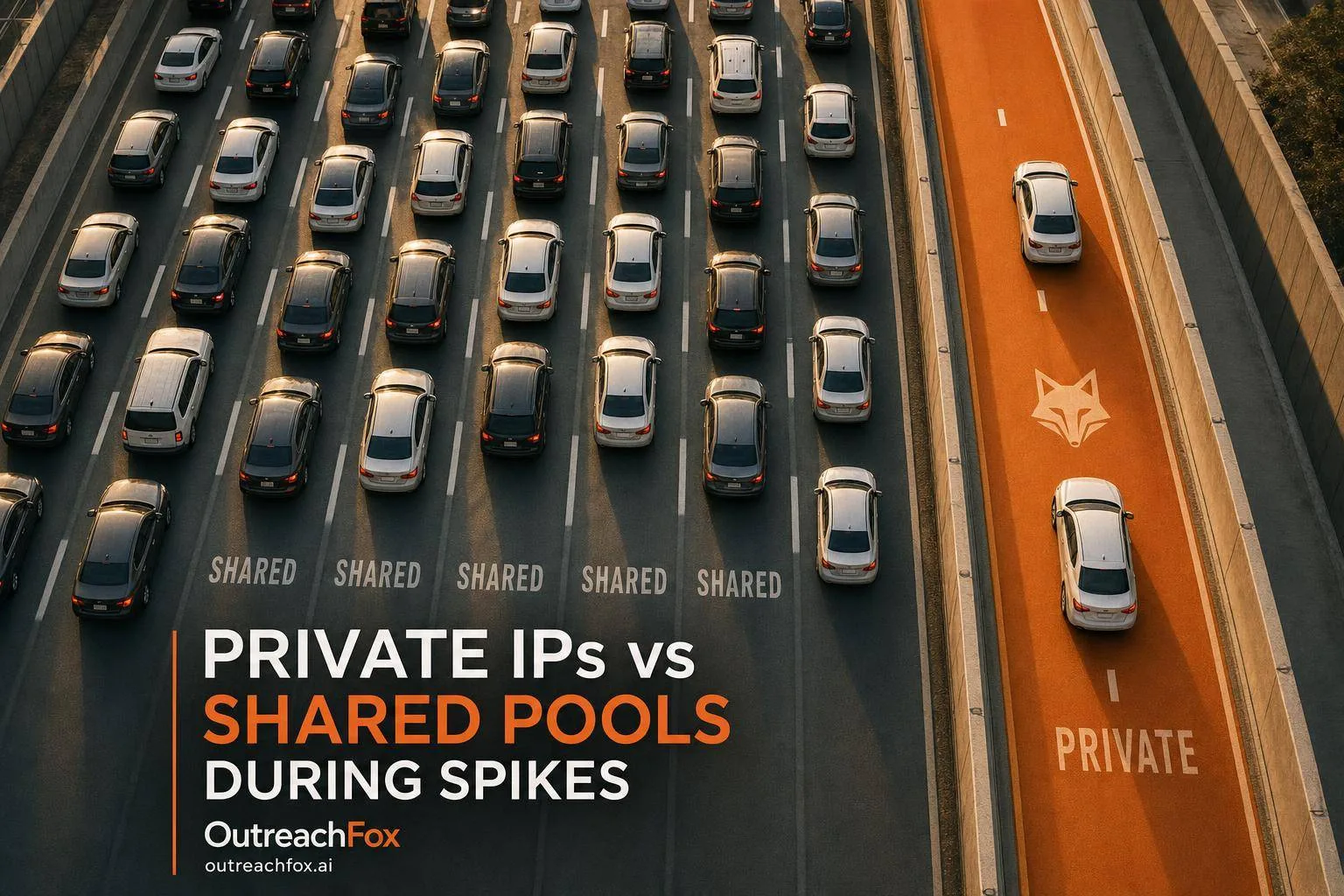
Private IPs keep reputation damage isolated to your campaigns during volume spikes, while shared pools spread risk across all senders, making troubleshooting harder and increasing spam-folder risk.
- Private IPs isolate reputation damage to your campaigns only during spikes
- Shared pools mix your deliverability with other senders' behavior and complaints
- Mailbox providers flag volume changes more than total volume itself
- Multiple accounts spiking simultaneously in shared pools amplify spam risk
- Private IPs make troubleshooting faster by eliminating cross-sender variables
- Agencies and GTM teams benefit from clearer attribution with private infrastructure
Private IPs vs Shared Pools During Spikes
If your send volume jumps, private IPs are usually the safer setup. They keep reputation problems tied to your own campaigns, while shared pools can spread risk across every sender on the same IPs.
Here’s the short version:
- Private IPs keep complaints, bounces, and poor ramping tied to your sending
- Shared pools mix your reputation with other senders
- During spikes, mailbox providers watch change in volume, not just total volume
- If multiple accounts spike at once in a shared pool, spam-folder risk can grow fast
- For agencies and GTM teams, private IPs make it much easier to see who caused the drop
A simple rule I’d use: if inbox placement affects pipeline or client results, I’d want isolation, cleaner tracing, and more control.
Cold Email Deliverability | Shared Vs. Dedicated IPs
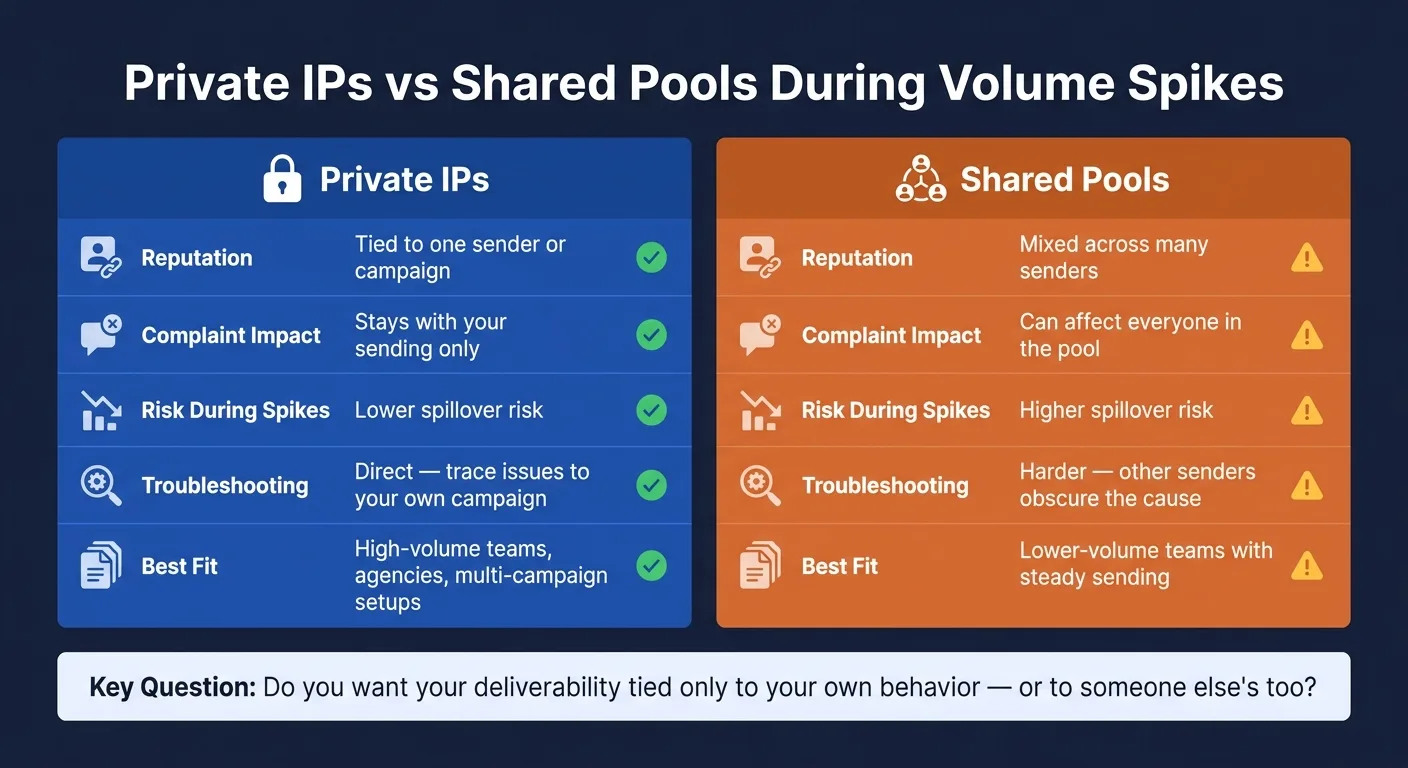
Quick Comparison
| Factor | Private IPs | Shared Pools |
|---|---|---|
| Reputation | Tied to one sender or campaign | Mixed across many senders |
| Complaint impact | Stays with your sending | Can affect everyone in the pool |
| Risk during spikes | Lower spillover risk | Higher spillover risk |
| Troubleshooting | More direct | Harder to trace |
| Best fit | High-volume teams, agencies, multi-campaign setups | Lower-volume teams with steady sending |
In short, this comes down to one question: do you want your deliverability tied only to your own behavior, or to someone else’s too?
How private campaign IPs behave during high-volume periods
A private campaign IP is used by one sender or for one campaign only. That setup keeps things separate. Inbox placement depends on your list quality, authentication, complaint rate, and how fast you ramp volume.
Reputation isolation keeps damage contained
When volume jumps, that separation helps keep problems contained. If complaint rates go up, or bounce rates climb and engagement drops, those signals stay connected to your sending only. Another sender can't hurt your reputation during that spike.
The flip side is simple: if your list is weak or your ramp is too aggressive, your IP takes the hit.
This also makes troubleshooting much cleaner. If something goes wrong on a private IP, the list of likely causes is short:
- your list
- your authentication
- your sending pattern
You don't have to guess whether an inbox placement drop came from your campaign or from someone else on the same setup.
Why private IPs are easier to manage during spikes
A spike can still create risk on private infrastructure. But it's easier to spot and fix because only your own sending pattern is under review.
Watch the signals that matter: list quality, complaints, bounces, engagement, authentication, and ramp speed. On a private IP, those metrics point straight back to your campaign. That makes it easier to find the issue, adjust the sending schedule, or cut volume and watch what changes.
Shared pools work the opposite way: your spike gets judged next to everyone else's behavior.
How shared warmup pools behave under stress
A shared warmup pool places several accounts on the same IPs under one combined reputation. The upside is simple setup. The downside is shared risk. When sending volume jumps, one sender can pull the whole pool down.
Composite reputation means another sender's behavior becomes your problem
Mailbox providers judge the pool as one unit, not as separate accounts. So every spam complaint, trap hit, or aggressive ramp from another sender affects the same reputation score your campaigns rely on.
That risk gets worse when several accounts ramp at the same time. That’s exactly the kind of pressure shared infrastructure takes during a spike. More concurrent volume means more chances for the pool’s combined sending pattern to get hit. And because the score is shared, figuring out what went wrong takes longer.
Why troubleshooting is harder on shared infrastructure
When open rates drop or emails start landing in spam, the first question is usually: what changed in this pool? On a private IP, the answer is often inside your own campaign. On a shared pool, it’s much harder to pin down because you can’t see what other senders are doing in their accounts.
You may not know if the drop came from your list, your timing, or another sender’s bad batch. That lack of visibility slows diagnosis and makes fixes harder to apply fast. Shared pools hide the source of the problem, which makes volume spikes tougher to control and recover from.
Private IPs vs shared pools: direct comparison during spikes
When sending volume jumps, the difference is pretty straightforward: private IPs keep damage contained, while shared pools can spread it around. You feel that gap fast when complaint rates shift or ramp speed changes in a short window.
| Factor | Private campaign IPs | Shared warmup pools |
|---|---|---|
| Complaint spread during spikes | Contained to one sender or campaign | Spreads across all senders on the same pool |
| Predictability under load | Still risky, but the damage stays tied to your own ramp and list quality | Less predictable; multiple accounts may spike at once |
| Traceability when performance drops | Higher; issues are easier to trace to your own sending | Weaker; reputation risk is shared across accounts |
Reputation spillover and spam complaint exposure
Private IPs keep the blast radius smaller. If your campaign drives complaints, your IP takes the hit and stops there. Other senders don't pay for your mistake, and you don't get dragged down by theirs.
Shared pools flip that setup. Liability is collective. If another sender on the same pool racks up complaints, trust can drop for everyone using that setup, including you.
That tradeoff is usually the deciding factor. If shared infrastructure feels fine at low stakes, it can feel a lot riskier once complaint pressure starts to build.
Control, predictability, and fit for high-volume campaigns
Shared pools make it easier to get started. That's the appeal. But as volume climbs, convenience matters less. When inbox placement affects pipeline, a shared pool can turn into a problem because reputation isn't controlled by one team.
Agencies and larger outbound teams usually need tighter control over deliverability. Private IPs keep reputation tied to one sender, which makes spikes easier to read, troubleshoot, and fix.
At that point, the choice comes down to control: the ease of shared pools, or the isolation that comes with private IPs.
Choosing the right model for your outbound team
After the load test, the choice comes down to one thing: who owns the risk.
When shared pools may still make sense
Shared pools aren't always the wrong move. If your team sends at a low, steady volume, the convenience can be worth it, especially when you don't need tight attribution.
But there's still a catch. In a shared pool, you don't control who else is sending or how their behavior shapes the environment around you. You're taking on outside risk, whether you want to or not. Once attribution starts to matter, that tradeoff looks very different.
When private infrastructure is the better choice
As volume goes up, or when you need clean attribution across campaigns, the math changes. Agencies running multiple client campaigns need to know exactly whose behavior affected deliverability. Shared pools make that a lot harder. The same goes for GTM teams that need clear ownership of deliverability.
Platforms like OutreachFox use dedicated campaign IPs and isolated warmup, so one sender's behavior never contaminates another sender's reputation.
Conclusion: Isolate your reputation before the next spike
When a spike hits, the main question is simple: is your reputation isolated or shared?
Shared pools are easier to get started with. Private IPs are safer when reputation matters. For teams that treat deliverability as core infrastructure, private IPs are the safer default.
Frequently asked questions
What happens to my email reputation when another sender in a shared pool spikes volume and gets complaints?+
In a shared warmup pool, mailbox providers judge all senders as one unit with a composite reputation. If another sender drives spam complaints or hits traps during their spike, the entire pool's trust score drops, which can hurt your inbox placement even if your own sending behavior is clean.
Why is troubleshooting deliverability drops harder on shared pools than private IPs?+
On a private IP, performance issues trace directly back to your list quality, authentication, or sending pattern. In a shared pool, you can't see what other senders are doing, so you don't know if the drop came from your campaign or someone else's bad batch, which slows down diagnosis and makes fixes harder to apply.
Do private campaign IPs eliminate deliverability risk during volume spikes?+
No, private IPs still carry risk if your list is weak or your ramp is too aggressive. The key difference is that reputation damage stays contained to your own sending, so another sender's mistakes won't drag you down and you can troubleshoot faster with clearer signals.
How do mailbox providers monitor sending behavior during a spike?+
Mailbox providers watch the change in volume, not just total volume. They track complaints, bounce rates, engagement drops, and how quickly you ramp up sends. On shared pools, if multiple accounts spike at once, the combined pattern can trigger spam folder placement faster.
When does it make sense for an agency or GTM team to use private IPs instead of shared pools?+
Private IPs become essential when you need clean attribution across multiple client campaigns or when inbox placement directly affects pipeline results. Agencies need to know exactly whose behavior caused a deliverability drop, which is nearly impossible to trace in a shared pool environment.
Can shared warmup pools still work for teams with steady, low-volume sending?+
Yes, shared pools can work for teams with low, steady send volume where tight attribution isn't critical. The convenience of easier setup may be worth the tradeoff, but you're still accepting outside risk from other senders' behavior that you can't control or monitor.
What specific metrics should I watch on a private IP during a volume spike?+
Monitor list quality, complaint rates, bounce rates, engagement metrics, authentication status, and ramp speed. On a private IP, these signals point directly to your campaign's health, making it easier to spot issues quickly and adjust your sending schedule before reputation damage worsens.