
In shared sending pools, one sender's bounces can hurt everyone's deliverability. Private infrastructure isolates reputation and keeps bounce risk contained to individual accounts.
- Shared pools blend bounce rates and complaints across multiple senders
- Private sending keeps your reputation isolated from other accounts' mistakes
- Hard bounces indicate invalid addresses while soft bounces are temporary
- Troubleshooting deliverability issues is easier with private infrastructure
- Agencies and revenue-critical campaigns benefit most from isolated sending
- Both shared and private setups still require proper warmup and authentication
Shared vs Private Sending: Bounce Risk
If one sender’s bad list can hurt your inbox placement, shared sending is the riskier setup. Bounce risk comes from two places: your list quality and the infrastructure you send on. In a shared pool, many accounts feed into the same reputation, so even a small bounce spike from another sender can affect you. In a private setup, the damage stays inside that sender’s own account.
Here’s the short version:
-
Shared pools mix reputation
- Bounce rates, complaints, and engagement signals are blended
- One sender’s bad data can hurt other senders
- Problems are harder to trace
-
Private sending keeps reputation separate
- Your mailboxes, domains, and IPs are tied to your account only
- Other senders’ mistakes do not spill into your setup
- Bounce problems are easier to link to your own list or campaign
-
Both setups still need good sending habits
- Hard bounces often mean invalid addresses
- Soft bounces often mean temporary delivery issues
- Warmup, list checks, SPF, DKIM, and DMARC still matter
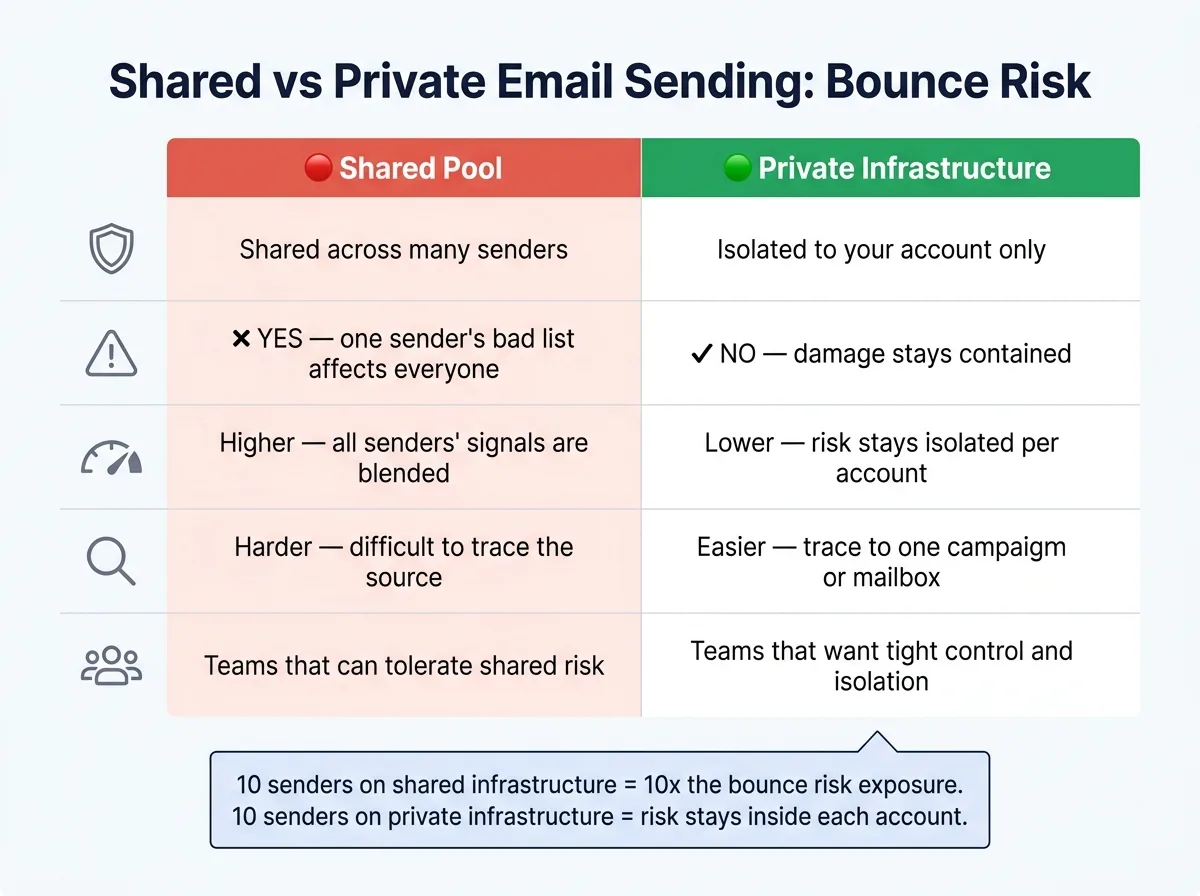
A simple way to think about it: if 10 senders share one reputation surface, each sender adds risk to the same pool. If those same 10 senders use separate infrastructure, one sender’s bounce problem stays contained instead of spreading across all accounts.
Cold Email Deliverability | Shared Vs. Dedicated IPs
Quick Comparison
| Factor | Shared Pool | Private Infrastructure |
|---|---|---|
| Reputation control | Shared across many senders | Limited to your account |
| Spillover risk | Yes | No |
| Bounce threshold pressure | Higher, because signals are mixed | Lower, because risk stays isolated |
| Troubleshooting | Harder | Easier |
| Best fit | Teams okay with shared risk | Teams that want tight control |
Bottom line: I’d choose private sending when inbox placement affects pipeline, client work, or any campaign where one account should not pay for another account’s mistakes.
Shared Warmup Pools: How Bounce Risk Spreads
In a shared sending pool, several senders use the same IPs. That means bounce rates, complaint rates, and engagement signals all get mixed into one reputation profile.
Here’s the problem: once those signals are blended, bounce thresholds can get hit faster and with a lot less warning. And it’s not just your own list driving the outcome. It’s everyone else in the pool too.
Reputation Contagion in Co-Mingled Infrastructure
When one sender puts bad data into the pool, their bounces and complaints pull down the shared reputation for everyone. In plain English, one client’s messy list can turn into another client’s deliverability issue.
That’s the risk with co-mingled infrastructure. You may do everything right and still feel the impact of someone else’s poor sending habits.
Why Troubleshooting Is Harder on Shared Systems
When performance drops, shared signals muddy the picture. It becomes hard to tell whether the issue came from your list or from another sender’s bounce spike.
You can see the pool slipping, but you can’t easily tell who pushed it over the threshold.
That shared blast radius is what private infrastructure removes.
Private Sending Infrastructure: How Bounce Risk Stays Contained
Private sending means your mailboxes, domains, and IPs belong to your account only. No other sender can chip away at your reputation.
Isolated Reputation and Clearer Accountability
With private infrastructure, your sender reputation reflects your behavior and nothing else. If bounce rates jump, the problem usually comes back to your list quality or how you're sending.
Each client's mailboxes and IPs stay separate, so one bad campaign doesn't spill over into another sender's deliverability. Hard bounces can still hurt that mailbox, but the damage stays contained. If one client has a data issue, it stays that client's issue.
That's why private systems usually decline in a more predictable way than shared pools.
The Tradeoff: Private Systems Still Require Warmup Discipline
Private infrastructure is not a free pass. A new domain or dedicated IP can still fail without warmup, list verification, and SPF, DKIM, and DMARC. Isolation shields you from other people's mistakes. It does not shield you from your own.
Warmup still matters. List verification still matters. Monitoring still matters.
OutreachFox uses this model with dedicated campaign IPs, pre-warmed mailboxes, and real-time bounce webhooks.
That containment becomes obvious when you compare how shared and private systems handle bounce thresholds.
Bounce Thresholds: How Shared and Private Risk Compare
The main issue isn’t whether bounces happen. They do. What matters is how much risk each setup can take before sender reputation starts to slip.
There’s no single bounce-rate cutoff for cold outbound. The bigger point is how the same bounce spike plays out on shared pools versus private infrastructure.
Shared pools hit trouble sooner because every sender’s bounces feed into the same reputation surface. If one account sends to a bad list, others can feel it too. Private infrastructure doesn’t make bounces disappear. It just limits who takes the hit.
Hard Bounces vs Soft Bounces
Hard bounces usually point to invalid addresses. Soft bounces mean temporary delivery issues.
With private infrastructure, that signal is easier to read. If bounce rates jump, it’s simpler to tie the issue back to your own list, mailbox, or campaign instead of guessing whether another sender played a part.
Comparison Table: Shared Pools vs Private Infrastructure
| Factor | Shared Pool | Private Infrastructure |
|---|---|---|
| Reputation control | Shared across senders | Isolated to your account |
| Cross-account spillover | One sender's poor list data can affect others | No spillover to other customers |
| Troubleshooting clarity | Harder to trace the source | Easier to isolate to one campaign or mailbox |
| Best for | Teams that can tolerate shared risk | Teams that want tighter control and isolation |
That’s why bounce threshold tolerance matters more in shared pools than in private systems.
When Private Sending Is the Safer Choice
The real cutoff is spillover. Once one sender can push the whole pool close to a bounce threshold, private sending is the safer move.
Here’s the issue: when one sender’s bounces or complaints can affect other accounts, shared setup stops being efficient and starts being risky. One client’s bad data can turn into everyone else’s deliverability problem.
That matters most in multi-account setups and high-stakes outbound, where a small hit can carry a big cost.
Use Cases That Fit Isolated Sending
Agencies managing multiple client campaigns need each account’s bounces and complaints contained. One client’s list problems should never bleed into another client’s sender reputation.
Go-to-market teams that rely on steady inbox placement and bounce rates often get more control from private sending, especially when outbound is tied directly to revenue.
Enterprise prospecting or revenue-critical campaigns are a poor fit for shared risk. When deal flow is on the line, the cost of spillover goes up fast, and shared infrastructure can’t promise that the damage stays with the sender who caused it.
OutreachFox uses private, isolated sending environments with dedicated campaign IPs and separate warmup. That’s the whole point of isolated infrastructure: keep each account’s risk inside its own boundary.
Choose private sending when account-level isolation matters more than shared efficiency.
Frequently asked questions
Can one sender's high bounce rate in a shared pool actually hurt my inbox placement?+
Yes. In a shared pool, bounce rates, complaints, and engagement signals from multiple senders are blended into one reputation profile. When one sender puts bad data into the pool, their bounces can pull down the shared reputation and affect your deliverability, even if your own list quality is good.
Why is troubleshooting deliverability problems harder on shared sending infrastructure?+
On shared systems, you see blended signals from all senders using the same IPs. When performance drops, it's difficult to determine whether the issue came from your own list or from another sender's bounce spike. The shared signal makes it hard to isolate the root cause and tell who pushed the pool over the threshold.
Does private sending infrastructure eliminate the need for warmup and list verification?+
No. Private infrastructure isolates you from other senders' mistakes but does not shield you from your own poor sending habits. You still need proper warmup, list verification, SPF, DKIM, DMARC, and monitoring to maintain good deliverability.
How does the same bounce spike affect shared pools differently than private infrastructure?+
Shared pools hit trouble sooner because every sender's bounces feed into the same reputation surface, so bounce thresholds get reached faster. With private infrastructure, bounce problems stay contained to the specific sender's account and don't spill over to affect other senders.
When should an agency choose private sending over shared infrastructure for client campaigns?+
Agencies should choose private sending when managing multiple client campaigns where one client's list problems could damage another client's sender reputation. Private infrastructure keeps each account's bounces and complaints contained, preventing cross-account spillover and making it easier to maintain separate reputation profiles for different clients.
What is the main difference between hard bounces and soft bounces in relation to sender reputation?+
Hard bounces usually indicate invalid email addresses and signal permanent delivery failures, while soft bounces represent temporary delivery issues. With private infrastructure, it's easier to read these signals and tie bounce rate increases back to your specific list, mailbox, or campaign rather than wondering if another sender contributed to the problem.