There's no confirmed 2026 LinkedIn hard cap. Focus on acceptance rate, pending invites, and reply quality to determine safe daily volume for invites, views, and messages.
- No confirmed 2026 hard caps exist; safe volume beats guessed limits.
- Watch acceptance rate, pending invites, and reply quality as risk signals.
- New accounts need lower volume; mature accounts can handle more activity.
- Spread outreach across multiple seats treating each as a separate risk unit.
- Keep activity steady and reduce volume when performance metrics start slipping.
- Profile views and messages should align with actual outreach conversations.
LinkedIn Limits 2026: Daily Caps and Safe Range
If you want to keep a LinkedIn account usable in 2026, don’t chase the max. I’d stay below any claimed cap, keep daily activity steady, and watch three signals: acceptance rate, pending invites, and reply quality.
Here’s the short version:
- There is no confirmed 2026 hard cap in the source text
- Safe volume matters more than guessed limits
- Invites should be paced based on acceptance rate and pending growth
- Profile views should match normal outreach, not come in spikes
- Messages and follow-ups should stay tied to live conversations
- New accounts should do less; older accounts can do more
- Each LinkedIn seat should be treated as its own risk unit
In other words, I wouldn’t ask, “What’s the most I can send?” I’d ask, “When do my numbers start to drop?” If acceptance falls, pending invites stack up, or replies get short and weak, that’s usually the point where volume is too high.
A simple way to read it:
| Area | What I’d watch | What it may mean |
|---|---|---|
| Invites | Acceptance rate, pending invites | Volume may be too high |
| Profile views | Sudden spikes | Activity may look off |
| Messages | Reply rate and reply quality | Outreach may be losing traction |
| Account setup | Account age, seat-by-seat activity | Newer seats need lower volume |
Bottom line: LinkedIn outreach tends to work better when activity is steady, spread across seats, and kept below the point where response quality starts to slip.
LinkedIn Daily Limits Explained (Stay Safe & Scale)
2. Daily Caps by Action Type
The confirmed 2026 limits are not in the sources provided. So instead of chasing a hard cap that may or may not be right, focus on the part that matters more in practice: when performance starts to slip.
That means watching what happens as activity goes up. If acceptance rates dip, pending invites pile up, or replies get thinner and less useful, that’s your warning sign. In plain English, the safer move is to test volume based on how the account responds under load.
Connection invites: weekly cap and daily pacing
For connection invites, use acceptance rate and pending invites as your main signals.
If pending invites are growing faster than accepted invites, that usually means you’re pushing too hard. At that point, cut volume and give the account some room. A steady pace tends to work better than sending in bursts.
Profile views: free, Premium, and Sales Navigator ranges
Keep profile views steady and connected to active outreach.
In other words, view profiles as part of a normal workflow, not as random spikes of activity. Bursty behavior can look off. A smoother pattern is easier to manage and lines up better with actual prospecting.
Messages and follow-ups: platform allowance vs. safe volume
For messages and follow-ups, stick to active conversations.
If reply quality starts to drop, or you see more rejections, take that as the signal to slow down. Those shifts matter more than any guessed-at platform allowance. When the pattern turns, pause or reduce activity before the account gets pushed too far.
3. Acceptance Patterns and Risk Signals
Once volume starts to climb, the account begins to show what it can handle. And here’s the catch: the same signals can mean one thing on a new account and something else on a mature one.
The main job is to watch the trend, not chase some fixed ceiling. If acceptance starts to drop, pending invites keep piling up, and replies get thinner, that usually means volume has gone too far.
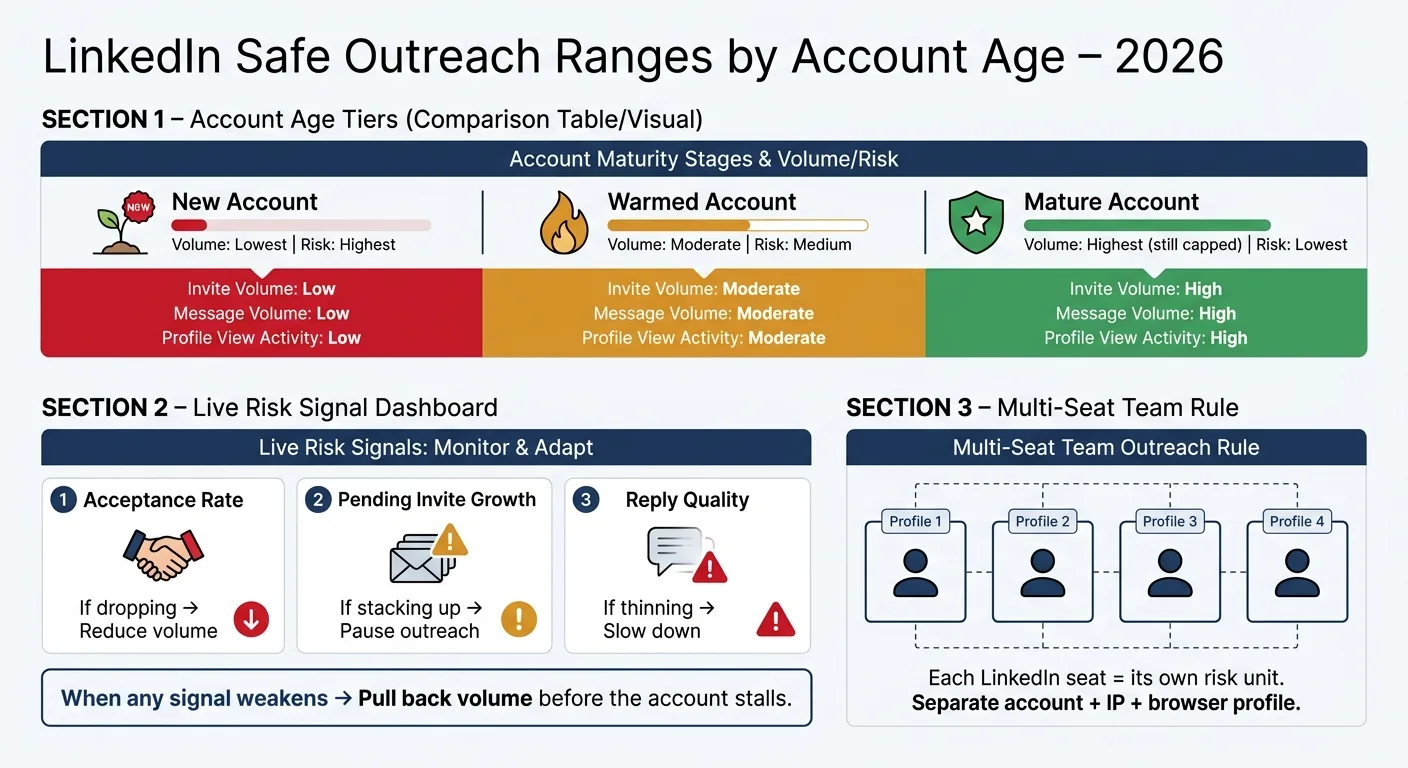
Use these as your live risk signals:
- acceptance rate
- pending-invite growth
- reply quality
When any of those starts to weaken, pull volume back before the account begins to stall.
4. Safe Ranges by Account Age and Team Setup
Those risk signals matter more when you look at seat age.
New, warmed, and mature account ranges
Don't push every LinkedIn seat to the same volume. Scale by account age, not by one team-wide cap.
Here's the simple version:
- New accounts: lowest volume
- Warmed accounts: moderate volume
- Mature accounts: highest volume, but still capped
That setup works only when each seat stays isolated.
How outbound teams should spread volume across seats
Multi-seat teams should treat each profile as its own operating unit, not as extra room for one account. In plain English, each LinkedIn profile is a separate risk unit.
So instead of loading up one profile, spread activity across seats that have been warmed the right way. That helps make sure no single profile turns into the bottleneck or the point of failure.
Each seat should also have its own account and IP, plus separate browser profiles. That keeps outbound activity spread out and makes the team less dependent on the health of any one account.
5. Conclusion: Running LinkedIn Outbound Safely in 2026
The safe way to run LinkedIn outbound in 2026 is simple: stay under hard caps and manage based on acceptance rate, pending invites, and reply quality.
Keep your invites, profile views, messages, and follow-ups steady. The moment acceptance drops or reply quality starts to slip, slow things down.
That’s the practical standard if you want to avoid restrictions and still keep your outreach volume usable.
Frequently asked questions
What are the three key signals to watch for LinkedIn outreach volume in 2026?+
The three signals are acceptance rate, pending invites, and reply quality. If acceptance falls, pending invites stack up, or replies get short and weak, that usually indicates volume is too high and should be reduced.
Should new LinkedIn accounts send the same daily volume as older accounts?+
No, volume should be scaled by account age. New accounts should use the lowest volume, warmed accounts can handle moderate volume, and mature accounts can use the highest volume while still staying within safe limits.
How should multi-seat teams structure their LinkedIn outreach activity?+
Each LinkedIn profile should be treated as its own separate risk unit with its own account, IP, and browser profile. Instead of loading up one profile, teams should spread activity across properly warmed seats to avoid creating bottlenecks or single points of failure.
What does it mean when pending invites are growing faster than accepted invites?+
This indicates you're pushing too hard with connection requests. When pending invites pile up relative to acceptances, it's a clear warning sign to cut volume and give the account some room to recover.
Why should profile views stay steady rather than coming in spikes?+
Bursty or spiked viewing behavior can look off to LinkedIn's systems. Steady profile views that align with normal outreach workflows are easier to manage and better match genuine prospecting activity, reducing the risk of restrictions.
When should you reduce message volume on LinkedIn?+
Reduce message volume when reply quality starts to drop or you see more rejections. These shifts in engagement patterns matter more than any theoretical platform allowance and indicate you should pause or reduce activity before pushing the account too far.