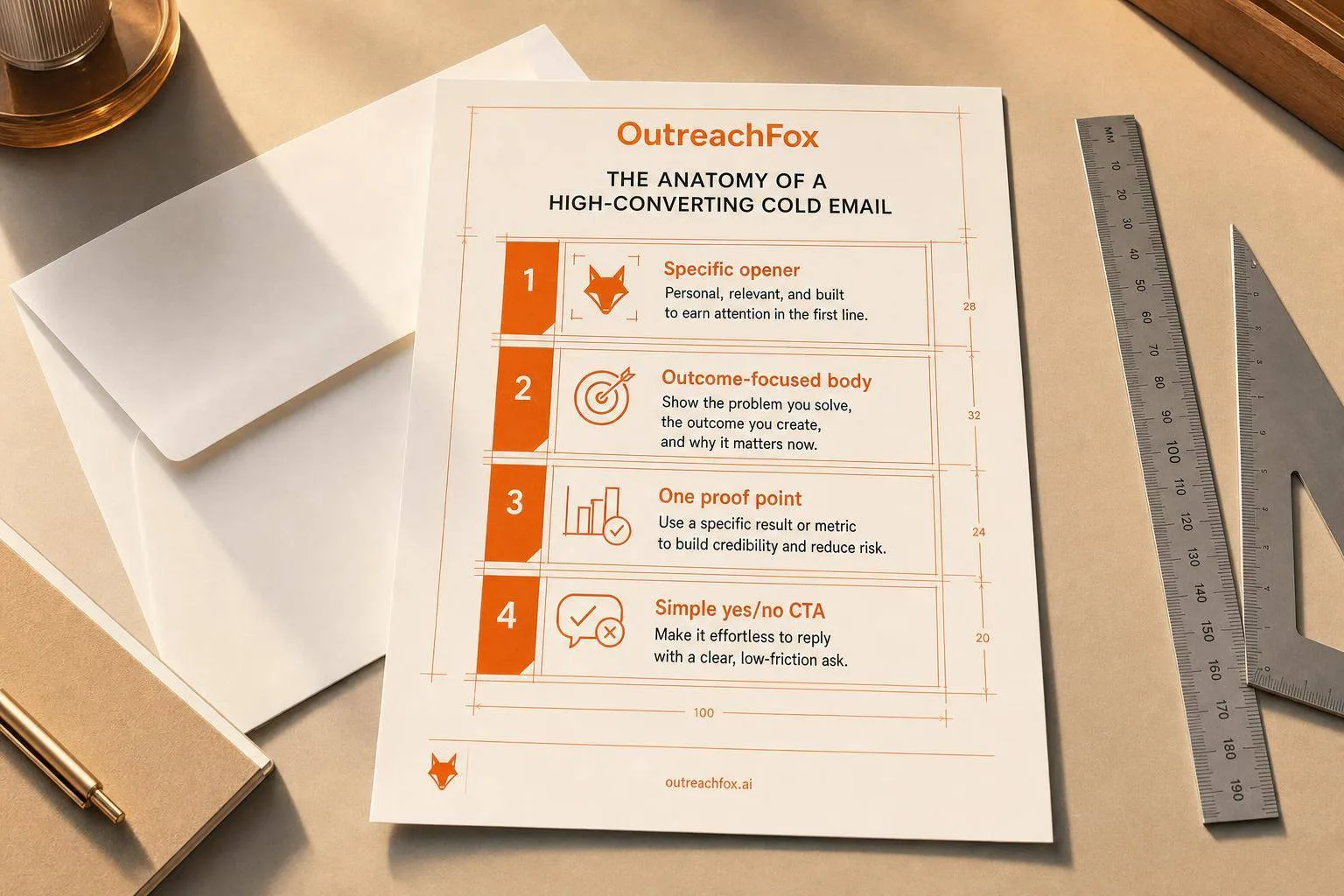
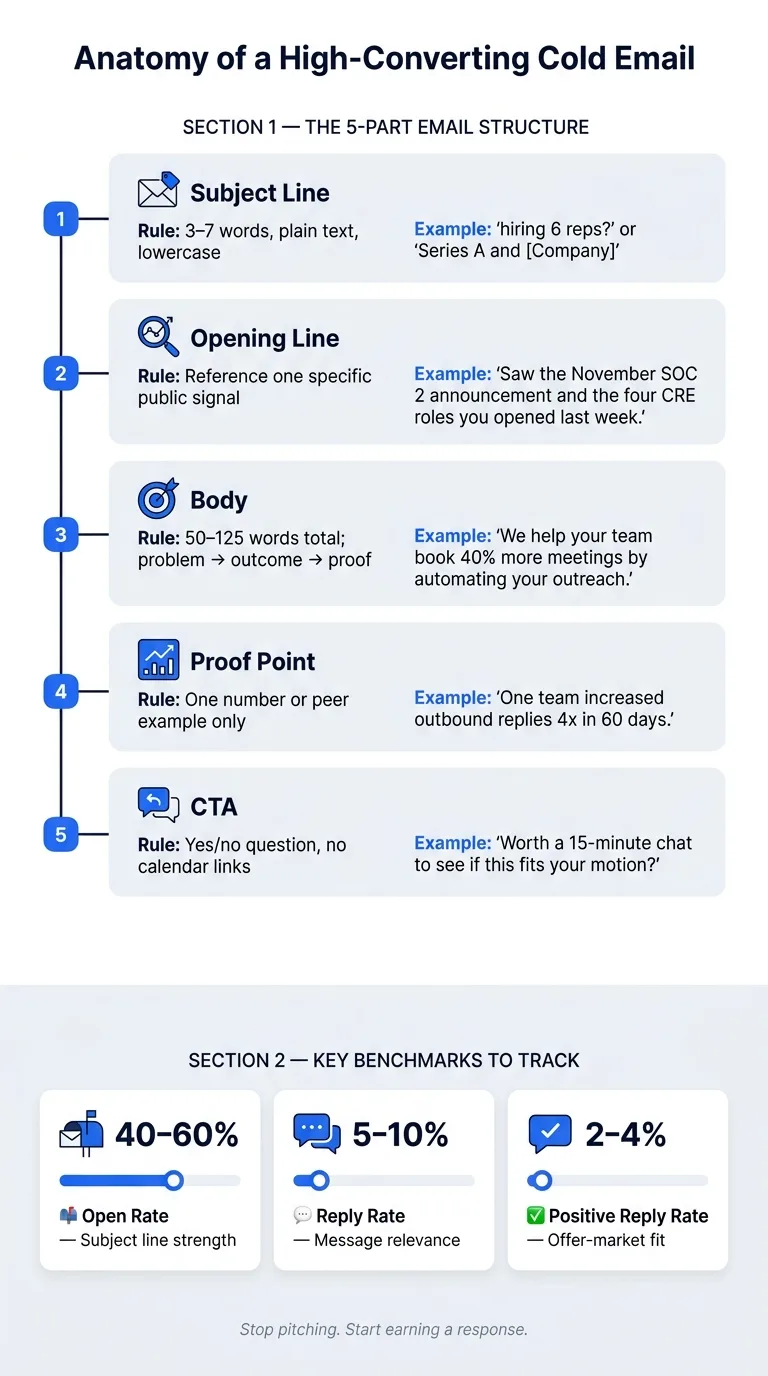
High-converting cold emails use five parts: a 3-7 word subject line, a research-based opener, outcome-focused body copy, one proof point, and a yes/no CTA—all in 50-125 words.
- Keep subject lines to 3-7 words using specific triggers, not generic pitches
- Open with a public signal like funding or hiring to prove manual research
- Focus body copy on business outcomes, not features, in 50-125 words maximum
- Use one proof point with a specific number or peer example only
- Ask for a yes/no reply instead of requesting a meeting or demo
- Target 40-60% open rate, 5-10% reply rate, and 2-4% positive reply rate
The Anatomy of a High-Converting Cold Email: Structure, Copy, and Real Examples
Most cold emails fail because they talk about the sender, not the reader. If I want more replies, I need a short email with five parts: a subject line that gets opened, an opening line tied to a public signal, a clear outcome, one proof point, and a simple reply ask.
Here’s the full takeaway in plain English:
- Subject line: keep it to 3–7 words
- Opening line: show I looked at something specific
- Body: connect a problem to a business result
- Proof: use one number or peer example
- CTA: ask for a yes/no reply, not a meeting
- Length: stay between 50 and 125 words
The article also points to three numbers I should track:
- Open rate: 40–60%
- Reply rate: 5–10%
- Positive reply rate: 2–4%
In other words: if my cold email does not feel personal in the first few seconds, it will likely get ignored. If it feels specific, short, and easy to answer, I have a much better shot at a reply.
The core idea is simple: I should stop pitching in the first email and start earning a response.
How To Write The Perfect Cold Email
Subject Lines That Get the Email Opened
A subject line has one job: earn the open.
After that, the email gets a chance to work. But first, the subject line has to clear the next gate. And it helps to think about it the right way: a subject line is not a headline. It’s a relevance filter.
If it matches something the prospect is dealing with right now - a new hire, a pipeline issue, a recent funding round - they’re more likely to open it. That’s why relevance beats cleverness every time. The goal isn’t to sell the offer in the subject line. It’s to make the message feel worth opening.
Most subject lines get read on mobile, so short wins. Aim for 3–7 words, use plain text, and skip gimmicks. Plain lowercase can help the email feel more like a direct message and less like a campaign.
Subject Line Formulas That Sound Like Email
The best subject lines tie back to a trigger the prospect already cares about. Start there. A few patterns that work:
- [Trigger] at [Company]:
Series A and [Company] - [Metric] on [Topic]:
[Company] CAC question - [Role] and [Initiative]:
hiring 6 reps? - [Specific Reference]:
routing rules for inbound from Plaid signups
These work because they sound like they were written for one account, not blasted to a list. A simple test helps here: if the subject line still works after you swap out the company name, it’s probably too generic.
Weak vs. Strong Subject Lines: Side-by-Side
Here are subject lines that feel like one-to-one email, not campaign copy.
| Weak Subject Line | Strong Alternative | What's Wrong / Right |
|---|---|---|
| "Quick question" | "{{company}} hiring 3 AEs" | Weak: spam signal. Strong: tied to a real hiring trigger. |
| "Better CRM tool" | "[Competitor] -> [Your Company]" | Weak: generic product pitch. Strong: shows a real account trigger. |
| "Increase revenue fast" | "Series A and {{company}}" | Weak: sounds like spam. Strong: references a specific milestone. |
| "Software question" | "Your Clearbit integration" | Weak: vague. Strong: proves technical relevance. |
| "Save money now" | "{{company}} CAC question" | Weak: sounds like spam. Strong: points to a metric the prospect will recognize. |
Two patterns are worth cutting completely: "Re:" and "Fwd:" on a first-touch email. Prospects spot the trick right away, and trust takes a hit before the body of the email even loads.
It also helps to stay away from bait-style language like "free", "guarantee," or "limited time."
Next, the opening line has to prove the email was written for this prospect.
Openings That Show You Did Your Research
Use a clear public signal to show the email was written for this person. That could be a funding announcement, a job post, a product launch, a LinkedIn post, a podcast appearance, a keynote, or a move off HubSpot.
The point is simple: use public signals, not praise. That proves relevance fast.
Write the First Line About the Prospect, Not Yourself
A good opener usually follows a simple flow: personalized observation, situational insight, then a bridge to business value.
Start with something real you noticed. Then connect it to the kind of problem that often comes next. After that, tie it to why your message matters right now.
What usually falls flat is empty flattery. Lines like "I've been following your work" or "I noticed your company is doing exciting things" sound generic. Most people read them and think: mass email.
Here's an easy test. Swap the recipient's name and company with someone else's. If the line still works, it's too generic.
A specific opener should break when you swap the details, because it was built around that person's actual situation.
Here’s what that looks like in practice.
Generic Openings vs. Specific Research: Before and After
Weak openers stay vague. Strong ones point to a specific signal.
| Generic Opening | Specific Rewrite | Why It Works |
|---|---|---|
| "I hope this finds you well. I noticed your company is doing exciting things." | "Saw the November SOC 2 announcement and the four CRE roles you opened last week." | Points to specific, verifiable public signals that show manual research. |
| "My name is Alex and I'm reaching out to introduce our platform." | "Noticed your team is hiring BDRs - looks like you're scaling outbound." | Starts in the prospect's world, not the sender's. |
| "I came across your website and thought we could help you grow." | "Saw your recent LinkedIn post - your take was spot on." | Refers to a specific piece of public content and shows it was read. |
| "I'm following up to see if you have 15 minutes for a demo." | "Saw you recently moved off HubSpot based on your G2 review - interesting timing." | Uses a real trigger event to create immediate relevance. |
Specific openers tend to lift reply rates because they show manual research. Openers that mention the recipient's company, a specific product or feature, and a concrete number - like headcount, funding amount, or recent hires - tend to beat generic versions.
Once your opener shows relevance, the next paragraph has to turn that relevance into business impact.
How to Write the Body: Problem, Value, and Proof in 50–125 Words
Once your opener gets attention, the body has one job: move the prospect from “this is about me” to “this could help me.” A simple three-part flow works best: problem, outcome, proof. That gives the body a clear task: turn attention into a business result the prospect can see.
Keep the body between 50 and 125 words. In many cases, shorter emails beat longer ones when the offer is the same. A short body is easier to scan, easier to read on mobile, and easier to reply to. Every extra sentence adds drag.
Cut any sentence about you, your company, or your product. If the email falls apart without those lines, rebuild it around the prospect instead.
Rewrite Feature Lists as Business Outcomes
Keep most of the body focused on the prospect’s problem and the result they want. At most, include one capability detail.
Here’s the switch from product language to buyer language:
| Feature-Centric Copy | Outcome-Centric Rewrite | Why It Works |
|---|---|---|
| "Our platform utilizes AI-driven algorithms for multi-channel engagement." | "We help your team book 40% more meetings by automating your outreach." | More replies, less manual work |
| "We offer a comprehensive CRM integration with automated sequencing." | "Cut your SDR ramp time from 5 months to 11 weeks." | Faster campaign launch, cleaner handoff |
| "We are a leading provider of lead generation services." | "We helped [Peer Company] add $2M in new revenue in 6 months." | Predictable pipeline growth |
The pattern is simple: don’t describe the tool, describe what changes for the buyer. That’s the part they care about.
Annotated Before-and-After Body Rewrites
Here’s a simple before-and-after example:
Before (feature-centric):
"Our platform utilizes AI-driven algorithms for multi-channel engagement. We offer a comprehensive CRM integration with automated sequencing."
After (outcome-centric):
"We help your team book 40% more meetings by automating your outreach. One team increased outbound replies 4x in 60 days."
What changed:
- Cut: Feature language and platform descriptions
- Kept: The business outcome and one quantified proof point
- Shortened: Compact enough to read quickly on mobile
Use one proof point only. Match that proof point to the problem you raised in the opener, and say it in plain English. Once the value is clear, the CTA should ask for a small next step.
CTAs, Length, and Tone That Drive Replies
Once the body has done its job and sparked interest, the CTA, length, and tone decide what happens next. At that point, the close shouldn't add work. It should make replying feel easy.
Low-Friction CTAs That Make Replying Easy
The first email is there to get a reply, not to book a meeting. That one shift changes the way you write the last line.
A high-friction CTA like "Book a 30-minute demo on my calendar here: [Link]" asks a stranger to give up time before they've even decided whether you're worth hearing out. A low-friction CTA does something simpler. It asks for permission to keep the conversation going, in a way the prospect can answer in under 10 seconds from their phone.
The formats that tend to work best are yes/no questions and simple reply prompts. "Worth a 15-minute chat to see if this fits your motion?" is easy to answer. "Should I send you a 2-minute video walkthrough?" asks for almost no commitment. Both work for the same reason: they ask for a reply, not a calendar decision.
Skip Calendly links and other booking tools in the first email. It can feel like you're setting up your schedule instead of respecting theirs. Also, don't stack multiple asks in one close. Give people two choices, and they may choose neither. One ask, one reply.
A Rewrite Checklist for Emails That Are Not Getting Replies
If a sequence isn't getting replies, check each email before you send the next round:
| Email Section | Common Problem | Specific Rewrite Action |
|---|---|---|
| Subject Line | Generic or salesy (e.g., "Quick Question") | Shorten to under 5 words; use a specific detail (e.g., "[Company] + [Outcome]") |
| Opening Line | Self-focused (e.g., "My name is...") | Reference one specific, researched detail about the prospect's recent activity |
| CTA | High-friction ask (e.g., 30-min demo link) | Swap for a low-friction reply prompt (e.g., "Worth a quick look?") |
After the ask, keep the wording plain and direct. Write like a colleague, not a campaign. Use plain text. Keep sentences short. Stick to simple words. Cut jargon like "utilize" and "facilitate." Short words and short sentences also make it easier to stay in that 50–125-word range. If a line sounds like it belongs in a press release, cut it.
A simple test helps here: delete every sentence about you, your company, or your product. If the email still speaks to the prospect's situation, you're on the right track. If it falls apart, build it again around the prospect's problem.
Conclusion: The Simple Structure Behind More Replies
The same pattern sits behind almost every reply. High-converting cold emails get the open, show relevance fast, tie the message to a clear outcome, and make it easy for the reader to respond. The structure is simple: subject line, personalized opener, value, proof, and a binary CTA.
Once that structure is set, the next step is measurement. Open rate tells you how strong the subject line is. Reply rate shows whether the message connects. Positive reply rate shows whether the offer matches what the prospect wants. Track all three: open rate, reply rate, and positive reply rate. Strong benchmarks are 40–60%, 5–10%, and 2–4%.
One solid rewrite can turn into the template for every sequence you send. When one version keeps performing best, make it your default template.
Frequently asked questions
What are the five required parts of the high-converting cold email structure described in this article?+
The five parts are: a subject line of 3-7 words that gets opened, an opening line tied to a specific public signal about the prospect, a clear business outcome in the body, one quantified proof point, and a simple yes/no reply ask instead of a meeting request.
Why does the article recommend against using 'Re:' or 'Fwd:' in cold email subject lines?+
The article states that prospects immediately recognize these as tricks on a first-touch email, which damages trust before the recipient even reads the email body. These prefixes are spam signals that hurt credibility rather than increase open rates.
What's the difference between the 'generic opening' and 'specific research' examples shown in the article?+
Generic openings use vague flattery like 'I noticed your company is doing exciting things' that could apply to anyone. Specific openings reference verifiable public signals like funding announcements, job postings, LinkedIn posts, or product launches that prove the email was written for that particular prospect.
What benchmark reply rates should you expect from a well-executed cold email campaign according to this article?+
The article provides three benchmarks: 40-60% open rate, 5-10% reply rate, and 2-4% positive reply rate. These numbers help measure whether your subject lines, message relevance, and offer quality are working effectively.
Why does the article recommend using a yes/no question instead of a calendar link in the CTA?+
Calendar links create high friction by asking strangers to commit time before deciding if you're worth hearing out. A yes/no question can be answered in under 10 seconds from a phone and asks for permission to continue the conversation rather than demanding a schedule commitment.
How does the article suggest you test whether your opening line is specific enough?+
Swap the recipient's name and company with someone else's details. If the opening line still works after the swap, it's too generic. A truly specific opener should break when you change the details because it was built around that particular person's actual situation.
What is the recommended word count range for the entire cold email body in this article?+
The article recommends keeping the body between 50 and 125 words. Shorter emails tend to perform better because they're easier to scan, easier to read on mobile devices, and easier to reply to quickly.