
Shared warmup pools expose your sender reputation to other users' mistakes, causing unstable deliverability and higher domain costs. Private warmup infrastructure isolates your reputation and gives you full control.
- Shared warmup pools mix your reputation with unknown senders who can trigger spam complaints
- Private warmup can cut domain replacement from 18% to under 8% monthly
- Bad IP reputation from shared pools can drop deliverability to 30-50% of normal
- Inbox placement swings 13%+ weekly on shared systems even when you change nothing
- Private infrastructure makes troubleshooting easier by isolating reputation to your sending behavior
- One agency saved over $2,000 monthly after switching from shared to dedicated infrastructure
Why Shared Warmup Pools Hurt Deliverability
Shared warmup pools can hurt your inbox placement before you even start sending at scale. If you use a pool with other senders, their complaints, bounces, or blocklist hits can affect your mail too.
Here’s the short version:
- Shared pools mean shared risk.
- Private warmup keeps reputation tied to your own mailboxes, domains, and IPs.
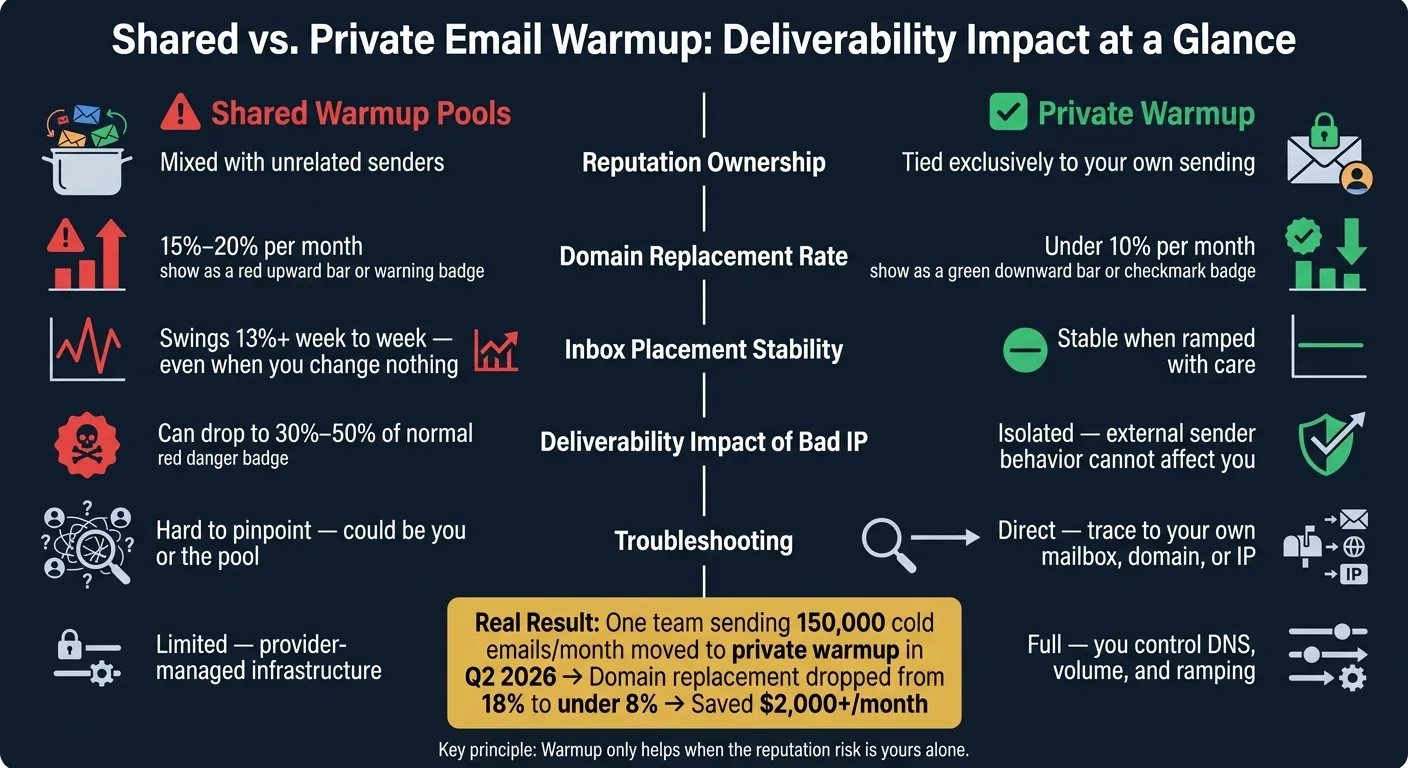
- Shared setups can push domain replacement to 15%–20% per month, while private setups can stay below 10%.
- Inbox placement can swing by 13%+ week to week on shared systems, even when you changed nothing.
- A bad IP listing can cut deliverability to 30%–50% of normal.
- In one Q2 2026 move, a team sending 150,000 cold emails per month cut domain replacement from 18% to under 8%, saving more than $2,000/month after moving off shared infrastructure.
If I had to sum it up in one line: warmup only helps when the reputation risk is yours alone.
Hidden Dangers of Email Warmup – How to Protect Your Email Deliverability!
Quick Comparison
| Factor | Shared Warmup Pools | Private Warmup |
|---|---|---|
| Reputation | Mixed with other senders | Tied to your own sending |
| Main risk | Other users can hurt your deliverability | Your results depend on your own setup |
| Troubleshooting | Hard to pinpoint the cause | Easier to trace mailbox, domain, or IP issues |
| Scaling | More exposure as volume grows | More stable when ramped with care |
| Domain replacement | Often 15%–20%/month | Often under 10% |
| Control | Limited | High |
So if your deliverability keeps moving up and down for no clear reason, the problem may not be your copy or volume. It may be the shared warmup system under it.
How shared warmup pools work
Shared warmup pools connect unrelated mailboxes into one automated network. Inside that network, accounts trade opens, clicks, replies, and inbox moves to mimic engagement before live outreach starts.
Here’s the catch: those accounts send automated messages to other accounts in the same pool. That setup is what turns warmup into shared exposure.
The trust created here lives inside the pool, not with prospects.
Pooled mailboxes share reputation exposure
When senders use shared infrastructure, one bad stretch can spill over to everyone else. A spike in complaints, a surge in bounces, or a blocklist hit can hurt the whole pool.
If an IP-level listing happens, every sender on that shared route can get blocked. Once reputation is shared, one sender’s mistake can become everyone’s problem. It’s a bit like riding in a carpool where one person’s crash puts every passenger behind schedule.
Warmup signals only work when they look credible
Inbox providers like Google and Microsoft don’t just count opens and replies. They look at patterns too. They check for past contact, timing behavior, and whether actions line up with how real people act.
Shared warmup networks break down on almost all of those checks. Mailboxes in the pool mostly exchange emails with each other, which creates a closed loop that providers can spot. On top of that, automated tools often act on machine-like timing, opening, reading, and replying at intervals no human would keep up with.
There’s also a content mismatch issue. Warmup services tend to use generic messages that don’t look like real outreach. Then, when you switch from warmup content to actual cold emails, the jump in messaging patterns and engagement rates can trip aggressive spam filters.
Shared pools depend on artificial engagement, and inbox providers can spot that pattern. That’s why deliverability can get shaky at scale.
How shared pools damage deliverability
Once the pool is shared, the trouble often starts at the IP layer. If the IP has a bad reputation, your mail can get blocked before domain reputation even comes into play. That means you can follow every best practice and still get shut out because someone else on the same pool made a mess.
Bad sender behavior spreads through the pool
Major blacklists like Spamhaus and Barracuda work at the IP level. So when one sender causes a bounce spike, a wave of complaints, or a spam-trap hit, that shared IP can get listed.
And when send spikes on a shared IP resemble spam bursts, the penalty doesn't stay neatly contained. It can hit everyone using that route. Shared tracking domains can run into the same issue. If they pick up a bad reputation, delivery can slip there too.
Reputation becomes unstable and hard to trace
This is where teams lose time. They start changing copy, rewriting sequences, and testing new hooks when the real issue sits in the infrastructure.
When opens drop or messages start landing in spam, new messaging angles won't fix a shared IP problem.
The symptoms can be easy to miss at first:
- Inbox placement swings by 13% or more week to week even though you changed nothing on your side
- Recovery can take 1–4 weeks because the shared IP has to clear the bad signal
- Warmup dashboards may show high inbox-placement rates that reflect performance only inside the artificial warmup network, not how actual mailbox providers treat your live outreach
Shared infrastructure makes reputation shaky, and teams can't fully control it or diagnose it cleanly. Private warmup removes that shared failure point.
Why private warmup is safer
Private warmup removes the shared failure point. When your mailboxes and sending IPs belong to you alone, every bounce, complaint, and engagement signal points back to your own sending behavior. Not someone else's mess. Not a noisy neighbor on the same system. Just you.
Isolated infrastructure keeps reputation ownership clear
On a dedicated IP, reputation comes from your sending behavior alone. That separation has measurable effects.
In one Q2 2026 migration, an AI automation agency sending 150,000 cold emails per month moved from shared SMTP infrastructure to dedicated Microsoft 365 tenants. After the switch, domain replacement rates dropped from 18% to under 8%, which saved the agency more than $2,000 per month.
OutreachFox is built around this idea. Every customer gets a private, isolated sending setup with dedicated campaign IPs that are never co-mingled.
Private warmup supports cleaner scaling for agencies and GTM teams
For agencies, isolation helps keep clients separate. For GTM teams, it makes deliverability issues much easier to trace.
If one client has poor list hygiene, that problem doesn't spill into other accounts when each one runs on its own dedicated setup. And when deliverability drops on private infrastructure, the source is easier to spot. Maybe it's a bounce spike from a bad list segment. Maybe it's a complaint cluster tied to one sequence. Either way, you can fix the issue directly instead of waiting on a shared provider to sort things out.
That only works when authentication, mailbox quality, and ramping are controlled.
What a reliable private warmup setup needs
Authentication, clean mailboxes, and controlled ramping
Once your infrastructure is isolated, your reputation comes down to how cleanly you authenticate, ramp, and send.
Private infrastructure only does its job if SPF, DKIM with 2048-bit keys, and DMARC are fully set up on every domain.
And list quality? That can make or break the whole setup. Private warmup falls apart fast when your lists are messy. In many cases, a bad list will hurt sender reputation faster than skipping warmup altogether. Keep bounce rates below 5% and verify every list before each campaign.
For dedicated SMTP IPs, start small: 50–100 emails per day. Then increase volume by 20–30% per day over 4–6 weeks. Google Workspace and Microsoft 365 tend to warm up faster. Domain-level warming usually takes 3–7 days, but you still need a steady ramp. Also, use custom tracking domains, or turn off open and link tracking instead of relying on shared defaults.
Track real sending health, not vanity metrics
After ramping, pay attention to the signals inbox providers care about. The big ones are bounce rate, spam complaint rate, and mailbox-level reputation - not open rates.
Use Google Postmaster Tools to keep your domain spam rate below 0.1%. Use Microsoft SNDS to monitor IP-level reputation and spot connection-level issues early.
IP reputation comes first. If that goes bad, mail can get blocked before domain reputation or content filters even come into play. A Spamhaus SBL listing can drop deliverability to 30–50% of normal levels.
Once ramping is done, deliverability depends on steady measurement, not a one-and-done setup. Private warmup only helps when you can pinpoint exactly which mailbox, domain, or IP caused the shift.
| Metric | Target Threshold | Where to Check |
|---|---|---|
| Bounce rate | < 5% | ESP analytics / list verification |
| Spam complaint rate | < 0.1% | Google Postmaster Tools |
| IP reputation | Clean | Microsoft SNDS / MXToolbox |
| DKIM key strength | 2048-bit | DNS audit |
Shared pools vs. private warmup: a direct comparison
This isn't a surface-level difference. It's an operational one.
If shared warmup means taking on borrowed risk, private warmup cuts that out.
Here’s the side-by-side view:
| Factor | Shared Warmup Pools | Private Warmup |
|---|---|---|
| Reputation ownership | Shared across unrelated senders | Tied exclusively to your own sending activity |
| Risk exposure | High - another sender's complaints or blocks can damage the pool | Low - isolated from external sender behavior |
| Troubleshooting | Hard to tell whether the problem is you or the pool | Direct - issues can be traced to your own setup |
| Operational control | Limited - reliant on provider-managed infrastructure | Full - you control DNS, volume, and ramping |
The line that matters most is ownership.
With a pooled setup, reputation is shared. That means the downside is shared too. If someone else in the pool sends poor mail and complaints spike, your deliverability can take a hit even if your own setup is clean.
With private warmup, reputation stays tied to your sending activity. That gives you a cleaner signal, lower outside risk, and much more control when something goes wrong.
Conclusion: Remove shared liability to protect deliverability
Shared pools bring shared risk. Private warmup keeps reputation, troubleshooting, and day-to-day control in your hands.
Frequently asked questions
How much can domain replacement rates differ between shared and private warmup setups?+
Shared warmup setups typically experience domain replacement rates of 15–20% per month, while private setups can maintain rates below 10%. In one documented Q2 2026 case, an agency sending 150,000 cold emails monthly reduced their domain replacement rate from 18% to under 8% after switching to private infrastructure, saving over $2,000 per month.
Why do inbox placement rates fluctuate on shared warmup systems even when I haven't changed anything?+
On shared warmup pools, your deliverability is tied to other senders using the same IP addresses and infrastructure. When another sender in the pool causes complaint spikes, bounce surges, or gets blocklisted, your inbox placement can swing by 13% or more week to week regardless of your own sending practices. The instability comes from shared reputation exposure, not your content or sending behavior.
What happens to deliverability when a shared IP gets listed on Spamhaus or similar blacklists?+
A Spamhaus SBL listing or similar blacklist hit can drop deliverability to 30–50% of normal levels. Because major blacklists work at the IP level, everyone using that shared IP gets affected when one sender causes the listing. Your mail can get blocked before domain reputation or content filters are even evaluated.
How do inbox providers detect artificial engagement from shared warmup networks?+
Inbox providers like Google and Microsoft analyze patterns beyond just opens and replies, including past contact history, timing behavior, and whether actions match real human patterns. Shared warmup pools create closed loops where mailboxes only email each other, use machine-like timing intervals, and employ generic content that doesn't match actual outreach—all patterns that providers can identify as artificial.
What authentication and ramping approach does private warmup require to work effectively?+
Private warmup requires full SPF, DKIM with 2048-bit keys, and DMARC setup on every domain. For dedicated SMTP IPs, start at 50–100 emails per day and increase volume by 20–30% daily over 4–6 weeks, maintaining bounce rates below 5%. Domain-level warming typically takes 3–7 days with steady ramping, and spam complaint rates must stay below 0.1% according to Google Postmaster Tools.
Why does the Q2 2026 case study show cost savings after switching to private infrastructure?+
The agency reduced domain replacement from 18% to under 8% monthly, which directly cut the cost of purchasing and setting up replacement domains. When domains burn out at nearly half the previous rate, the monthly expense for maintaining email infrastructure drops significantly—in this case, saving more than $2,000 per month on a 150,000 email monthly volume.
Can private warmup fix deliverability problems if my list quality is poor?+
No. Private warmup isolates your reputation but cannot overcome poor list hygiene. Bad lists with high bounce rates and low engagement will damage your sender reputation regardless of infrastructure setup. The article explicitly states that in many cases, a bad list will hurt sender reputation faster than skipping warmup altogether.