
Waterfall enrichment systematically queries multiple data providers in sequence to find verified contact information, achieving 96% match rates and reducing email bounce rates to under 3%.
- Waterfall enrichment queries 20+ providers sequentially until valid data is found
- Reduces email bounce rates from 15-25% down to under 3% through layered verification
- Achieves 96% match rates compared to 80% from single provider databases
- Discovers net-new leads unavailable in individual databases through multiple data sources
- Real-time SMTP verification and catch-all filtering ensure data accuracy and deliverability
- Protects sender reputation by preventing high bounce rates that damage domain standing
Waterfall Enrichment Explained: How It Finds More Leads
Waterfall enrichment is a systematic process of improving lead data by sequentially querying multiple data providers. If one provider lacks verified information (like an email or phone number), the system moves to the next provider until the missing data is found or all options are exhausted. This approach ensures better data accuracy, lower email bounce rates, and access to additional leads that single-provider databases often miss.
Key Benefits:
- Higher Lead Match Rates: Combining 20+ sources increases match rates up to 96%, compared to ~80% from single providers.
- Lower Bounce Rates: Reduces email bounce rates to under 3%, protecting your sender reputation.
- New Lead Discovery: Access contacts unavailable in individual databases, especially for niche industries or specialized roles.
- Improved Data Accuracy: Includes real-time verification and filtering out invalid or role-based emails.
How It Works:
- Sequentially queries data providers, starting with the most reliable and cost-effective.
- Verifies key fields like emails, phone numbers, and LinkedIn URLs.
- Filters out low-quality data, ensuring only valid, actionable leads are used.
Why It Matters:
Relying on a single provider often results in incomplete or inaccurate data, leading to wasted outreach efforts and damaged email domain reputations. Waterfall enrichment solves this by layering multiple data sources, ensuring clean, verified, and comprehensive lead profiles for outreach.
If you're struggling with high bounce rates or limited lead coverage, waterfall enrichment could transform your campaigns by providing reliable data and uncovering new opportunities.
How Waterfall Enrichment Works
The Sequential Provider Logic
Waterfall enrichment operates on a straightforward principle: if one provider (let’s call it Provider A) doesn’t have the verified information you need, the system automatically moves to the next provider (Provider B), and then to Provider C, until the required data is found. This method is far more dynamic than a static database lookup, where a missing record often signals a dead end.
For instance, platforms like Amplemarket employ a managed waterfall system, pulling from carefully curated data sources that are reviewed and adjusted monthly. Similarly, tools like lemlist leverage over 25 providers in sequence, while OutreachFox taps into more than 50. This layered strategy ensures maximum lead coverage.
"A native waterfall across 20+ providers beats a Zapier hop to Apollo every time." - Kushal Magar, SyncGTM
Now, let’s explore the specific data fields these providers prioritize to supercharge your outreach.
Key Data Fields and Their Uses
Certain data fields are essential for effective outreach. These include:
- Verified business emails: The cornerstone of any cold email campaign.
- Direct mobile numbers: Critical for calls and SMS follow-ups.
- LinkedIn URLs: Perfect for social selling and crafting personalized messages.
- Job titles: Ensure you're targeting the right decision-makers.
Some waterfall systems go a step further by incorporating intent signals - like recent funding announcements, hiring trends, or information about a company’s tech stack. These details can elevate a generic opener into something far more engaging and relevant.
Data Accuracy and Verification
Once the key fields are identified, ensuring their accuracy becomes the next priority. Waterfall workflows typically include real-time SMTP verification to confirm whether an email address actually exists before it’s added to your campaign.
But one round of verification often isn’t enough. Catch-all domains, which accept all emails regardless of recipient, can be particularly tricky. While these addresses might not bounce immediately, they can still inflate your bounce rates over time. To tackle this, the industry relies on double verification: an initial validation step followed by a second check specifically for catch-all domains.
Another safeguard in waterfall processes is filtering out role-based emails (e.g., info@ or sales@). These addresses rarely reach individual decision-makers and can even lead to spam complaints. By combining SMTP verification with role-based filtering, a well-designed waterfall system can keep bounce rates under 3% - a dramatic improvement compared to the 15%–25% rates often seen with single-provider databases.
All About Waterfall Enrichment to Improve Your Lead Data Quality
Benefits of Waterfall Enrichment for Lead Generation
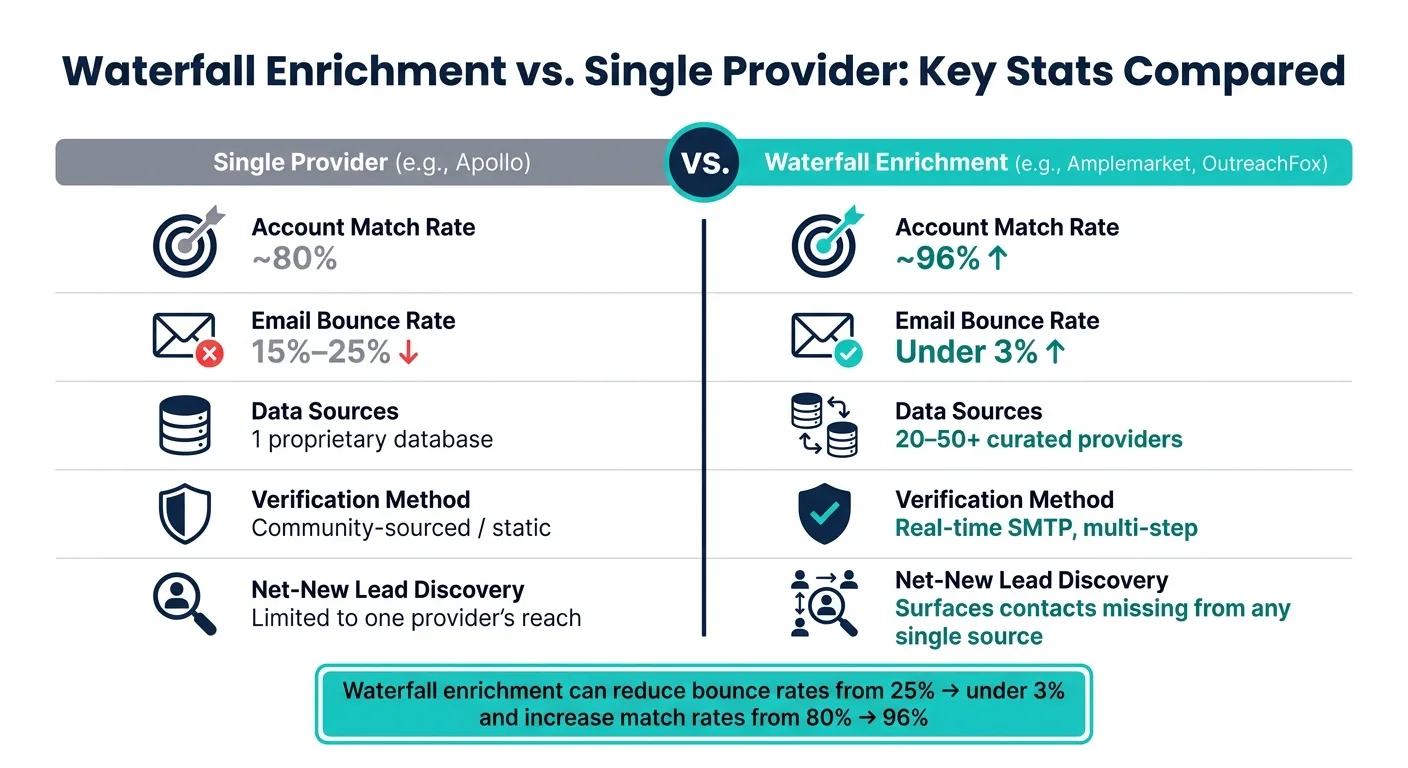
Using verified data as a foundation, waterfall enrichment enhances both the scope and precision of your lead generation efforts.
More Lead Coverage and Better Accuracy
Waterfall enrichment significantly increases the number of valid leads you can access. While a single provider might achieve a match rate of around 80%, combining data from over 20 sources can push that rate up to 96%. That extra 16% isn't just a number - it represents more conversations and a stronger sales pipeline.
It's not just about quantity; it's about quality too. Many large B2B databases boast millions of contacts, but studies show that only about 35% of those records are confirmed as deliverable. Waterfall enrichment ensures the leads you’re working with are valid, giving you more chances to connect with the right people.
Lower Bounce Rates and Better Deliverability
Relying on a single data provider often results in email bounce rates of 15% to 25%. High bounce rates can harm your email sender reputation, as email providers may interpret them as spam activity. This can lead to throttling or even blacklisting of your domain. To stay safe, the industry standard is to keep bounce rates under 5%.
With waterfall enrichment, layered SMTP verification and catch-all filtering reduce bounce rates to below 3%. For instance, switching from Apollo to Amplemarket has been shown to lower bounce rates from 25% to under 3%.
"The bounce rate was much higher for Apollo, so the data quality and deliverability was clearly much better with Amplemarket." - Mariana Guerci, Product Growth, Albato
Maintaining a low bounce rate not only protects your reputation today but also builds trust with email providers for future campaigns. Plus, this process often uncovers additional contacts, as detailed below.
Finding Net-New Leads
Waterfall enrichment doesn’t just clean up your existing lists - it also helps you discover entirely new leads. Different providers often specialize in various market segments, so layering data from 25+ sources can uncover contacts that a single provider might miss.
This is particularly valuable when targeting niche industries or specialized roles where data is harder to find. For example, OutreachFox, which integrates data from over 50 providers, can locate direct mobile numbers and verified emails for hard-to-reach contacts. This approach eliminates the need for time-consuming manual research while expanding your prospect pool.
| Feature | Single Provider (e.g., Apollo) | Waterfall Enrichment (e.g., Amplemarket, OutreachFox) |
|---|---|---|
| Account Match Rate | ~80% | ~96% |
| Bounce Rate | 15%–25% | Under 3% |
| Data Sources | One proprietary database | 20–50+ curated providers |
| Verification | Community-sourced / static | Real-time SMTP, multi-step |
| Net-New Lead Discovery | Limited to one provider's reach | Surfaces contacts missing from any single source |
How to Build a Waterfall Enrichment Workflow
Now that you understand how waterfall enrichment can improve lead quality, let’s dive into creating a workflow that transforms raw leads into actionable, enriched contacts. A structured workflow ensures your data is clean, targeted, and ready for outreach.
Preparing Your Lead Data
Before enriching your leads, it’s critical to clean up your raw data. Inconsistent entries - like mismatched company names, missing domains, or typos - can lead to inaccurate results and waste your enrichment credits.
Start by defining your Ideal Customer Profile (ICP). Use firmographic filters such as industry type and company size, combined with technographic indicators like the software a company uses. This narrows your list to leads worth pursuing, helping reduce bounce rates and improve outreach quality. Once you’ve refined your list, standardize key fields:
- Normalize company domains (e.g., use "acme.com" instead of variations like "Acme Corp" or "www.acme.com").
- Ensure first and last names are formatted consistently.
- Verify that location data is uniform and accurate.
Tools like Clay can simplify this process by automating much of the data cleanup, converting raw contacts into structured profiles.
Next, enrich your data with intent signals - such as recent job changes, funding announcements, or hiring activity. These signals help you prioritize high-value prospects, ensuring they’re processed first during enrichment.
Once your data is organized and prioritized, the next step is choosing the right providers for the job.
Choosing and Ordering Data Providers
Selecting the right data providers depends on their coverage, accuracy, and cost per credit. No single provider excels in all these areas, which is why the waterfall approach works so well.
Start with a broad database like Apollo for sourcing initial contacts. With over 275 million contacts, Apollo offers extensive coverage. Then, pass any unmatched or incomplete records to specialized enrichment tools. For example, Apollo can handle raw contact sourcing, while Clay adds valuable layers like company signals, tech stack details, and intent data.
"Apollo plus Clay is the dominant data and enrichment pipeline. Apollo provides the raw contact data. Clay layers in enrichment - company signals, tech stack, intent data, custom variables." - Alex Berman, Cold Email Practitioner
Arrange your providers by accuracy and cost. Begin with the most reliable (and often pricier) sources, then use broader, cost-effective databases to fill in the gaps. Always finish with a verification step using tools like MillionVerifier or Snov.io. These tools help identify "catch-all" domains that accept any email, ensuring your final list is both accurate and actionable. This layered strategy reduces bounce rates and uncovers new leads that a single provider might miss.
With your provider sequence in place, automation becomes the key to scaling your workflow.
Automating the Workflow
Manual enrichment is time-consuming and doesn’t scale. Automating the process ensures smooth data flow and consistency.
Platforms like OutreachFox can handle this seamlessly. They process contacts through over 50 providers in sequence and apply built-in email verification before any address is added to a campaign. This eliminates the need for manual CSV exports or complex Zapier setups. Alternatively, tools like SyncGTM offer a modular approach, with a flat $99/month plan that queries over 20 providers in priority order. It also syncs enriched data directly to platforms like HubSpot or Salesforce, removing the hassle of manual uploads.
Whatever platform you choose, make sure it includes deduplication logic and integrates with your CRM. This keeps your pipeline clean and prevents unnecessary costs from enriching the same data multiple times.
Measuring and Improving Enrichment Results
Once your automated workflow is up and running, keeping an eye on its performance is key to ensuring high-quality data and successful campaigns.
Metrics to Track
After implementing automation, focus on three main metrics: enrichment coverage (the percentage of leads enriched with valid data), bounce rate (the percentage of undelivered emails), and reply rate (the percentage of prospects who respond to your outreach).
Waterfall workflows can reduce bounce rates to under 3%, compared to the 15%–25% typical of unverified or single-provider setups. High bounce rates can harm your sender domain reputation, causing open rates to plummet - from 65% to just 23% within six months. On the other hand, strong enrichment combined with reliable deliverability practices can push open rates to 60%–70%. When paired with personalized campaigns, reply rates often land between 8% and 15%.
"We saw very different results from the data and emails we ran through them. The bounce rate was much higher for Apollo, so the data quality and deliverability was clearly much better with Amplemarket." - Mariana Guerci, Product Growth, Albato
Adjusting Provider Order and Filters
Once you’ve enriched your data, fine-tune your provider order if bounce rates climb above 5%. Providers with fewer verified contacts should be moved down the sequence. For example, Apollo’s database contains over 275 million contacts, but only about 96 million (around 35%) are verified. This highlights the importance of prioritizing providers with higher verification ratios.
Put your most accurate providers at the top of the list, even if they charge more per credit - recovering from a damaged domain reputation is far more costly than investing in better data upfront. As your campaigns grow, shift from broad filters to "verified only" settings across your provider stack. Additionally, align the provider order with your campaign’s focus. For instance, if your outreach revolves around job changes or funding announcements, prioritize providers that specialize in tracking these signals. This ensures your messaging remains timely and relevant.
Ongoing Optimization
Waterfall enrichment isn’t a one-and-done deal - it’s an ongoing process. Review match rates and bounce rates for each provider on a monthly basis. Replace underperforming sources and experiment with new ones to keep performance levels steady.
A/B testing can also play a big role. For example, test whether referencing a recent funding round in your outreach performs better than mentioning a prospect’s tech stack. The enriched data you collect directly shapes your AI-generated copy, making your messaging more tailored and impactful. Tools like OutreachFox simplify this process by pulling data from over 50 providers in sequence, ensuring each contact profile is thoroughly enriched before you hit send.
"Amplemarket gives us prospect insights we cannot get anywhere else. We have seen a 9x ROI from their buying intent signals." - Victor Schwenoha, GTM Operations, Vanta
Regular audits and A/B tests ensure your enrichment process stays aligned with your outreach goals. Remember, the quality of your workflow depends on the quality of your data today - consistent reviews and adjustments will keep your pipeline accurate, your costs manageable, and your campaigns performing at their peak.
Conclusion: What Waterfall Enrichment Does for Your Outreach
Waterfall enrichment plays a key role in overcoming the challenges of poor data quality that can derail cold outreach efforts. By systematically querying over 20 providers, it bridges gaps left by relying on single sources. This process ensures access to verified emails, direct phone numbers, and valuable contextual signals, all of which are essential for creating personalized and effective outreach. Reliable data is where successful outreach begins.
This approach significantly reduces bounce rates compared to single-provider methods. After all, protecting your sender reputation starts long before you press "send."
But it doesn’t stop at deliverability. The data gained through enrichment directly improves your messaging. Signals like recent funding rounds, hiring trends, or tech stack updates empower AI to craft more relevant and compelling openers.
"AI copy is only as good as the context it gets - an AI that knows the prospect just raised a Series B... writes a meaningfully different opener than one with just a first name." - Kushal Magar, SyncGTM
Cost efficiency is another major advantage. While integrating separate tools for outreach can cost around $481 per month for 50,000 emails, native waterfall platforms cut this expense by about 80%. For example, platforms like OutreachFox streamline the process by pulling data from over 50 providers, handling verification, managing sending infrastructure, and enabling multichannel outreach. This eliminates the hassle of maintaining multiple tools while ensuring data quality and deliverability.
The bottom line is clear: the success of your outreach campaigns depends on the strength of the data behind them. Waterfall enrichment provides the solid foundation your campaigns need to thrive.
Frequently asked questions
How does waterfall enrichment reduce bounce rates from 15-25% to under 3%?+
Waterfall enrichment uses layered SMTP verification and catch-all filtering across multiple data providers in sequence. Each provider adds verification steps, including real-time email validation and double verification for catch-all domains. The system also filters out role-based emails (like info@ or sales@) that rarely reach decision-makers, ensuring only verified, deliverable contacts remain in your outreach list.
Why does waterfall enrichment achieve 96% match rates when single providers only reach 80%?+
Single providers are limited to their own databases, which may lack coverage in specific industries or regions. Waterfall enrichment queries 20-50+ data providers sequentially, with each source specializing in different market segments. This layered approach captures contacts that individual providers miss, increasing the overall match rate by 16 percentage points and uncovering net-new leads unavailable in any single database.
What happens to my data when the first provider in the waterfall sequence doesn't have the information?+
The system automatically moves to the next provider in the sequence without requiring manual intervention. It continues querying providers in priority order until the required data fields (email, phone number, LinkedIn URL) are found or all providers are exhausted. This sequential logic ensures no lead is left behind due to gaps in a single provider's database.
How does waterfall enrichment specifically help with finding contacts in niche industries?+
Different data providers specialize in various market segments, with some focusing on specific industries or geographic regions. By querying 25-50+ providers sequentially, waterfall enrichment accesses specialized databases that single providers don't cover. This is particularly valuable for hard-to-reach specialized roles or niche B2B markets where contact data is sparse in mainstream databases.
What role do intent signals play in waterfall enrichment workflows?+
Intent signals like recent funding rounds, hiring activity, tech stack changes, or job transitions are incorporated by certain providers during the enrichment process. These contextual details enable more personalized and timely outreach messaging. AI-powered tools can use these signals to craft relevant openers that reference specific company events, dramatically improving response rates compared to generic cold emails.
Should I prioritize expensive providers first or last in my waterfall sequence?+
Place your most accurate providers first in the sequence, even if they cost more per credit. High bounce rates from poor data damage your sender domain reputation, which is far more expensive to repair than paying for quality data upfront. Start with reliable, verified sources, then use broader, cost-effective databases to fill remaining gaps, always finishing with a verification step.
How often should I review and adjust my waterfall provider sequence?+
Review match rates and bounce rates for each provider monthly. Replace underperforming sources that consistently fail to provide verified data or contribute to bounce rates above 5%. As your campaigns scale, shift provider settings from broad coverage to 'verified only' modes and reorder providers based on their actual performance in your specific target markets and industries.