
Dedicated IP warmup isolates reputation to one sender for better control, while shared pool warmup spreads reputation and risk across multiple senders for easier setup.
- Dedicated IP warmup ties reputation to your sending behavior alone
- Shared pools mean other senders can affect your inbox placement
- Agencies need client-level isolation to prevent reputation spillover
- Dedicated IPs make troubleshooting faster and contain blast radius
- Shared pools offer easier setup but harder fault isolation
- GTM teams running repeat campaigns benefit from dedicated IP control
Dedicated IP vs Shared Pool Warmup
If I want more control over deliverability, I pick a dedicated IP. If I want simpler setup, I use a shared pool. That’s the whole decision in one line.
Here’s the short version:
- Dedicated IP warmup ties reputation to my sending only
- Shared pool warmup ties reputation to my mail plus other senders in the pool
- Dedicated IPs help limit damage when complaint rates or volume swings hit
- Shared pools can save setup time, but one sender’s poor results can affect everyone
- For agencies and GTM teams, isolation often matters more than convenience
A few facts make this clear:
- In a dedicated IP setup, the IP reputation is built from one sender’s history
- In a shared pool, ISPs judge traffic from the same IP group as a combined signal
- That means one sender’s spam complaints, bounce spikes, or send-volume jumps can hurt inbox placement across the pool
Cold Email Deliverability | Shared Vs. Dedicated IPs
Quick Comparison
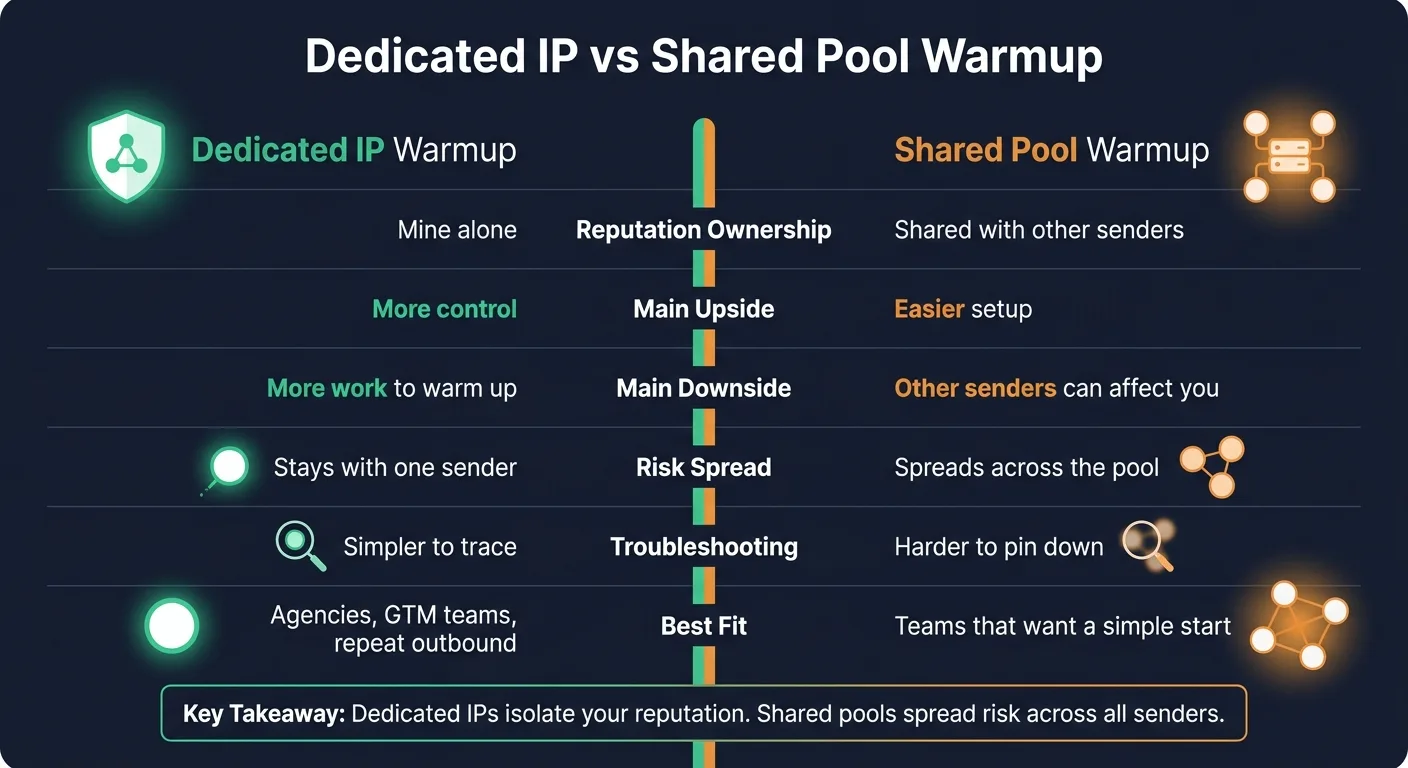
| Criteria | Dedicated IP Warmup | Shared Pool Warmup |
|---|---|---|
| Reputation ownership | Mine alone | Shared with other senders |
| Main upside | More control | Easier setup |
| Main downside | More work to warm up | Other senders can affect me |
| Risk spread | Stays with one sender | Spreads across the pool |
| Troubleshooting | Simpler to trace | Harder to pin down |
| Best fit | Agencies, GTM teams, repeat outbound | Teams that want a simple start |
Bottom line: if my pipeline depends on steady inbox placement, I want reputation separated from everyone else. If I care more about setup ease and can accept shared risk, a pool can work.
Below, I break down how each warmup model works and when each one makes sense.
How Dedicated IP Warmup Works
With a dedicated IP, warmup depends on one sender's behavior instead of a pooled setup. You start with low sending volume, then increase it bit by bit as engagement stays healthy and complaint rates remain low. Over time, that builds an IP reputation tied only to that sender.
Because the IP is isolated, no one else's sending habits affect it. That’s the big difference from shared warmup, where reputation is spread across many senders.
How Shared Pool Warmup Works
Shared pools work in a different way: your mail gets judged alongside everyone else sending through that pool.
In a shared warmup pool, reputation is built and scored across all senders in the group. ISPs see traffic coming from the same IP setup and read it as a collective signal. No one sender owns that reputation - it belongs to everyone using the pool. That’s the basic tradeoff: shared warmup makes it easier to get started, but your inbox placement also depends in part on what other senders are doing.
The hidden risk is spillover. One sender’s bad behavior - a spike in spam complaints, a bounce rate that climbs too fast, or a sudden jump in volume - can hurt inbox placement for everyone else in the pool. For agencies managing multiple clients or GTM teams running high-stakes campaigns, that kind of exposure is tough to box in. One weak sender can pull down the whole pool, and there’s no clean way to isolate the damage after the fact.
So yes, shared reputation can make onboarding simpler. But it also makes the blast radius much harder to control - which is exactly the tradeoff the next section examines.
Dedicated IP vs Shared Pool Warmup: Deliverability and Risk
Deliverability tradeoffs in outbound operations
Once you understand how warmup works, the next step is figuring out what it means when you're sending at scale. In outbound ops, the main issue is fault isolation. A dedicated IP keeps reputation tied to one sender. A shared pool puts your inbox placement at the mercy of other senders in that same pool.
| Dimension | Dedicated IP | Shared Pool |
|---|---|---|
| Troubleshooting speed | Trace issues directly to your own sending | Harder to diagnose when risk is shared across the pool |
| Blast radius | Contained to your campaigns | One sender's spike can hurt everyone in the pool |
That difference shapes the risk each team is taking on. With a dedicated IP, your problems are your own. With a shared pool, someone else's bad week can become your problem too.
When agencies and GTM teams should choose each model
Agencies usually need client-level isolation. If one client gets a spike in complaints, that shouldn't spill over and hurt everyone else.
GTM teams should lean toward dedicated IPs when they need steady inbox placement across repeat campaigns. If you're running outbound again and again, tied to pipeline goals, more control over reputation can make a big difference.
Private infrastructure in practice: OutreachFox

One practical example of this setup is OutreachFox. OutreachFox uses private, isolated sending infrastructure with dedicated campaign IPs, so reputation depends on your sending behavior instead of pool-wide activity.
Conclusion: Which Warmup Model Fits Your Team
Shared pool warmup is a better fit for teams that want faster onboarding and less infrastructure work. Dedicated IP warmup makes more sense for teams that need isolated reputation and tighter control over deliverability. That's the main tradeoff here.
In day-to-day use, agencies and GTM teams often pick dedicated IPs when they need client-level isolation or steady inbox placement at scale. If your results depend on other senders in the same pool, control gets a lot harder.
Bottom line:
Pooled warmup spreads risk across every sender in the pool. Dedicated IPs keep that risk isolated and make deliverability easier to control.
Frequently asked questions
How does a single sender's spam complaints affect others in a shared pool warmup?+
In a shared pool, ISPs judge traffic from the same IP group as a combined signal. When one sender experiences spam complaints, bounce spikes, or sudden volume jumps, it can hurt inbox placement for everyone else in that pool because reputation is shared across all senders rather than isolated.
What is the main troubleshooting difference between dedicated IP and shared pool warmup?+
With a dedicated IP, you can trace deliverability issues directly to your own sending behavior, making diagnosis faster. In a shared pool, troubleshooting is harder because the risk is spread across multiple senders, making it difficult to pinpoint whether problems stem from your campaigns or another sender's actions.
Why do agencies typically prefer dedicated IP warmup over shared pools?+
Agencies need client-level isolation to prevent one client's poor sending behavior from affecting other clients. With dedicated IPs, each client's reputation remains separate, so a spike in complaints from one campaign won't spill over and damage inbox placement for other accounts.
How does the warmup process differ between dedicated IPs and shared pools?+
Dedicated IP warmup builds reputation based solely on one sender's behavior, starting with low volume and gradually increasing as engagement remains healthy. Shared pool warmup builds reputation collectively across all senders in the group, with ISPs reading the combined traffic as a single signal rather than individual sender histories.
What does 'blast radius' mean in the context of shared pool warmup?+
Blast radius refers to how far the impact of one sender's problems can spread. In a shared pool, one sender's issues—like complaint spikes or volume jumps—can affect everyone else in the pool, whereas dedicated IPs contain problems to a single sender's campaigns.
When should GTM teams choose dedicated IP warmup over shared pools?+
GTM teams should choose dedicated IPs when they need steady inbox placement across repeat campaigns tied to pipeline goals. If outbound operations run continuously and deliverability directly impacts revenue, having isolated control over reputation becomes more valuable than the convenience of shared setup.