
Waterfall enrichment reduces bounces by checking multiple providers sequentially, verifying emails before send, and filtering weak data at each step instead of relying on a single source.
- Single-source enrichment creates coverage gaps that lead to stale or guessed email addresses
- Waterfall logic queries providers sequentially until finding a verified high-confidence match
- Field-level lookup pulls each data point from the strongest specialized source available
- Final verification checks syntax, domain DNS records, and mailbox status before sending
- Integrated platforms eliminate CSV handoff errors that let bad records into sequences
- Lower bounce rates come from filtering invalid contacts before send not increasing volume
How Waterfall Enrichment Reduces Email Bounces
If your list has bad emails, your campaign will bounce no matter how good your copy is.
I’d sum it up like this: fewer bounces come from better data checks before send time. The article shows that teams can lower bounce risk by checking more than one data source, rejecting weak or guessed emails, and running final email verification before a contact enters a live sequence.
Here’s the short version:
- Single-source enrichment misses records and can return old or guessed emails
- Waterfall enrichment checks providers one by one until it finds a verified match
- Field-level lookup pulls each data point from the source that does that job best
- Final verification checks syntax, domain, and mailbox status before sending
- One workflow beats CSV handoffs, which often let bad records slip back in
In other words: bounce reduction starts before outreach starts.
A hard bounce usually means one thing: the contact data was wrong. Since email marketers often aim to keep bounce rates under 2%, even a small batch of invalid emails can hurt sender reputation, inbox placement, and budget.
What I like about this approach is that it treats email quality as a filtering problem, not a sending problem. Don’t send more. Send to fewer bad records.
That’s the core idea behind the article.
The NEW Targeted Cold Email Strategy for 2026 | Jed Mahrle
Why single-provider enrichment creates avoidable bounce risk
No single provider is equally strong across every contact segment. One source might do well with certain industries, job functions, or company sizes, then struggle elsewhere. That gap shows up fast: missed work emails, stale records, and bounces before a campaign even goes out.
Coverage gaps lead to invalid or stale addresses
When a provider can't find a confident match, it doesn't always return a blank field. In some cases, it returns an uncertain match - an inferred or outdated email address. On the surface, those records look fine. Then send time hits, and they bounce.
Stale data makes the problem worse. People switch jobs. Companies reorganize. Domains change. And when one provider updates data on its own schedule, blind spots are inevitable.
Single providers also tend to perform better in some parts of the market than others. They may have stronger data for one role or industry and weaker data for another. So coverage gaps aren't a one-off issue. They're built into the model.
The cost of bad contact data compounds across the stack
A bad record doesn't stop at one bounce. It spreads across the rest of the workflow. If your team runs multiple campaigns, that means more bounces, more wasted sends, and more cleanup work.
Run that pattern across campaign after campaign, and the cost stacks up:
- More bounces
- More wasted credits
- More cleanup
Waterfall enrichment solves this by checking multiple providers before a record reaches the send queue. The answer isn't sending more. It's getting broader coverage before send time.
Next: how waterfall fallback and field-level lookup turn those gaps into higher match rates.
How waterfall enrichment reduces bounces before sending
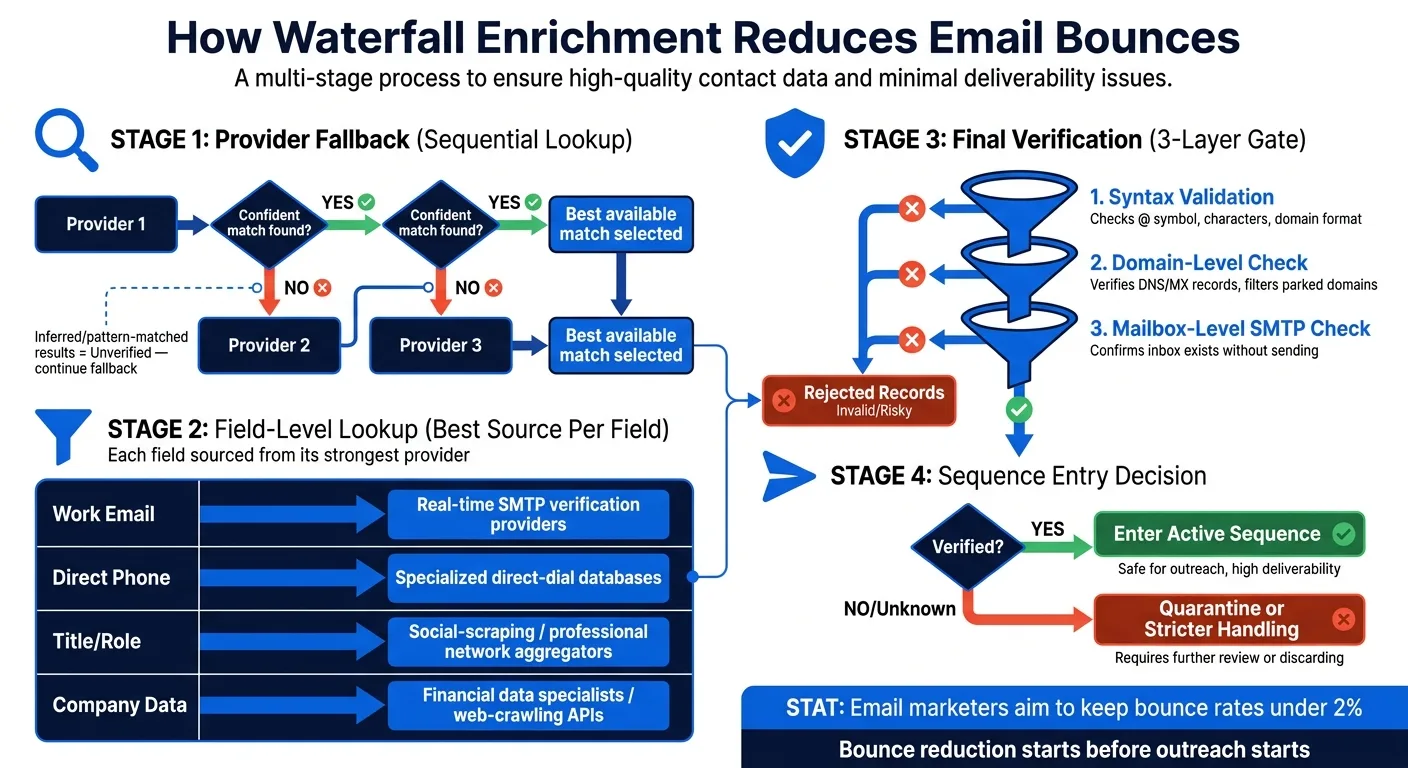
Waterfall enrichment helps cut bounces before a contact ever reaches the send queue. The idea is simple: query data providers one by one, then stop as soon as you get a high-confidence match. If an email looks weak, guessed, or inferred, it doesn’t move forward.
That matters because single-source enrichment often leaves holes. One provider may miss a contact entirely. Another may return an address that looks plausible but isn’t confirmed. Waterfall logic closes those gaps before they turn into hard bounces.
Sequential provider fallback improves match coverage
The system starts with Provider 1. If Provider 1 returns a confident match, the lookup ends there. If it returns nothing, or labels the result as inferred instead of verified, the system moves to Provider 2, then Provider 3 if needed.
Inferred emails should be treated as unverified. If the result comes from pattern matching alone, fallback should keep going until it finds a record confirmed by a source.
This approach improves match rate and cuts bounce risk at the same time. You’re not just adding more sources. You’re filtering out weak results before send.
Once fallback lifts match coverage, the next step is to fix weak points inside the record itself.
Field-by-field lookup finds the best record, not one all-or-nothing record
Field-level waterfalls pull each field from the strongest source for that type of data. That’s a big shift from the all-or-nothing model, where one provider is expected to fill every field.
That setup often breaks down in practice. A provider that’s strong on verified work emails may be weak on mobile numbers. A direct-dial database may have solid phone data but thin firmographic detail. So instead of forcing one source to do it all, field-level selection picks the best source for each field.
| Field | Why Providers Vary | Best Provider Type |
|---|---|---|
| Work Email | Databases vary by industry and geography | Providers with real-time SMTP verification |
| Direct Phone | Mobile data is often siloed or restricted | Specialized direct-dial or people-search databases |
| Title/Role | Job changes happen frequently | Social-scraping tools or real-time professional network aggregators |
| Company Data | Firmographics are often estimated | Financial data specialists or real-time web-crawling APIs |
Platforms like OutreachFox use field-level waterfalls across 50+ providers to source each field from the strongest database. That leaves fewer weak records for final verification to filter.
Why final verification is the last filter that protects deliverability
Waterfall enrichment finds a match. Verification tells you whether that address is safe to email. Those are two different jobs.
A matched email can still bounce. Enrichment helps you get more coverage, but it doesn't confirm current mailbox status. Most enrichment providers pull from historical databases, which means a matched address can still be stale. Someone may have switched jobs. A domain may have been parked. That’s where final verification steps in with real-time checks that static enrichment just can’t do.
The last gate is verification.
And that gate should work in layers.
Syntax, domain, and mailbox checks catch what enrichment misses
Verification runs in three stages, and each one filters out a different kind of bad address.
Syntax validation comes first. It catches malformed addresses before any network request goes out, including missing @ symbols, invalid characters, and broken domain formatting.
Domain-level checks come next. The system looks at DNS and MX records to confirm that the domain exists and can receive email. Parked, expired, or inactive domains get filtered out here before you send anything.
Mailbox-level validation is the last step. Using an SMTP check, the system confirms whether the specific mailbox exists without sending an actual message. This catches cases where the domain is valid, but the inbox itself has been deleted or turned off.
Only verified emails should move into active sequences
Only verified emails should enter active sequences. For higher-risk outcomes like accept-all domains, unknown results, and role-based addresses, use stricter handling instead of sending to them by default.
OutreachFox builds verification into the same pipeline, so unverified contacts never make it into a sequence.
How to apply this in your stack
Integrated platforms reduce the handoff errors that cause bounces
One of the biggest causes of avoidable bounces is the handoff between tools. Enrichment, verification, and CSV imports can each add bad records. The fix is simple: keep those steps inside one workflow.
When a team pulls enriched contacts from one provider, runs them through a separate verifier, and then imports a CSV into a sending platform, things can go wrong at every step. Records can break. Data can go stale. And during a manual import, failed contacts can slip back into the list.
OutreachFox keeps waterfall enrichment, verification, and sending in one API-first flow, so bad records don’t slip through CSV handoffs.
Conclusion: fewer bounces come from better enrichment logic, not more sending
In practice, the goal is to stop bad contacts from entering the sequence in the first place.
The fix is straightforward: remove handoffs, verify before send, and gate every contact before it enters a sequence.
Frequently asked questions
What is the difference between waterfall enrichment and final email verification?+
Waterfall enrichment finds a matching email by checking multiple data providers sequentially until it gets a high-confidence result. Final verification then confirms whether that matched email is actually deliverable by running real-time syntax, domain, and mailbox checks. Enrichment improves coverage, while verification confirms current mailbox status before sending.
How does sequential provider fallback work in waterfall enrichment?+
The system queries Provider 1 first. If it returns a confident, verified match, the lookup stops. If it returns nothing or an inferred result, the system moves to Provider 2, then Provider 3 if needed. This continues until a verified match is found, rejecting weak or guessed emails instead of using them.
Why does single-source enrichment lead to higher bounce rates?+
No single provider has equally strong coverage across all industries, job functions, or geographies. When a provider can't find a confident match, it may return an inferred or outdated email that looks valid but bounces at send time. These coverage gaps and stale records create avoidable bounce risk that compounds across campaigns.
What is field-level lookup and how does it reduce bounces?+
Field-level lookup pulls each data point from whichever provider does that specific job best, rather than forcing one source to fill every field. For example, one provider might supply the verified work email while another provides the direct phone number. This prevents weak fields from one provider from compromising the entire contact record.
What three stages does final email verification run before sending?+
First, syntax validation catches malformed addresses like missing @ symbols or invalid characters. Second, domain-level checks verify DNS and MX records to confirm the domain exists and can receive email. Third, mailbox-level validation uses SMTP checks to confirm the specific inbox exists without sending an actual message.
Why do CSV handoffs between enrichment and sending tools cause bounces?+
Manual handoffs between enrichment, verification, and sending platforms create multiple points where records can break, data can go stale, or failed contacts can slip back into the list. Each export, import, and manual step adds risk that bad records will enter the send queue instead of being filtered out.
Should inferred or guessed emails be treated as verified matches in waterfall enrichment?+
No. Inferred emails come from pattern matching rather than source confirmation, so they carry higher bounce risk. If a provider returns an inferred result instead of a verified one, the waterfall fallback should continue to the next provider until it finds a confirmed record or exhausts all sources.