Avoid redundant multichannel messaging by syncing prospect data in a single CRM, tailoring messages to each platform, setting exit rules when prospects engage, and continuously monitoring metrics like reply rates and bounce rates.
- Centralize prospect data in one CRM to prevent duplicate follow-ups across channels
- Space touchpoints and tailor messaging style to each platform's expectations
- Set automatic exit rules to stop sequences immediately when prospects engage
- Authenticate sending domains with SPF, DKIM, and DMARC for inbox placement
- Track positive reply rates and meeting conversions instead of open rates
- Use unified platforms for real-time cross-channel coordination and reply detection
Checklist for Multichannel Messaging Without Redundancy
When reaching out to prospects via email and LinkedIn, redundancy can hurt your campaigns. Sending identical messages across platforms feels robotic and reduces response rates. To avoid this, follow these steps:
- Sync Prospect Data: Use a single CRM to track responses across channels and avoid duplicate follow-ups.
- Plan Unique Sequences: Space out touchpoints and tailor messages to each platform’s style.
- Set Exit Rules: Stop outreach when a prospect engages to maintain trust.
- Leverage Tools: Use integrated platforms for real-time updates and cross-channel coordination.
- Monitor Metrics: Focus on reply rates, bounce rates, and meeting conversions to refine your strategy.
Channel and Data Alignment Checklist
Unify Prospect Data and Statuses
Centralize all prospect data into a single CRM or enrichment table. For example, if a prospect responds on LinkedIn, their status should update instantly, ensuring your email sequences pause automatically. This prevents redundant follow-ups and safeguards the trust you've built.
A single research pass is the most efficient method: gather all relevant signals - like LinkedIn activity, funding updates, or tech stack details - at once. Then, use this data to shape both your email and LinkedIn outreach strategies. This unified system keeps your messaging consistent across platforms and eliminates unnecessary effort. Plus, it lays the groundwork for the sequencing strategies you'll see in the next steps.
Standardize Contact Identifiers Across Channels
Avoid duplicate messaging by creating unique identifiers for each prospect. Using their email address and LinkedIn URL as primary identifiers is a reliable approach. As a backup, reference the company domain to catch cases where a prospect might appear under slightly different names.
AI-powered tools can also help clean up your data. For instance, they can standardize entries - like changing "ACME CORP" to "Acme Corp" - so your personalization feels natural in both emails and LinkedIn messages.
Align Sending Infrastructure
Before launching any campaign, make sure your sending domain is authenticated with SPF, DKIM, and DMARC. Skipping this step is a surefire way to end up in the spam folder, no matter how strong your messaging is.
Mailbox warmup is equally important. Sending from an unprepared domain can hurt deliverability, even if your domain is authenticated. Tools like OutreachFox offer pre-warmed mailboxes and private sending setups, allowing you to skip the usual 2–4 week warmup period and go live in about ten minutes. These platforms also provide isolated infrastructures, ensuring your campaigns remain unaffected by issues on shared systems. For multichannel campaigns, using dedicated IPs for each client or campaign can prevent one underperforming sequence from dragging down your overall deliverability.
"Cold email only works when it lands. That's where Salesforge and Mailforge have made the difference." - Carlos Palop Moliner, CEO, UniteSync
Teams sending over 50,000 emails per month have achieved consistent inbox placement by combining authenticated multi-domain setups with steady warmup routines. While it may not be the most exciting part of the process, having a robust infrastructure is critical for success. It ensures your outreach campaigns are well-supported and ready for seamless execution.
The Best Multichannel Cold Outreach Strategy for 2026 (Get 3x More Replies)
Sequence Design Checklist for Non-Redundant Touches
Map and Schedule Touchpoints Across Channels
Once your infrastructure and data are set up, it's time to create a sequence where each touchpoint has a specific role in the timeline. The idea is to avoid overlapping channels and ensure every interaction delivers distinct value.
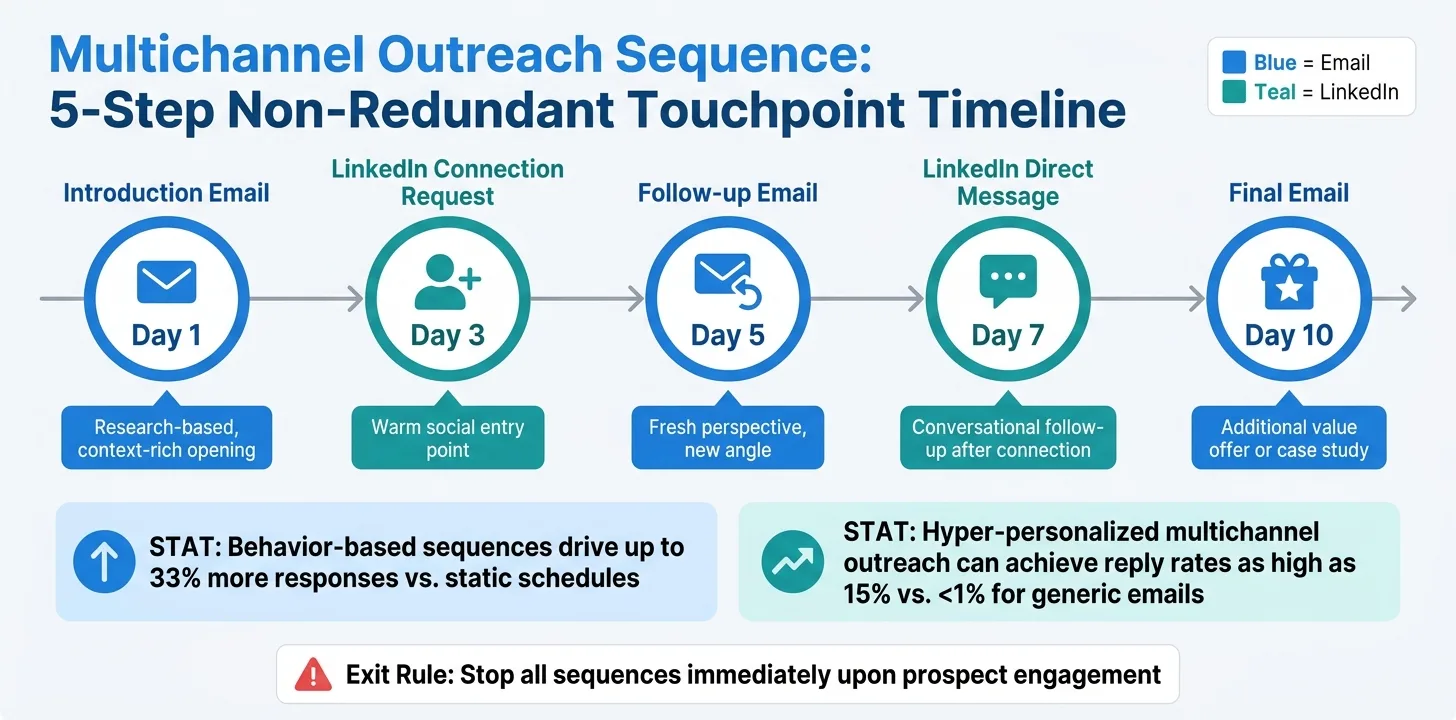
Here’s an example of an effective sequence:
- Day 1: Introduction email based on research
- Day 3: LinkedIn connection request
- Day 5: Follow-up email with a fresh perspective
- Day 7: LinkedIn direct message after connection approval
- Day 10: Final email offering additional value
Spacing out these touchpoints keeps prospects engaged and avoids overwhelming them. Campaigns designed around behaviors rather than fixed schedules can see up to 33% more responses compared to static sequences.
Use your initial research to guide the flow of the sequence, and fine-tune your content to fit the tone and expectations of each platform.
Differentiate Messaging by Channel and Intent
Once you’ve scheduled your touchpoints, it’s important to adapt your messaging to fit the unique style of each channel. Different platforms call for different approaches. For example, emails should be detailed and action-oriented, while LinkedIn messages should feel conversational and succinct.
| Channel | Style | Key Objective |
|---|---|---|
| Cold Email | Detailed and context-rich | Provide value with a clear call-to-action |
| Short, conversational, and social | Build rapport and establish connection | |
| Follow-up | Fresh angle or new proof point | Add depth without repeating earlier messages |
Avoid simply "bumping" your previous messages. Each follow-up should bring something new to the table - like a different proof point, a company-specific insight, or a new perspective. When emails and LinkedIn outreach are hyper-personalized and offer fresh value with each touch, response rates can climb as high as 15%.
Set Exit and Pause Conditions
To maintain credibility and avoid over-messaging, your sequence should stop immediately when a prospect engages. Without proper exit conditions, you risk damaging your reputation. For example, sending a LinkedIn message to someone who’s already replied via email can undermine trust.
Here are some common conditions to consider:
| Condition | Action Taken | Rationale |
|---|---|---|
| Direct Reply | Stop the sequence | Prevent unnecessary follow-ups |
| Out-of-Office | Delay the next touch | Ensure messages reach prospects when they return |
| Email Bounce | Exit the sequence | Protect your email sender reputation |
| Unsubscribe | Permanently opt out | Comply with CAN-SPAM and GDPR regulations |
| Link Click | Pause and alert a rep | Allow a human to follow up while interest is high |
| Connection Accepted | Send a LinkedIn message | Transition the conversation to a social channel |
Tools like OutreachFox simplify this process by offering AI-powered reply tagging. These platforms can classify responses as "interested", "wrong person", or "unsubscribe", and automatically trigger the appropriate actions across channels in real time. Coordinating these efforts ensures a smooth experience for prospects while keeping your outreach professional and effective.
Operational and Tooling Checklist for Cross-Channel Coordination
To ensure smooth and effective multichannel messaging, having the right tools and real-time coordination is crucial.
Use Unified or Integrated Platforms
Managing email and LinkedIn outreach through separate tools can create unnecessary overlap. For instance, if platforms don’t communicate, a rep might send a LinkedIn message to someone who has already replied to an email. This kind of misstep can damage trust. A unified platform solves this by integrating both channels into a single workflow. This way, sequence logic, suppression rules, and reply tracking operate from one consistent source.
For example, a unified inbox combines email and LinkedIn replies, making it easy to track responses while continuing outreach on other channels. Cross-channel suppression ensures that all active steps stop immediately when a prospect engages.
The next step is ensuring updates across all channels happen in real-time.
Enable Real-Time Data Sync
Static contact lists can be a major problem in multichannel campaigns. If bounces or replies aren’t immediately updated in your CRM and outreach tools, you could send follow-ups to invalid addresses or prospects who’ve already responded. Real-time synchronization prevents this by instantly reflecting every status change - whether it’s a reply, bounce, unsubscribe, or LinkedIn connection.
An API-first architecture can use webhooks to push these updates in real time, keeping your CRM, data enrichment tools, and sequence engine completely up-to-date. For high-volume senders managing 50,000+ emails per month, this level of live data accuracy is essential to maintaining deliverability at scale.
Once your data sync is solid, it’s time to focus on governance to protect your sender reputation.
Set Governance and Safeguards
Strong governance ensures your outreach stays consistent and protects your sender reputation. Unchecked volume or overlapping sequences can hurt deliverability. Before scaling your efforts, implement these safeguards:
- Daily send caps for each mailbox and LinkedIn account to mimic natural human behavior and comply with platform limits.
- Role-based permissions to restrict who can modify active sequences or suppression lists.
- Suppression list management to account for opt-outs, bounces, and existing customers across all channels.
"Tying your strategy of setting up domains + inboxes + warming up + daily limits with our royalty audit lead magnet has allowed us to grow efficiently, bringing in strong results without excessive effort." - Carlos Palop, CEO, UniteSync
Another effective safeguard is sender rotation. By spreading outreach across multiple accounts, you reduce the risk of any single account being flagged while maintaining a natural, human-like sending pattern.
Measurement and Continuous Improvement Checklist
Before scaling your campaigns, take time to evaluate their effectiveness and identify any redundancies. This step ensures your outreach strategy stays impactful and consistent across all channels.
Track Key Redundancy and Fatigue Metrics
Open rates are no longer a reliable indicator, thanks to privacy protections and the use of proxies. In 2026, the positive reply rate, bounce rate, and meeting conversion rate have become the go-to metrics for assessing campaign success.
"We stopped reporting on open rates entirely. Positive reply rate and meeting conversion are the only numbers that matter." - Jennifer L., SDR Manager
Pay close attention to bounce rates. Lists that aren’t verified often result in bounce rates of 10–20%. It’s also critical to monitor these metrics at the mailbox level since even one underperforming sender can negatively impact your overall deliverability. Together, these numbers provide the foundation for comparing performance across your outreach channels.
Analyze and Compare Channel Performance
Make it a habit to regularly review and compare metrics from your email and LinkedIn campaigns. For active campaigns, weekly reviews are ideal, while broader playbook trends can be assessed monthly. Look for patterns - does one channel consistently perform better for certain industries or job titles? For instance, are LinkedIn connection requests leading to replies less frequently than email interactions?
Unified analytics can save you from manually piecing together data from separate tools. With everything in one place, you can accurately determine which channel contributed to a conversion, rather than mistakenly attributing it to the last touchpoint. For example, AKOOL used a structured, multichannel strategy to engage over 214,000 prospects, achieving a positive reply rate of more than 16%.
Update Playbooks and Run Structured Tests
Use the insights from your performance data to fine-tune your playbooks and test sequences. Regularly review underperforming steps - ideally on a weekly basis - before scaling up. If a step has a low positive reply rate, the problem is often tied to the messaging angle, timing, or repetitive content, rather than just the subject line.
Run A/B/C tests on subject lines, calls-to-action, and opening lines. Ensure that each follow-up introduces new proof points or addresses fresh pain points. Outreach that incorporates AI-driven personalization often achieves reply rates of 15%, compared to less than 1% for generic templates. Lastly, automate exit conditions so sequences halt the moment a prospect engages. Use your data to decide when a playbook has served its purpose and needs to be retired or refreshed.
Conclusion
Effective multichannel outreach hinges on four key elements: unified data, tailored sequences, integrated tools, and consistent measurement. When these pieces align, your email and LinkedIn efforts become part of a seamless, cohesive conversation instead of feeling like disjointed campaigns aimed at the same prospect.
Here’s the proof: personalized multichannel outreach typically achieves a reply rate of around 15%, compared to less than 1% for generic mass emails. The takeaway? It’s not about blasting out more messages - it’s about sending them strategically.
"Real multichannel outreach is not just more channels. It is more context, better sequencing, and platform-native writing at every step." - Mailly.io
Using separate tools for email, LinkedIn, enrichment, and inbox management often leads to unnecessary duplication. Platforms like OutreachFox solve this by combining everything you need: dedicated sending infrastructure, enrichment from over 50 providers, and unified email and LinkedIn sequences - all tied together in a single inbox. This eliminates fragmentation, keeps your data synced, and ensures every reply fits into your overall strategy.
Think of this checklist as a dynamic guide. Revisit it regularly - whether you’re launching a new campaign, adding a channel, or noticing a dip in engagement. Continuous refinement is the key to staying ahead.
Frequently asked questions
How do I prevent duplicate outreach when a prospect responds on one channel but I'm still messaging them on another?+
Use a unified platform with real-time data sync that automatically updates prospect status across all channels. When a prospect replies via email or LinkedIn, the system should immediately pause all pending touchpoints in your sequences. Tools with cross-channel suppression and centralized reply tracking ensure that once engagement occurs on any channel, all other outreach stops instantly to maintain trust.
What spacing should I use between email and LinkedIn touchpoints in a multichannel sequence?+
A proven sequence structure spaces touchpoints 2-3 days apart: Day 1 (email), Day 3 (LinkedIn connection), Day 5 (follow-up email), Day 7 (LinkedIn DM after connection), Day 10 (final email). This cadence prevents overwhelming prospects while maintaining consistent visibility. Each touchpoint should introduce a new angle or proof point rather than repeating the same message.
Why is a single research pass more efficient than separate research for email and LinkedIn?+
Conducting one comprehensive research pass allows you to gather all relevant signals—LinkedIn activity, funding updates, tech stack details—at once, then apply this data to shape both email and LinkedIn strategies. This unified approach eliminates duplicate effort, ensures consistent messaging across platforms, and provides the foundation for personalized outreach that achieves reply rates around 15% compared to less than 1% for generic templates.
What exit conditions should I set to avoid over-messaging prospects?+
Critical exit conditions include: stopping sequences on direct replies, delaying touchpoints for out-of-office responses, exiting on email bounces to protect sender reputation, permanently opting out unsubscribes for compliance, pausing on link clicks to allow human follow-up, and transitioning to LinkedIn messaging after connection acceptance. These automated rules prevent redundant follow-ups and maintain professional credibility.
How should I differentiate my messaging between email and LinkedIn in the same sequence?+
Emails should be detailed and context-rich with clear calls-to-action, while LinkedIn messages should be short, conversational, and rapport-focused. Each follow-up must introduce fresh value—a new proof point, company-specific insight, or different perspective—rather than simply bumping previous messages. This platform-native approach respects each channel's communication style while avoiding repetitive messaging.
What metrics indicate my multichannel campaign has redundancy issues?+
Focus on positive reply rate, bounce rate, and meeting conversion rate rather than open rates, which are unreliable due to privacy protections. Monitor these metrics at the mailbox level to identify underperforming senders. Low reply rates combined with multiple touchpoints to the same prospect often signal redundant messaging. Compare channel performance weekly to identify patterns and eliminate overlapping or ineffective steps.