
The cheaper enrichment option delivers the lowest cost per verified contact, not the lowest price per record. Waterfall wins when coverage is patchy; single-source works when one provider covers your ICP well.
- Cost per verified contact matters more than cost per record or upfront pricing.
- Waterfall enrichment recovers more matches when single sources have coverage gaps.
- Single-source buying works best when one provider already covers your ICP cleanly.
- Bounce waste and verification failures raise the true cost of cheap data.
- Bundled platforms like OutreachFox reduce stack complexity while maintaining waterfall coverage.
- Optimize for verified contacts delivered per dollar spent, not records purchased.
Waterfall Enrichment Cost Model: Clay vs Single Source
Here’s the short answer: the cheaper option is the one that gives you the lowest cost per verified contact, not the lowest price per record.
If I compare Clay-style waterfall enrichment with a single-source vendor, I’d look at three numbers first:
- Cost per match
- Cost per verified contact
- Bounce waste avoided
That changes the buying decision fast. A single-source tool can look cheaper at $X per record, but if more records fail verification or bounce later, your actual cost per usable contact goes up. A waterfall can cost more per lookup, yet still win if it turns more raw records into contacts you can send to.
The main takeaway is simple:
- Use waterfall enrichment when coverage is uneven, your ICP is narrow, or one vendor misses too many records.
- Use single-source data when one provider already covers most of your list well.
- If you also care about tool sprawl, a bundled setup like OutreachFox changes the math by putting enrichment, verification, and sending in one place.
Clay 101 | Lesson 6: Enrich People Using Waterfalls
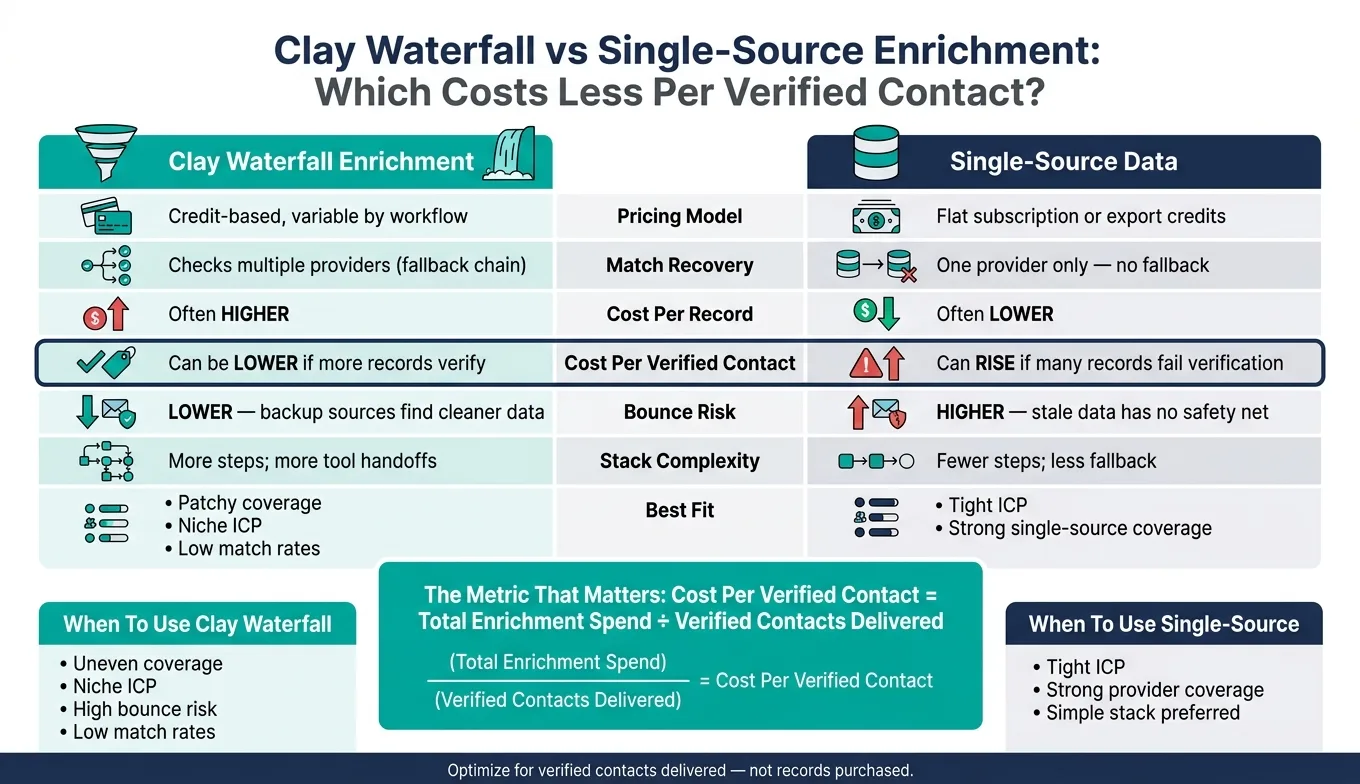
Quick Comparison
| Criteria | Clay Waterfall | Single Source |
|---|---|---|
| Pricing model | Credit-based, costs can change by workflow | Flat vendor pricing or export credits |
| Match recovery | Checks more than one provider | One provider only |
| Cost per record | Often higher | Often lower |
| Cost per verified contact | Can be lower if more records verify | Can rise if many records fail |
| Bounce risk | Lower when backup sources find cleaner data | Higher if source data is stale |
| Best fit | Patchy coverage, niche lists, low match rates | Tight ICP, strong source coverage |
| Stack complexity | More steps if paired with separate tools | Fewer steps, but less fallback |
If I were making the call, I’d ignore headline pricing and compare verified contacts delivered per dollar spent. That’s the number that tells you what your list is actually costing.
How Clay Waterfall Enrichment Is Priced
Clay uses a credit-based pricing model. That means every failed lookup adds to your spend, so the longer the waterfall, the more you pay.
Here’s the simple version: a longer waterfall costs more because each failed provider adds another credit charge. That gives Clay a lot of flexibility, but it also means your unit cost can shift from one workflow to the next.
How Credits Translate Into Enrichment Cost
The price of a single record depends on how many sources the workflow needs to check before it finds a verified match. If an email lookup resolves on the first try, the cost stays fairly low. If the workflow has to move through several vendors before it finds a verified contact, the cost goes up.
It can climb even more when you need multiple fields.
- Work email
- Mobile number
- LinkedIn profile
Those often come from different providers. So one prospect can set off several separate enrichment actions before you end up with a complete record.
Where Clay Gets Expensive and Where It Gets Efficient
The best way to judge Clay is by cost per verified contact. That’s the number that matters.
Clay makes sense when those extra provider hops lead to more verified contacts than they cost. If one source gives you a lot of unverified records, you’re paying for data you still can’t use. A waterfall keeps checking other providers until it finds a verified match, which increases the share of contacts you can actually send to, even if the cost per attempt is higher.
But that tradeoff can swing the other way.
If one provider already covers most of your list cleanly, extra hops just add more credit spend without adding more verified contacts. In that case, buying from a single source can be the better move. It may look cheaper at first glance either way, but bounce risk and verification losses can wipe out that paper savings fast.
How Single-Source Data Buying Is Priced
Single-source data buying is simple on paper. You either pay a subscription or use export credits to get access to one vendor’s dataset. It’s one vendor, one dataset, and one shot per record.
That setup sounds clean because it is clean. But there’s a catch: if a contact is missing, old, or can’t be verified, there’s no built-in backup source. So if that record fails, the money tied to it is gone. That’s why single-source can look cheaper at first glance, right up until verification enters the picture.
Why Single-Source Looks Cheaper Up Front
Single-source buying appeals to a lot of teams for a plain reason: it’s easy to understand. One vendor. One invoice. One dataset.
When the provider has strong coverage and your target list lines up with that data, the cost per usable contact can stay low. In that case, the model does its job well and keeps things simple.
Where Single-Source Cost Rises After Verification and Bounces
The trouble shows up after the export.
Records that are stale, missing, or unverified can’t be used. And once you’ve paid for them, that spend is sunk. At that point, the number that matters is no longer cost per exported record. It’s cost per verified contact.
So a single-source provider that seems cheap at export time can end up costing more per deliverable contact after failed verification and bounce waste are added in. The next step is to see whether that lower sticker price still holds once match rate and bounce risk are part of the math.
Comparing Both Models on Match Rate, Verified Contacts, and Bounces
Don’t compare these models by sticker price alone. Compare them by usable contacts and cost per usable contact. Start with coverage. Then look at what that coverage costs per match.
Cost Per Match: Coverage vs. Credit Burn
A single-source setup hits a ceiling fast because it depends on one dataset. If that provider has weak coverage, match rates flatten out in a hurry.
Waterfall works around that problem. When the first provider misses, the record moves to the next one. That extra step can push up the cost per record. But it can also cut cost per match if those extra provider calls recover contacts the first source missed.
So yes, match rate matters. But verified contact cost matters more.
Cost Per Verified Contact: The Metric Most Teams Should Optimize
Raw matches aren’t the finish line. Verified contacts are.
Cost per verified contact = total enrichment spend ÷ verified contacts delivered
That’s the number most teams should watch.
A lower upfront price can still end up costing more if it gives you fewer usable contacts or leaves you with more cleanup work. Waterfall enrichment may cost more per record and still come out ahead if it turns more of your database into verified contacts.
That’s where bounce reduction starts to change the math.
Bounce Reduction as a Direct Cost Lever
Bounce reduction protects both enrichment spend and deliverability.
With waterfall, each record gets another shot at verification before it lands on the send list. That matters because cheap upfront isn’t always cheap in the end. If verification is the bottleneck, waterfall can trim total spend even when it triggers more provider calls.
When to Use Waterfall Enrichment and When to Use Single-Source
Pick the option with the lower cost per verified contact after you account for bounce risk and cleanup.
Cases Where Waterfall Enrichment Makes Sense
Waterfall works best when one provider can't cleanly cover your list. If source coverage is patchy or your ICP is niche, a waterfall setup can fill the gaps that a single source leaves open.
It also makes sense when weak records drive up bounce risk and cleanup work. In that situation, the total cost of getting to a contact that can actually be delivered may be higher than it looks at first glance.
Cases Where Single-Source Buying Makes Sense
Single-source buying is the sensible move when your ICP is tight and one provider already covers it well. In that case, the extra workflow that comes with a waterfall setup usually isn't worth the added complexity.
Bundled Alternative: OutreachFox vs. Clay Plus a Separate Sending Tool
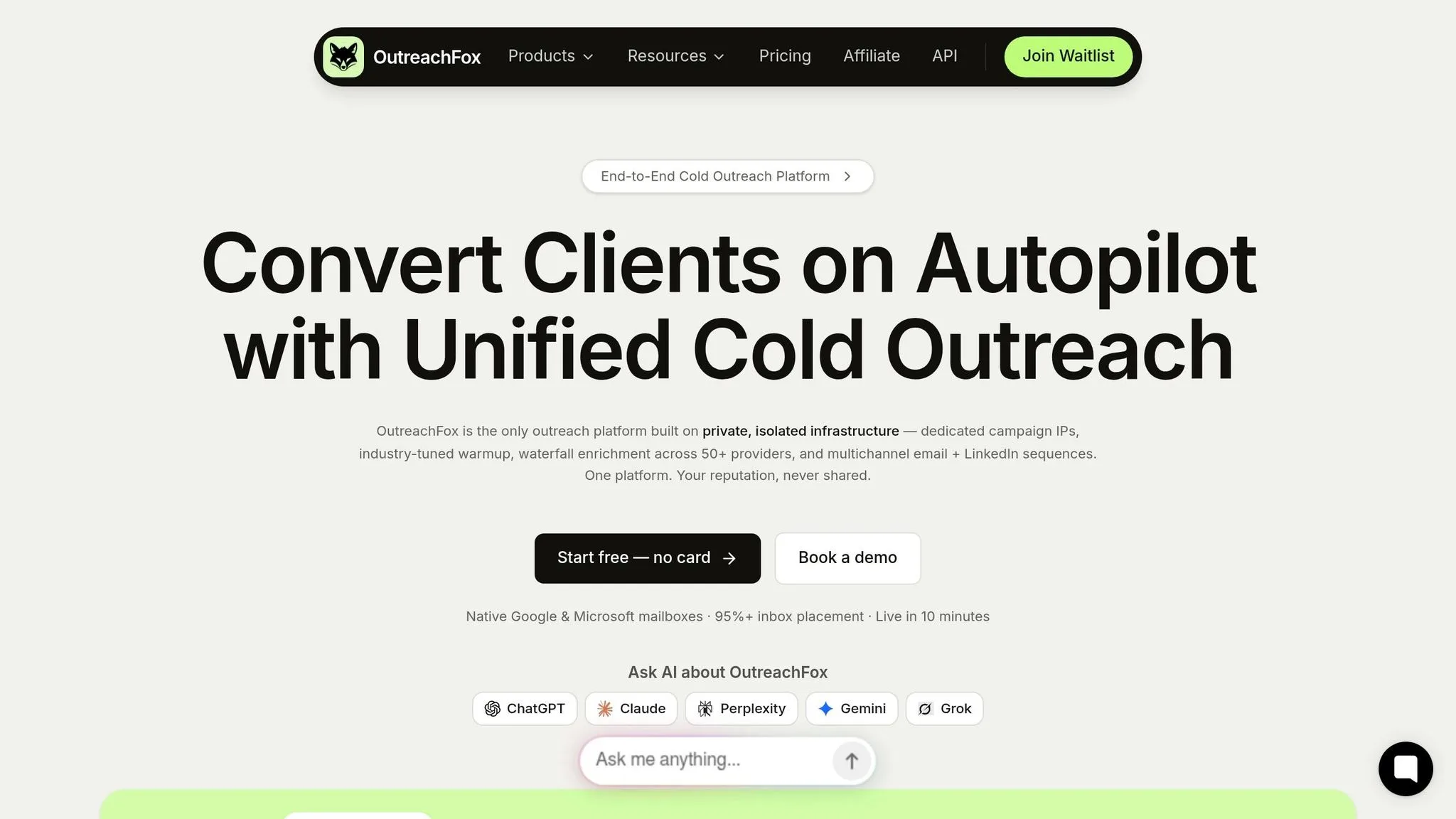
If the problem isn't only data quality, but also stack complexity, a bundled setup can shift the math. OutreachFox combines waterfall enrichment, verification, and sending in one API-first platform with private infrastructure.
| Factor | Clay + Separate Sender | OutreachFox (Bundled) |
|---|---|---|
| Enrichment providers | Clay waterfall | 50+ providers, field-level waterfall |
| Email verification | Separate tool | Built-in, native |
| Sending infrastructure | External sender required | Private, isolated IPs per customer |
| Complexity | Higher - more handoffs and tools | Lower - one platform, unified workflow |
The core rule stays the same: optimize for verified contacts delivered, not records purchased.
Frequently asked questions
How is waterfall enrichment priced differently than single-source data providers?+
Waterfall enrichment uses a credit-based model where you pay for each provider lookup attempt until a match is found, meaning costs vary per record based on how many sources are checked. Single-source providers typically charge flat subscription fees or per-export credits with one lookup per record. While waterfall may have higher per-record costs, it can deliver lower cost per verified contact by finding matches that single sources miss.
What is the most important metric when comparing Clay waterfall to single-source enrichment?+
The most important metric is cost per verified contact, calculated as total enrichment spend divided by verified contacts delivered. This matters more than headline pricing or cost per record because it accounts for failed verifications, bounce waste, and unusable data. A cheaper upfront price can still cost more per usable contact after factoring in verification failures and bounces.
When does Clay waterfall enrichment actually cost less than single-source providers?+
Clay waterfall enrichment costs less when your target list has patchy coverage from any single provider, when your ICP is narrow or niche, or when high bounce rates from stale data create waste. In these scenarios, the additional provider lookups recover enough verified contacts to offset the higher per-record cost, resulting in a lower total cost per usable contact than single-source alternatives.
Why do single-source data providers sometimes end up more expensive after purchase?+
Single-source providers can become more expensive after factoring in verification failures and email bounces. Once you've paid for exported records that turn out to be stale, missing, or unverified, that spend is sunk cost. The lack of backup sources means failed records represent wasted money, driving up the actual cost per verified contact even if the initial export price looked attractive.
How does bounce reduction affect the cost comparison between waterfall and single-source?+
Bounce reduction directly impacts both enrichment spend efficiency and deliverability costs. Waterfall enrichment gives each record multiple verification attempts across providers before adding it to send lists, reducing bounce rates. Lower bounce rates mean less wasted enrichment spend on unusable contacts and better sender reputation, which can make waterfall more cost-effective even with higher per-lookup costs.
What factors determine whether you should use waterfall enrichment or stick with a single source?+
Use waterfall enrichment when provider coverage is uneven, your ICP is narrow, or one vendor misses too many records in your target segment. Choose single-source when one provider already covers most of your list cleanly and your ICP is tight. The decision should be based on which approach delivers the lowest cost per verified contact after accounting for match rates, verification, and bounce risk.
How does OutreachFox's bundled approach differ from using Clay with a separate sending tool?+
OutreachFox combines waterfall enrichment from 50+ providers, built-in email verification, and private sending infrastructure in one platform with isolated IPs per customer. Clay requires pairing with separate verification and sending tools, creating more handoffs and complexity. The bundled approach reduces stack complexity while maintaining waterfall enrichment benefits, though the core optimization principle remains the same: verified contacts delivered per dollar spent.