
AI detects catch-all emails by scoring bounce risk using domain patterns, SMTP behavior, bounce history, and engagement data. It segments addresses into send, slow-send, or suppress actions before campaigns launch.
- SMTP acceptance alone is unreliable because catch-all servers accept almost any address
- AI assigns bounce-risk scores using domain age, MX records, probes, and bounce history
- Addresses are segmented into send, slow-send, or suppress based on confidence levels
- Feeding bounce and reply data back improves future catch-all scoring accuracy
- Even 2-5% hard bounce rates damage deliverability at scale without proper verification
- Confidence labels separate verified addresses from predicted ones for better sending decisions
How AI Detects Catch-All Emails Before Sending
A catch-all domain can make a fake email look valid. That’s why I don’t treat verification as a simple yes-or-no check. I treat it as a risk score problem.
Here’s the short version: before I send, I look at domain setup, MX and SMTP behavior, random-address probe results, past bounce data, reply history, and provider patterns. Then I sort each address into 3 simple paths: send, slow-send, or suppress.
A few points matter most:
- SMTP alone is not enough because catch-all servers often accept almost any address.
- Past bounce outcomes matter more than first-pass acceptance.
- Replies and engagement data help show whether a mailbox is live.
- Confidence labels matter: verified, predicted, and unclear should not be treated the same.
- Feedback loops improve results: when I feed hard bounces and replies back into the system, later scoring gets tighter.
In plain terms, the process works like this:
-
Remove obvious bad records first Bad syntax, missing MX records, and role accounts like
info@get filtered out. -
Score the gray area For catch-all addresses, the system estimates bounce probability instead of guessing “valid.”
-
Gate campaign entry Low-risk records can send at normal volume. Mid-risk records should go out in small batches. High-risk records should stay out.
One simple benchmark I keep in mind: even a 2% to 5% hard bounce rate can start hurting outbound performance, especially at scale. So if a domain looks uncertain, I’d rather slow it down than force it into a full campaign.
If I’m checking a tool for this job, I look for:
- historical bounce data by domain
- confidence labels
- API access and webhooks
- risk-based segmentation for sending decisions
Bottom line: AI helps most when it ranks catch-all risk before launch and then updates that score after launch with bounce and reply data. That’s how I send to fewer bad addresses and keep list quality under control.
How to REALLY Run Catch-All Email Verification (The 2026 B2B Method)
The signals AI uses to score risky catch-all addresses
AI scores catch-all risk by looking at a mix of domain, SMTP, bounce, reply, and provider signals. It pulls those inputs together and turns them into a bounce-risk score before an address ever gets into a campaign.
Domain patterns, MX behavior, and random address probing
The model starts with the domain itself. Domain age, DNS health, and TLD reputation all feed into the score. If SPF, DKIM, or DMARC records are missing, broken, or changed recently, that’s an early warning sign before the system even checks a single mailbox.
MX records matter too. They show which email provider is behind the domain, and that changes how the model weighs risk. Not all providers behave the same way, so this step helps the system avoid treating every domain like a carbon copy.
AI also sends probes to addresses that are likely fake, such as zq7x-test@domain.com. Then it checks whether the mail server accepts them. If it does, the domain is acting like an accept-all, and the model puts more weight on later signals.
Bounce history, SMTP outcomes, and response patterns
SMTP acceptance alone doesn’t tell the whole story. Some catch-all domains say “yes” at first and fail later. That’s why bounce history and SMTP outcomes carry so much weight.
If the same domain or provider keeps showing bounce outcomes, those patterns become warning signs, even when the first probe looked fine. In plain English: the model cares less about what the server claims and more about what happens next.
That gives it a better shot at estimating future risk than a basic pass-or-fail check.
Reply history, engagement data, and provider-level signals
Replies are one of the clearest signs that a mailbox is live. Opens and mailbox-level outcomes add more context. Put together, those signals help the model sort an address into one of three buckets: send, slow-send, or suppress.
Provider-level signals add another layer. The model compares the address with past outcomes from the same mail system, which is far more useful than lumping all catch-all domains together. The final score comes from both observed outcomes and inferred provider behavior.
| Signal Type | What It Measures | AI Use |
|---|---|---|
| Domain age & DNS records | Domain legitimacy and configuration | Flags incomplete or recently changed setups |
| MX record fingerprint | Underlying email provider | Identifies provider-specific behavior |
| Random address probing | Whether server accepts non-existent addresses | Confirms accept-all behavior |
| Bounce history & SMTP outcomes | Delivery failures after acceptance | Predicts future risk from past outcomes |
| Reply & engagement history | Mailbox activity and monitoring | Classifies address as send, slow-send, or suppress |
| Provider-level signals | Outcome patterns by provider | Adjusts risk score based on observed behavior |
Those signals only matter if they lead to a clear action: send, slow-send, or suppress.
How AI scores catch-all emails before they enter a campaign
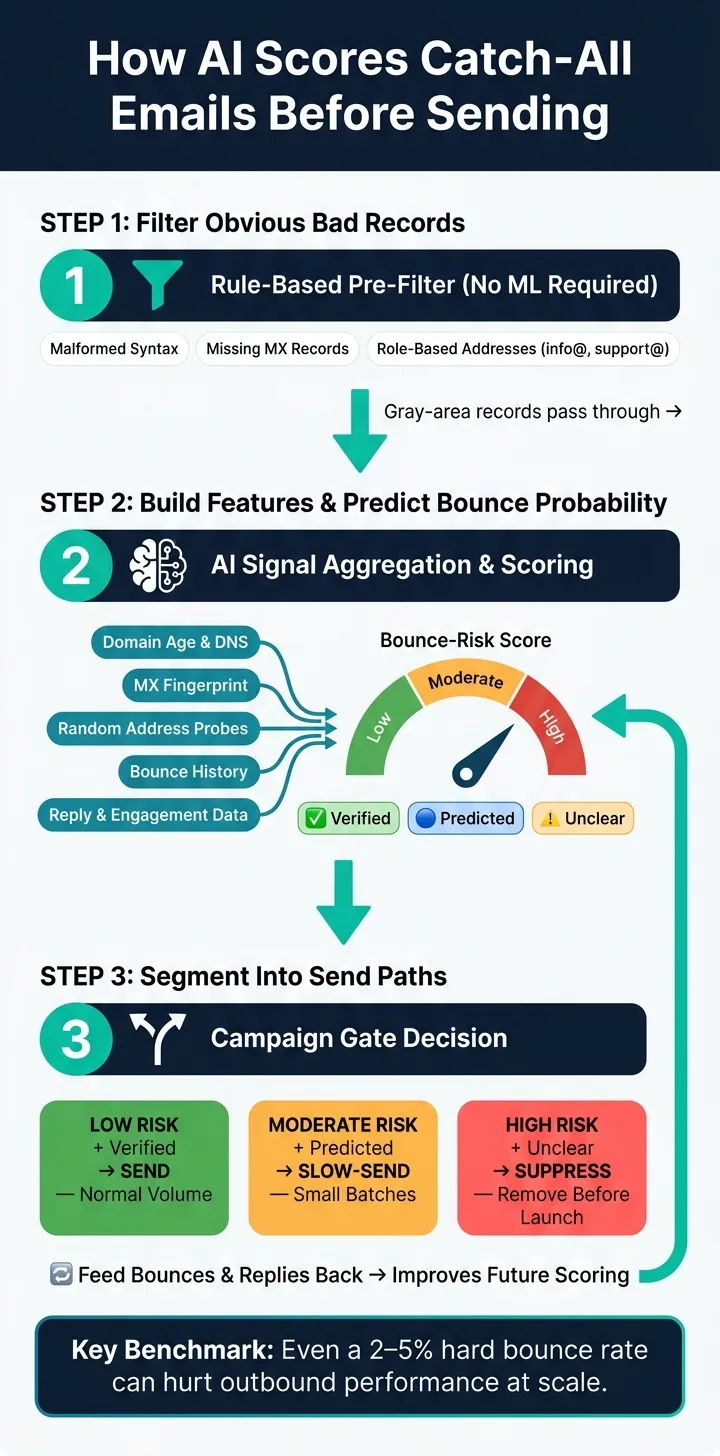
After the system collects the signals, it turns them into a simple send decision.
Step 1: Filter obvious bad records before catch-all analysis
Before any risk scoring starts, the system runs each address through a rule-based filter. This pass handles the easy rejects first: malformed syntax, missing MX records, and role-based addresses like info@ or support@.
This step doesn't need machine learning. It can run locally with deterministic parsing, so the verifier saves heavier analysis for addresses that are still uncertain. That way, only the gray-area records move on to model scoring.
Step 2: Build features and predict bounce probability
Addresses that pass the first filter move into feature building. The model pulls the available signals together and turns them into a bounce-risk score.
Catch-all domains stay uncertain until behavior, provider history, and engagement help narrow the risk. So instead of returning a plain "valid" or "invalid", the model gives a bounce probability score along with a confidence label:
- Verified: directly confirmed
- Predicted: inferred from patterns or model resolution
- Unclear: uncertain enough to require caution
Predicted results call for more care than Verified ones.
Step 3: Segment addresses into send, slow-send, or suppress
The score then becomes the campaign gate.
| Risk Level | Confidence | Action |
|---|---|---|
| Low bounce risk | Verified | Send - approve for normal volume |
| Moderate bounce risk | Predicted | Slow-send - test in smaller batches |
| High bounce risk | Unclear | Suppress - remove before launch |
If the result is ambiguous, it should stay out until the verifier has better evidence. In plain English, the score decides whether the address gets approved, throttled, or suppressed.
How to apply catch-all scoring in your outbound setup
Feed campaign outcomes back into the model
Pre-send scoring is only the first pass. The next step happens after you send.
Once campaigns go live, hard bounces, replies, and mailbox health events give you new evidence. AI-driven systems can use confidence labels to split verified data from inferred data. That matters because it separates direct confirmation from model-based probability. Without that feedback loop, the score stays stuck and doesn't get better.
Connect verification straight to campaign outcomes through API sync or webhooks. If a tool treats verification like a one-time checkbox, it misses the signals that make catch-all scoring more accurate over time.
Why isolated infrastructure makes catch-all decisions safer
That feedback loop only works if the sending setup is clean. On shared infrastructure, bounce signals from that setup may have little to do with your own list quality. That's where private mailboxes and dedicated campaign IPs help.
When sender reputation comes from your own behavior, a spike in hard bounces on one domain is more likely to mean your catch-all scoring got something wrong. And that makes send, slow-send, or suppress decisions a lot easier to trust.
OutreachFox uses isolated mailboxes and dedicated IPs, so bounce data reflects your own sending, not noise from a shared pool. Its API sends bounces, replies, and mailbox health events in real time through webhooks, so the loop between campaign outcomes and verification decisions stays direct and clear.
What to look for in tools that claim catch-all verification
A useful verifier needs to turn live outcomes into future score changes. At a minimum, look for these:
| Capability | Why it matters |
|---|---|
| Historical bounce data by domain | Turns past outcomes into forward-looking risk |
| Confidence labels for verified vs. inferred results | Separates proof from inference |
| API access and real-time webhooks | Enables feedback loops and campaign-level automation |
| Campaign segmentation by risk tier | Lets you slow-send or suppress without manual sorting |
Confidence labels matter because they separate proof from inference. Skip tools that hide those labels. If they do, inferred results can look certain when they aren't.
Conclusion: A practical playbook for sending to fewer bad catch-all addresses
Catch-all verification works best when you treat it like a ranking job, not a simple yes-or-no check.
Pre-send verification shouldn’t just ask whether an address exists. It should rank risk. That’s where AI helps most: it turns catch-all screening into a bounce-risk score. Then you can use that score to sort addresses into clear paths:
- Send
- Slow-send
- Suppress
The next part matters just as much. Feed bounce and reply results back into the model so later scoring reflects what happened in past campaigns.
That feedback loop is what leads to fewer bounces and tighter control over your list over time. And it gives you a practical way to protect deliverability before the first send.
Frequently asked questions
Why can't I just rely on SMTP acceptance to verify catch-all emails?+
SMTP acceptance alone is unreliable because catch-all servers often accept almost any address initially, even fake ones. These domains may say 'yes' during the first probe but bounce the email later. That's why AI verification uses multiple signals including bounce history, engagement data, and provider patterns to predict actual delivery risk rather than trusting the initial SMTP response.
What are the three classification paths mentioned for handling catch-all addresses?+
The three paths are send, slow-send, and suppress. Low-risk addresses with verified status get approved for normal volume sending. Moderate-risk addresses with predicted confidence go out in smaller test batches. High-risk or unclear addresses should be suppressed and removed from campaigns before launch to protect deliverability.
How does random address probing help detect catch-all behavior?+
The system sends test messages to obviously fake addresses like 'zq7x-test@domain.com' to see if the mail server accepts them. If the server accepts these random addresses, it confirms the domain is operating as an accept-all, which means SMTP acceptance can't be trusted as proof of validity. This triggers the model to rely more heavily on other signals like bounce history and engagement data.
What's the difference between 'verified' and 'predicted' confidence labels in catch-all scoring?+
Verified results mean the address has been directly confirmed through actual delivery or engagement proof. Predicted results are inferred from behavioral patterns, provider history, and model analysis but lack direct confirmation. Predicted addresses require more caution and should typically be treated as slow-send candidates rather than being approved for full campaign volume.
Why does the article recommend feeding campaign outcomes back into the AI model?+
Feeding hard bounces, replies, and engagement data back into the model creates a feedback loop that improves future scoring accuracy. Pre-send verification is just the first pass—real campaign outcomes provide concrete evidence about which predictions were correct. Without this feedback loop, the model can't learn from actual results and stays stuck with its initial estimates.
At what hard bounce rate does sender reputation typically start suffering?+
According to the article, even a 2% to 5% hard bounce rate can start hurting outbound performance, especially at scale. This is why catch-all domains that look uncertain should be slowed down or suppressed rather than forced into full campaigns, as their bounce risk can quickly push overall rates into damaging territory.
Why does isolated sending infrastructure matter for catch-all verification decisions?+
On shared infrastructure, bounce signals may reflect other senders' list quality problems rather than your own verification accuracy. With private mailboxes and dedicated IPs, bounce data directly reflects your sending behavior, making it much clearer when catch-all scoring needs adjustment. This isolation makes send, slow-send, and suppress decisions more reliable and trustworthy.