
Shared warmup pools offer speed but link your reputation to other senders. Private pre-warmed mailboxes isolate your sender reputation, giving you predictable deliverability and full control.
- Shared pools save 2-4 weeks but expose you to cross-account reputation risk.
- Private setups tie deliverability directly to your own sending behavior only.
- Shared pools make troubleshooting harder when deliverability drops unexpectedly.
- Private infrastructure provides more predictable health scores and inbox placement.
- Agencies and GTM teams benefit most from isolated private pre-warmed mailboxes.
- OutreachFox offers dedicated IPs and private infrastructure for controlled reputation.
Pre-Warmed Mailboxes in Shared vs Private Setup
If I want more control over inbox placement, I'd pick private pre-warmed mailboxes over shared warmup pools. Shared pools can save 2–4 weeks at the start, but they also tie my mailbox reputation to other senders. That means my inbox rate, mailbox health, and troubleshooting can shift even when my own sending stays the same.
Here's the short version:
- Shared setup: I get a warmed mailbox fast, but I share reputation risk with other senders.
- Private setup: My reputation stays tied to my own behavior only.
- Main trade-off: Shared means less control. Private means cleaner signals and fewer outside swings.
- What changes most:
- spillover from other accounts
- mailbox health swings
- who owns the risk when deliverability drops
If I run outreach where inbox placement affects pipeline, client work, or reporting, that difference matters a lot.
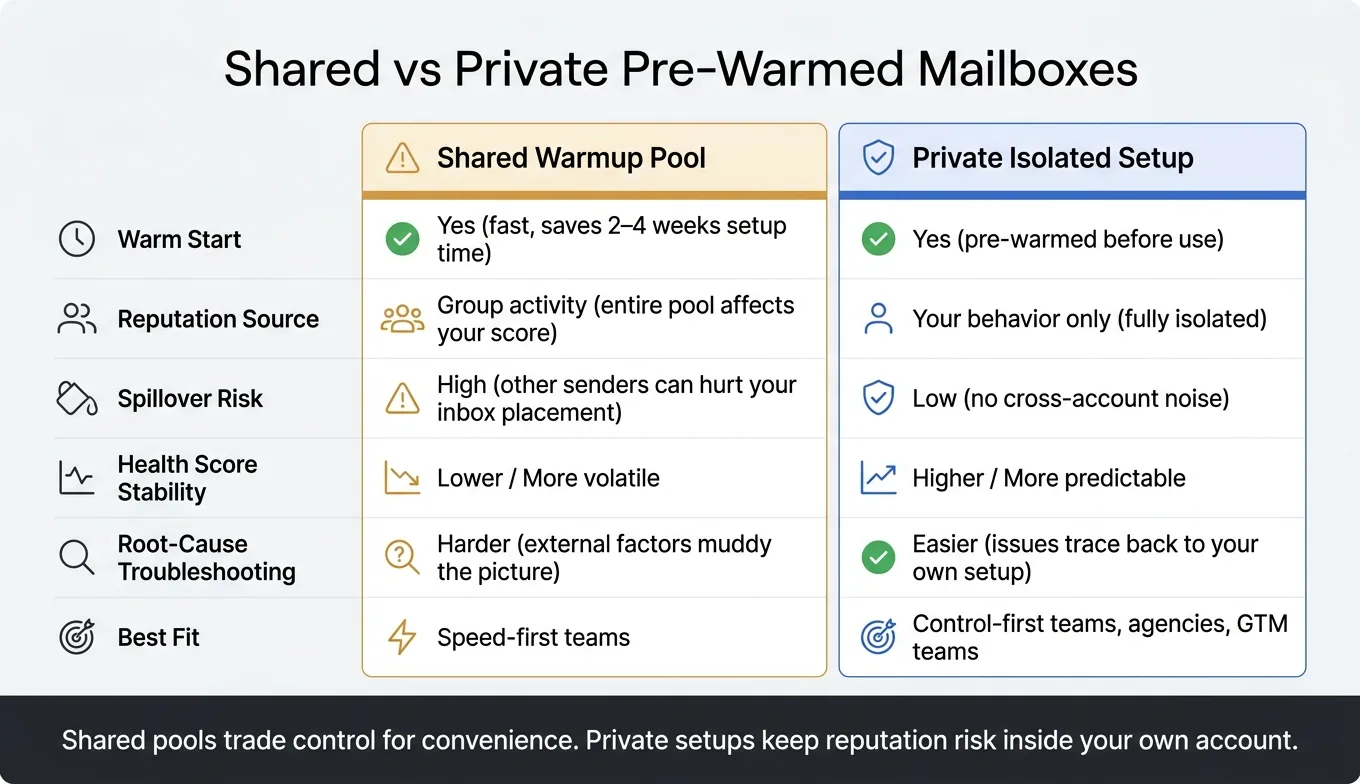
Quick Comparison
| Factor | Shared Warmup Pool | Private Isolated Setup |
|---|---|---|
| Warm start | Yes | Yes |
| Reputation source | Group activity | My own sending |
| Spillover risk | High | Low |
| Health score stability | Lower | Higher |
| Root-cause checks | Harder | Easier |
| Best fit | Speed-first teams | Control-first teams |
Put simply: shared pools trade control for convenience, while private setups keep reputation risk inside my own account.
How to send Cold Emails WITHOUT 2 week email warm up
How Shared Warmup Pools Work and Where the Risk Comes From
Shared warmup pools are attractive because they're fast. They cut setup time. But inbox placement depends on how the whole pool behaves, not just what you do. And that's where the trade-off starts.
Shared Reputation Means Other Senders Can Hurt Your Inbox Placement
Deliverability and inbox placement depend in part on other senders in the pool. You don't control pool-wide reputation shifts, which means things can change for reasons outside your account.
That usually hits inbox placement first. Then you may see health-score swings. In shared pools, those score changes can happen faster when shared warmup pools hurt deliverability by mixing your reputation with other senders. That's the difference between shared spillover and a reputation you own yourself.
The risk is pretty simple: shared warmup pools give you speed, but you give up some control over inbox placement.
Other Senders Can Move Your Inbox Placement
Other senders in the same network can affect how your mailbox performs. Even if your own sending stays steady, pool-wide activity can still push inbox placement up or down.
You can't control that outside influence in a shared setup. Private infrastructure removes it. That's what private isolation removes.
How Private Pre-Warmed Mailboxes Isolate Reputation and Stabilize Signals
Private infrastructure cuts out the spillover risk that comes with shared pools. Each mailbox stands on its own, so reputation ties back to that sender's activity alone.
Your Sender Reputation Reflects Your Own Behavior Only
When traffic isn't shared, other accounts can't drag you down. There are no cross-account spam complaints bleeding into your sender reputation, and no pool-level swings pushing your deliverability off course.
That changes how you diagnose problems too. If a health score drops in a private setup, the issue is inside your own process. In a shared setup, that's much harder to pin down because other senders can muddy the picture. That's exactly what the side-by-side comparison below is meant to show.
Health Scores Become More Predictable, But Discipline Still Matters
Private isolation doesn't replace SPF, DKIM, and DMARC. It removes cross-account noise, but your DNS setup and email authentication still matter.
Think of it like this: private infrastructure gives you a cleaner signal. It doesn't give you a free pass. If your setup is off, your results can still suffer.
Where OutreachFox Fits In
OutreachFox is one example of private pre-warmed infrastructure. It offers dedicated campaign IPs, pre-warmed Google, Microsoft, SMTP, and Azure mailboxes, plus per-mailbox health visibility in real time.
Those differences tend to show up most clearly in three places:
- Spillover
- Volatility
- Control
Shared vs Private: Direct Comparison of Spillover, Volatility, and Control
Here's the side-by-side view. The table below strips this down to the three differences that matter most: spillover, volatility, and control.
| Factor | Shared Warmup Pool | Private Isolated Setup |
|---|---|---|
| Reputation exposure | Collective - other senders affect your score | Individual - your behavior only |
| Health score behavior | More volatile, influenced by other accounts in the pool | More predictable, tied to your own sending patterns |
| Operational risk | Shared across the pool and provider | Kept inside your own environment |
Sender Reputation: Collective in Shared Pools, Individual in Private Setups
Start with reputation, because that's usually where spillover hits first.
In shared warmup networks, your mailbox reputation is tied to the behavior of everyone else in the pool. If the pool includes spam-heavy senders, negative signals can hurt deliverability for other senders in that same pool. One weak sender can pull the group down.
Private setups change that. Your sender reputation reflects only your own sending behavior. There's no cross-account noise getting mixed in.
Operational Control: Externalized Risk vs Self-Owned Risk
The next piece is risk: who carries it when performance starts to shift?
In a shared setup, part of that risk sits with the provider and its customer base. That may sound easy at first. But when something breaks, finding the cause gets harder because the problem often sits outside your account.
Private infrastructure keeps that risk inside your own environment. Yes, that means more responsibility. But it also gives you more control. If a health score drops, the issue is more likely tied to your own setup and sending patterns, which makes troubleshooting a lot clearer.
Shared pools push both risk and visibility outside your control. Private setups keep both inside your environment.
Which Setup Fits Your Team
Choose shared pools if you want to get moving fast. Choose private pre-warmed mailboxes if you need tighter control over sender reputation.
When Shared Pools Are Acceptable
Shared warmup pools make sense when speed matters more than control. They're a fit for teams that want a faster setup and can live with less predictability in deliverability.
If inbox placement ties directly to revenue, client work, or reporting, private infrastructure is usually the safer call.
When Private Pre-Warmed Infrastructure Is the Safer Choice
Private setups cut out cross-account spillover. That matters a lot for agencies. If one client racks up spam complaints, inbox placement can slip for other senders in the same pool.
The same goes for GTM teams running production outreach. They usually need steady deliverability data, not numbers that shift because of someone else's sending habits. When you need to warm up a new email domain properly from the start, you control every variable in a private setup.
That's the day-to-day edge private infrastructure is built to give you. OutreachFox is built around this model, giving every customer a private, isolated sending environment with dedicated campaign IPs. So your deliverability comes down to your behavior, not a stranger's.
Conclusion: Isolated Infrastructure Changes the Risk Model
Shared pools trade control for speed. Private pre-warmed mailboxes trade convenience for isolated reputation, steadier health scores, and cleaner troubleshooting.
Frequently asked questions
How does shared warmup pool reputation affect my inbox placement even when my own sending stays consistent?+
In shared warmup pools, your mailbox reputation is tied to the behavior of all senders in that pool. If other senders in the pool generate spam complaints or poor engagement, those negative signals can hurt your deliverability and inbox placement even when your own sending practices remain unchanged. This cross-account spillover creates unpredictable swings in performance that you cannot control.
What makes troubleshooting deliverability issues harder in shared warmup pools compared to private setups?+
Shared pools mix signals from multiple senders, making it difficult to isolate whether a health score drop stems from your own practices or from other accounts in the pool. In private setups, reputation reflects only your behavior, so when issues arise, the cause is typically within your own sending patterns and technical configuration, making root-cause analysis much clearer.
Do private pre-warmed mailboxes eliminate the need for proper email authentication?+
No, private infrastructure does not replace fundamental email authentication requirements like SPF, DKIM, and DMARC. Private setups remove cross-account noise and spillover risk, but your DNS configuration and authentication protocols still directly impact your deliverability outcomes.
How much time can shared warmup pools save compared to warming up a private mailbox from scratch?+
Shared warmup pools can save approximately 2–4 weeks at the initial setup stage by providing access to already-warmed mailboxes. However, this time savings comes at the cost of sharing reputation risk with other senders in the pool.
Why would agencies particularly benefit from private pre-warmed infrastructure over shared pools?+
Agencies managing multiple clients face amplified risk in shared pools because one client's spam complaints can affect inbox placement for other clients using the same pool. Private infrastructure isolates each sender's reputation, preventing cross-client contamination and providing more predictable deliverability for client reporting and outcomes.
What are the three main factors that differ most between shared and private warmup setups?+
The three critical differences are spillover (whether other senders affect your reputation), volatility (how predictable your health scores remain), and control (whether you own the risk within your environment or share it externally). Shared pools have high spillover and volatility with externalized control, while private setups minimize spillover and volatility with self-owned risk.