
Mailbox rotation sends one campaign through multiple inboxes for simplicity. Sequence sharding assigns each campaign segment to one mailbox for better control and risk isolation.
- Mailbox rotation spreads one campaign across many inboxes with minimal setup work
- Sequence sharding assigns separate campaign parts to individual mailboxes for tighter control
- Rotation works best for small teams needing fast setup and simple operations
- Sharding isolates risk and enables stage-by-stage reply handoffs for agencies
- Infrastructure-first platforms reduce sharding complexity with real-time mailbox analytics
- Choose rotation for speed or sharding for control based on team bandwidth
Sequence Sharding vs Mailbox Rotation
If I want the short answer: mailbox rotation is easier to launch, while sequence sharding gives me tighter control.
Here’s the whole article in plain English:
- Mailbox rotation keeps one campaign together and spreads sends across many inboxes.
- Sequence sharding splits one campaign into smaller parts, with each part tied to one mailbox.
- The choice usually comes down to 3 things:
- Setup time
- Risk isolation
- Reply ownership
If I care most about getting live with less admin work, I’d lean toward mailbox rotation.
If I care most about keeping client, segment, or funnel-stage activity separate, I’d lean toward sequence sharding.
A simple way to think about it:
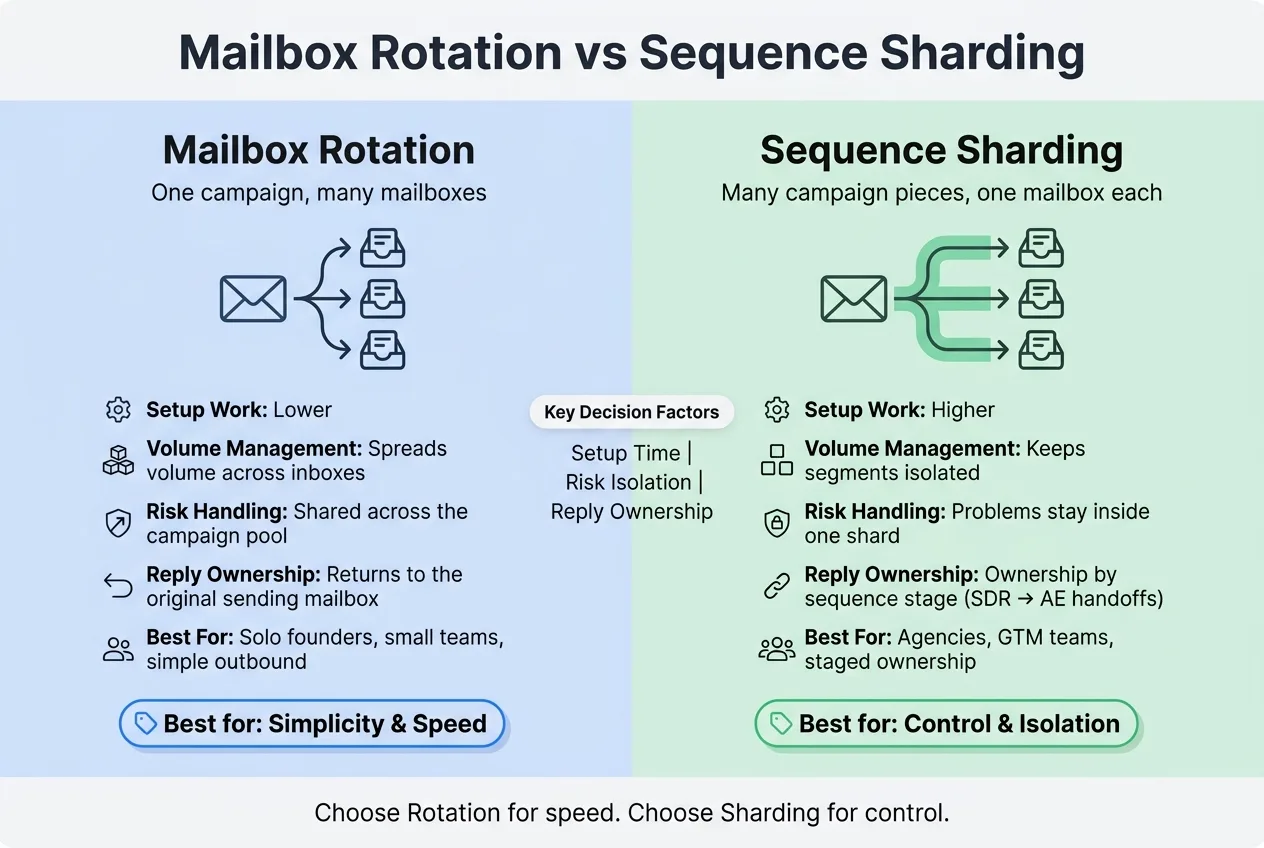
- Rotation = one campaign, many mailboxes
- Sharding = many campaign pieces, one mailbox each
That changes how teams handle volume, replies, and sender control. For example, when one mailbox sends 30 to 50 emails per day, adding more inboxes can push total output much higher without forcing one sender to carry the full load. But how I split that load affects where replies land and how much trouble stays contained if one mailbox has issues.
Quick Comparison
| Criteria | Mailbox Rotation | Sequence Sharding |
|---|---|---|
| Core setup | One campaign across many inboxes | One campaign split into mailbox-owned parts |
| Setup work | Lower | Higher |
| Send volume | Spread across inboxes | Split by segment, role, or risk |
| Risk handling | Shared across the campaign pool | Problems stay inside one shard |
| Reply flow | Replies return to the sending mailbox | Replies can move by owner or stage |
| Best fit | Small teams, founders, simple outbound | Agencies, GTM teams, staged ownership |
My takeaway: if I want simplicity, I pick rotation. If I want control, I pick sharding.
The rest of the piece explains how those trade-offs play out in day-to-day outbound work.
How each model works in practice
Mailbox rotation: simpler setup, shared campaign logic
Mailbox rotation links multiple inboxes to one campaign and spreads sends across that pool. Platforms like Instantly and Smartlead send mail through the inbox group and keep each mailbox under its daily limit.
Every inbox runs on the same sequence, timing, and follow-up rules. One campaign manages the full set of inboxes, so the setup is pretty simple: add inboxes, connect them to the campaign, and let the platform spread out the send volume.
That simplicity starts to matter less when you need to isolate risk or send replies back through a specific mailbox.
Sequence sharding: more setup, tighter mailbox ownership
Sequence sharding flips that ownership model. You give up some speed in exchange for mailbox-level control. Instead of one campaign sending through many mailboxes, you split the campaign by lead segment, sender role, or risk level. Each shard is assigned to one mailbox, either by hand or through rules.
That creates more setup work, but it gives you cleaner control at the mailbox level. Each shard keeps its own timing, sender, and follow-up rules, so it acts like its own outreach lane. That kind of control helps when different outreach tracks need different senders or stricter risk limits.
That separation matters when deliverability, reply handling, and campaign control start pulling in different directions.
What Is Inbox Rotation? (And How To Use It)
Deliverability, reply handling, and campaign control compared
Once the setup is in place, the differences come down to risk, reply flow, and how much control you want.
Deliverability: spreading volume versus isolating risk
Mailbox rotation spreads sends across multiple inboxes, which keeps the load lower on each mailbox.
Sequence sharding takes a different path. It keeps each segment or test inside its own shard, so if one part runs into trouble, the issue stays there instead of spilling into everything else. Think of it like putting campaigns in separate lanes instead of sending them all down the same road.
Reply routing: one sender thread versus stage-by-stage handoffs
With rotation, replies stay in one thread tied to the sending mailbox. Many teams handle those replies from a shared inbox for reply triage.
Sequence sharding can pass conversations from SDR inboxes to AE inboxes. That can make handoffs smoother, but it also means you need strict routing rules. Without those rules, things can get messy fast.
That level of control matters most when different team members own different stages of the same sequence.
Campaign control: easier scaling versus deeper visibility
Rotation is usually easier to run. Sharding is usually easier to govern.
| Factor | Mailbox Rotation | Sequence Sharding |
|---|---|---|
| Setup complexity | Lower | Higher |
| Volume management | Spreads volume across inboxes | Keeps segments isolated |
| Reply ownership | Original sender mailbox | Ownership by sequence stage |
| Best for | Straightforward high-volume campaigns | Specific segments that need tighter control |
Infrastructure-first platforms like OutreachFox make sharding easier by isolating mailboxes and showing per-mailbox, per-campaign metrics in real time.
Which model fits your team
Once the mechanics are clear, the choice comes down to routing control and ops bandwidth.
When mailbox rotation is the better choice
Mailbox rotation makes sense for teams that want the fastest setup and the least routing work. It tends to fit solo founders and small outbound teams that don't have much time for day-to-day admin work.
If mailbox ownership doesn't need to change, rotation is usually the lower-friction default.
When sequence sharding is the better choice
Sharding works well for agencies and GTM teams that need separate ownership by client or by stage. It's a better fit when isolation matters more than running everything from one shared campaign.
How infrastructure-first platforms affect the decision
Infrastructure-first platforms can cut down the extra work that comes with sharding by isolating mailboxes and showing per-mailbox analytics in one inbox. OutreachFox does that with private infrastructure and real-time visibility, so teams can use sharding without as much ops load.
Conclusion: Simplicity versus control
Once setup is done, the choice is pretty simple: control or speed.
Mailbox rotation is faster to get live. Sequence sharding takes more setup, but it gives you tighter control, clearer ownership, and better separation. That matters a lot for agencies and GTM teams running campaigns by client or funnel stage.
Platforms like OutreachFox make sharding easier with isolated mailboxes and real-time per-mailbox analytics.
Pick the model that fits your ops bandwidth.
Frequently asked questions
What is the main difference between mailbox rotation and sequence sharding?+
Mailbox rotation keeps one campaign together and spreads sends across many inboxes, while sequence sharding splits one campaign into smaller parts with each part tied to one mailbox. Rotation means one campaign using many mailboxes, whereas sharding means many campaign pieces with one mailbox each.
How does risk isolation differ between mailbox rotation and sequence sharding?+
In mailbox rotation, risk is shared across the entire campaign pool, so deliverability issues can affect all connected inboxes. With sequence sharding, problems stay isolated within one shard, preventing issues in one segment from spilling into other campaign parts.
How are replies handled differently in mailbox rotation versus sequence sharding?+
Mailbox rotation keeps replies in one thread tied to the original sending mailbox, often managed through a shared inbox. Sequence sharding allows replies to move between team members by owner or stage, enabling handoffs from SDR inboxes to AE inboxes with proper routing rules.
When should a team choose mailbox rotation over sequence sharding?+
Mailbox rotation is better for solo founders and small outbound teams that want fast setup with minimal admin work and don't need to change mailbox ownership. It works well when simplicity and getting live quickly matter more than granular control.
What types of teams benefit most from sequence sharding?+
Agencies and GTM teams that need separate ownership by client, segment, or funnel stage benefit most from sequence sharding. It's ideal when isolation, tighter control, and clearer ownership matter more than ease of setup.
What is the typical daily sending limit mentioned for individual mailboxes in this approach?+
The article mentions that one mailbox typically sends 30 to 50 emails per day. Adding more inboxes through rotation or sharding allows teams to push total output much higher without forcing one sender to carry the full load.
How do infrastructure-first platforms like OutreachFox change the sharding decision?+
Infrastructure-first platforms reduce the operational burden of sharding by isolating mailboxes and providing per-mailbox, per-campaign analytics in real time. This makes it easier for teams to use sequence sharding without the traditional high ops load that comes with managing separate campaign pieces.